TL;DR
A diet that seems ineffective may be hard to follow, leave you hungry or tired, or produce progress that is difficult to interpret. Identify the specific problem, check the relevant evidence, and choose a proportionate next step, such as adjusting the plan, clarifying measurements, or seeking professional advice.
- What you'll learn
- How to distinguish a single scale change, slower-than-expected progress, and a flat trend
- What to check when a diet repeatedly clashes with your schedule, budget, or daily routine
- Why recurring hunger or fatigue calls for a tolerability or health check, not automatically more restriction
- How to separate difficulty following a plan from uncertainty in food-intake records
- When to reassess a goal with a registered dietitian or primary care clinician
- Why significant symptoms and eating-disorder concerns should take priority over weight-loss troubleshooting
“My diet isn’t working” might mean “I cannot keep doing this,” “I’m hungry or exhausted,” or “my latest weigh-in was higher.” For weight-management eating plans, those complaints need different responses, not automatically more restriction.
A disappointing result is an observation, not an explanation. Start by naming what’s going wrong; this guide connects each symptom to what to check and a realistic first action.
Persistent or concerning symptoms take priority over clarifying a weight trend. Seek professional assessment if unexplained fatigue lasts a few weeks, affects daily life, or comes with other symptoms.
Is progress missing, or just hard to see?
One weigh-in is not a verdict. A higher reading, slower-than-expected loss, and an established flat trend are different observations, not interchangeable evidence that a diet has failed.
Start with a dated series of readings, the plan’s start or change date, and your intended goal. For comparable measurements, use the same scales and location on a firm, level surface, consistent timing, and similar minimal clothing, following NHS England guidance; daily weighing is not required.
| What you see | What to check | First step |
|---|
| One higher reading | Dates and weighing conditions | Collect comparable readings |
| Falling, but slower than hoped | Actual trend versus promised pace | Review the expectation |
| No clear downward pattern | Comparable series and relevant changes | Check fit, information, and context |
Short-term scale changes need not reflect fat changes. A small study under unrestricted living conditions, not a dieting trial, found that water contributed importantly to two-week weight variation.
If readings are sparse or inconsistent, improve comparability before declaring failure. If weight is trending downward, review expectations before intensifying the plan: the CDC’s approximate 1–2 pounds per week is a general planning reference, not a minimum, guarantee, or universal personal target.
There is no universal plateau deadline: interpretation depends on expected change, measurement frequency, variability, and context. A flat pattern warrants the remaining checks, but does not reveal its own cause.
If you keep abandoning the plan, check whether it fits your life
Look beyond the scale to an ordinary week. Instead of asking, “Why can’t I be disciplined?”, identify one recurring situation: which rule becomes difficult, when it happens, and what you do instead.
Work schedules, food costs, and family meals can expose a mismatch between a plan and daily life. NIDDK recommends reviewing barriers and adjusting goals without blame. If the same rule repeatedly breaks down in the same situation, review the rule and situation before treating it as a lack of discipline.
For example, suppose your plan requires a freshly cooked lunch, but your shifts repeatedly make that impractical. The first adjustment could be a feasible packed or ready-to-eat lunch, not skipping another meal to compensate. Change the troublesome demand before replacing your entire eating pattern or adding more rules.
Implementation deserves attention: in a randomized trial of 160 adults, greater self-reported adherence was associated with greater weight loss, while assigned diet was not. That association does not explain any individual’s difficulties or show that adherence alone determines outcomes.
For a deeper look at recurring barriers, see why sticking to a diet can be difficult. Keep two questions separate: Can I follow this plan? and, if you record intake, “How accurately does that record reflect what I eat?” Difficulty with one does not establish difficulty with the other.
If you’re hungry or exhausted, check tolerability before cutting more
Recurring hunger: A diet can produce weight loss and still need changing if hunger, symptoms, or practical demands make it unsustainable. Note when hunger occurs, how often it repeats, and meal gaps: hunger before an occasional meal differs from a recurring pattern that disrupts sleep, concentration, or following the plan. Hunger can increase after weight loss, so review meal structure and restriction with a registered dietitian rather than treating hunger as weak willpower or a reason to restrict further.
Fatigue: Seek a primary care assessment if unexplained tiredness lasts a few weeks, affects daily life, or comes with other symptoms. Bring a brief timeline covering onset, duration, severity, effects on daily functioning, sleep, diet changes, associated symptoms, and medication changes. Fatigue alone cannot tell you whether the diet is responsible; that timeline helps a clinician decide what needs investigating.
Seek care rather than troubleshoot harder: Loss-of-control eating, purging, severe restriction, or compensatory excessive exercise call for eating-disorder-informed care, not tighter diet rules. Fainting, palpitations, or other significant physical symptoms warrant prompt assessment, particularly alongside restrictive eating or compensatory behaviors. Do not wait for more weight data or a perfect food record before asking for help.
If the numbers look consistent, check what they actually tell you
Following a plan and measuring intake accurately are separate questions. Uncertainty about the information does not prove difficulty following the plan, dishonesty or lack of effort.
A systematic review of 59 studies found that self-reported energy intake commonly differed from independently estimated expenditure, usually through under-reporting, with substantial variation. That highlights a measurement limitation, not proof that your own intake is under-reported.
Ask whether your information reflects ordinary weekdays and weekends, and which parts are estimated or missing. A record might describe routine workdays well but leave typical weekends unclear; that limits the conclusion without proving excess intake.
The first adjustment is to clarify the uncertainty that matters, not automatically eat less or audit every detail. Food logging is optional: you can discuss a representative account with a registered dietitian, or use our guide to why calorie totals don’t always add up if a closer check would help your decision.
If a clear trend still misses the goal, reassess the plan
An established flat trend can justify reassessing a weight-loss plan, but cannot identify the cause on its own. If observation, implementation, information and context have been considered, review whether the goal remains appropriate and the plan fits.
Bring your weight series, prior trajectory, meaningful plan-change dates, a representative account of implementation, and health or medication changes.
Changing energy needs and physiological responses can slow loss; our calorie-deficit guide explains the mechanisms.
Plateaus should prompt reassessment, not blame
A registered dietitian can assess plan fit and intake; a primary care clinician can address symptoms, medication questions and medical context. Agree on a review point suited to your situation, not a universal plateau deadline.
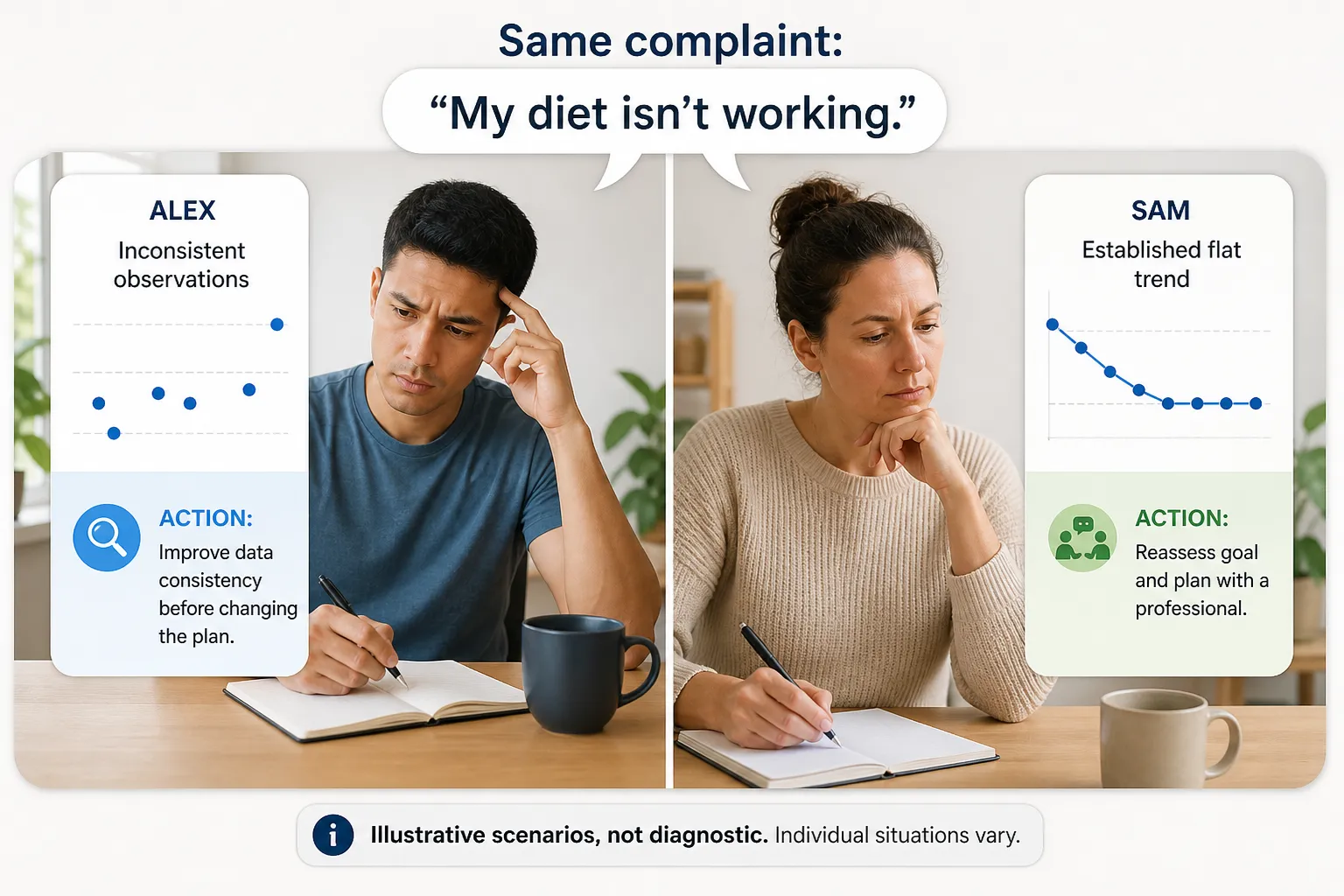
Consider two hypothetical people saying, “My diet isn’t working.” Alex has a few readings taken at different times, including one higher result; comparable measurements are more useful than stronger restriction. Sam has a comparable flat series after a downward trend, no obvious implementation barrier and reasonably representative information. Sam arranges individualized reassessment of the goal and plan rather than waiting indefinitely or cutting intake blindly.
Improvements in blood pressure, cholesterol, functioning and wellbeing matter, even though they do not independently prove fat loss.
Choose the next useful check, not a stricter diet
Replace “nothing works” with something you can observe: “I’m too hungry to concentrate in the afternoon” or “My measurements haven’t shown a clear trend.” Reviewing progress and barriers can help you reconsider the plan without assigning blame.
Ask what missing information would actually change your decision. Then complete this sentence: “The problem I can observe is ____. The next useful check or appointment is ____.” Choose one proportionate action: a manageable adjustment, a clearer observation, or a professional conversation.
If you’re making a self-directed change and have no safety concerns, change one relevant thing at a time where practical. That makes its effect easier to interpret, without requiring perfect records.
You can ask for help before your notes are complete. Significant symptoms or eating-disorder warning signs should take priority over finishing a tracking exercise. Your next step does not have to be stricter; it needs to address the problem you’re actually facing.
- Key sources
- NIDDK — Talking with Your Patients about Weight
- NHS England — How to record your weight
- CDC — Steps for Losing Weight
- Polidori et al. — How Strongly Does Appetite Counter Weight Loss?
- Burrows et al. — Validity of Dietary Assessment Methods When Compared to the Method of Doubly Labeled Water
- VA/DoD — Comprehensive Management of Adult Overweight / Obesity: A Provider Guide
- NHS — Tiredness and fatigue
- NICE NG69 — Eating disorders: recognition and treatment