


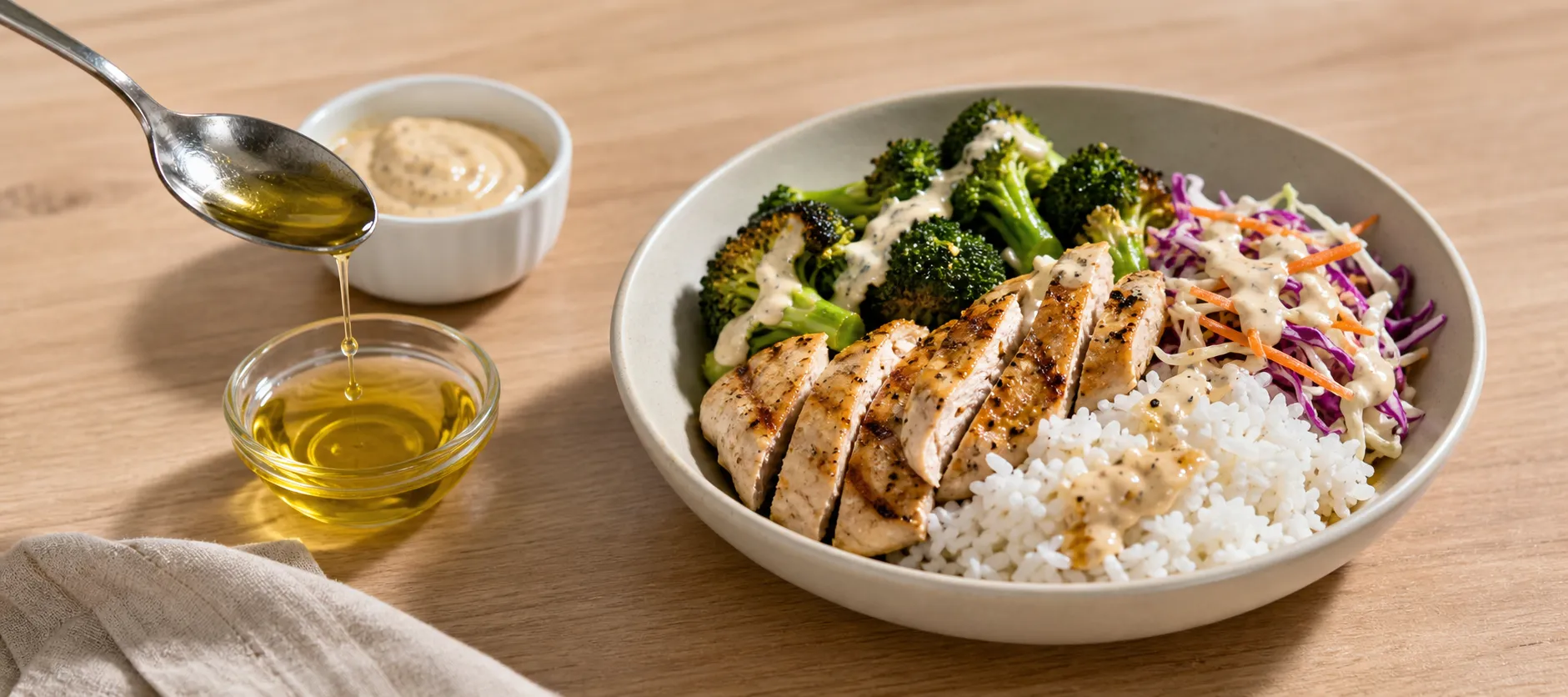
- What you'll learn
- Why food photo calorie estimators can identify meals well but still miss hidden calories
- Which ingredients and cooking methods most often distort calorie estimates, including oil, butter, and sauce
- Why portion size estimation is a major weak point for photo-based tracking
- How packaged foods, simple meals, home cooking, and restaurant meals differ in trust level
- Why consistent logging matters more than one perfect meal estimate for self-monitoring
- How to use AI calorie tracking as a first draft and correct the parts the camera cannot know
The biggest myth about AI calorie detection accuracy is not that it is fake. It is that people expect a food photo calorie estimator to behave like a lab instrument. That standard sounds rigorous, but it is the wrong test from the start.
A photo can show what a meal looks like, but it cannot show everything that determines calories. AI food recognition can often identify foods surprisingly well and make a reasonable first-pass estimate of portion size estimation. What it cannot do is see hidden oil, butter, sauce, sugar, or the exact amount of each ingredient mixed into the dish.
That gap matters more than most people admit. A salad can be 300 calories or 900 depending on dressing, oil, cheese, nuts, and portion size. Two bowls of pasta can look nearly identical while one carries far more calories because of extra cream, butter, or oil.
So this article is not here to defend hype, and it is not here to dismiss the category either. Photo-based tracking can be genuinely useful, but not because it delivers exact calorie truth from a single image. It is useful when it gives directionally consistent estimates, stays easy to correct, and helps you notice patterns in how you eat over time.
That is the middle ground worth caring about. The real question is not, “Did the app guess this plate perfectly?” It is, “Does this system help me track consistently enough to make better decisions next week than I made today?”
AI can recognize food better than it can count calories
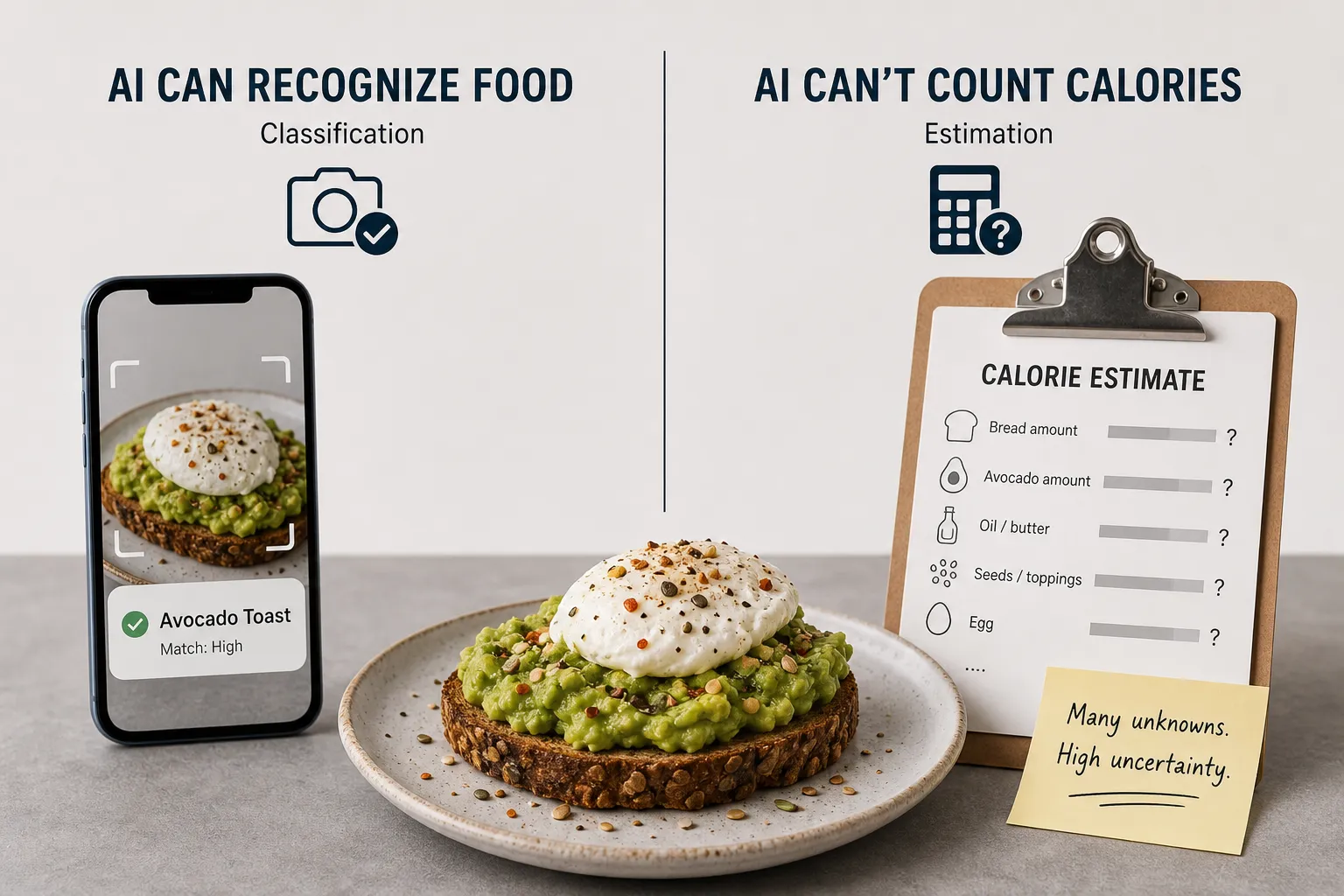
Start by separating two very different jobs: AI food recognition asks, “What is this likely to be?” Calorie estimation asks, “How much of each ingredient is in this serving, and how was it prepared?” Those are not the same problem, and too much marketing pretends they are.
Recognition is classification. A model can often look at a photo and say, with reasonable confidence, “pizza,” “chicken curry,” “oatmeal,” or “sushi.” That is useful, and research reviews in food image analysis consistently treat food recognition, portion size estimation, and calorie estimation as distinct challenges, not one single accuracy score PubMed review search.
Calories require missing information. A photo cannot directly tell you exact weight, full recipe, cooking method, or every ingredient quantity. Once you move from naming a food to calculating its energy content, the uncertainty rises fast.
Recognition can be right while calories are still wrong
Avocado toast is the easiest example. AI may correctly identify avocado toast, but the calories depend on bread thickness, avocado amount, oil, butter, seeds, eggs, and toppings. Two plates that look almost identical can land very differently once those details change.
Burgers have the same problem. A photo may clearly show the bun and patty, but not the beef fat percentage, sauce quantity, cheese weight, mayo spread, or cooking oil left on the grill. The label can be right while the calorie estimate is still meaningfully off.
That is why “accuracy” claims need context. If an app says it is accurate, the obvious follow-up questions are:
- Accurate at recognizing which food?
- Accurate for what serving size range?
- Accurate using which nutrition database?
- Accurate within what margin of error?
- Accurate for plain foods, mixed dishes, or restaurant meals?
Without those definitions, the claim is too vague to trust. A system can be strong at AI food recognition and still weak at mixed dish calorie estimation. It can also perform better on simple foods than on recipes with hidden ingredients.
The honest standard is estimation, not detection
“Exact calorie detection” from a single photo is the wrong mental model. The honest description is that AI is a fast estimator. It can give you a plausible starting point quickly, then let you adjust portions or ingredients when needed.
That is also the better way to evaluate apps. Instead of asking whether one meal photo produced a perfect number, ask whether the system is directionally useful and easy to correct over time. That is the standard behind how we think about tools like Kibora vs Cal AI: competitive AI can recognize foods well, but the real test is whether it helps you track patterns without pretending the camera knows the full recipe.
The biggest calorie errors are often invisible
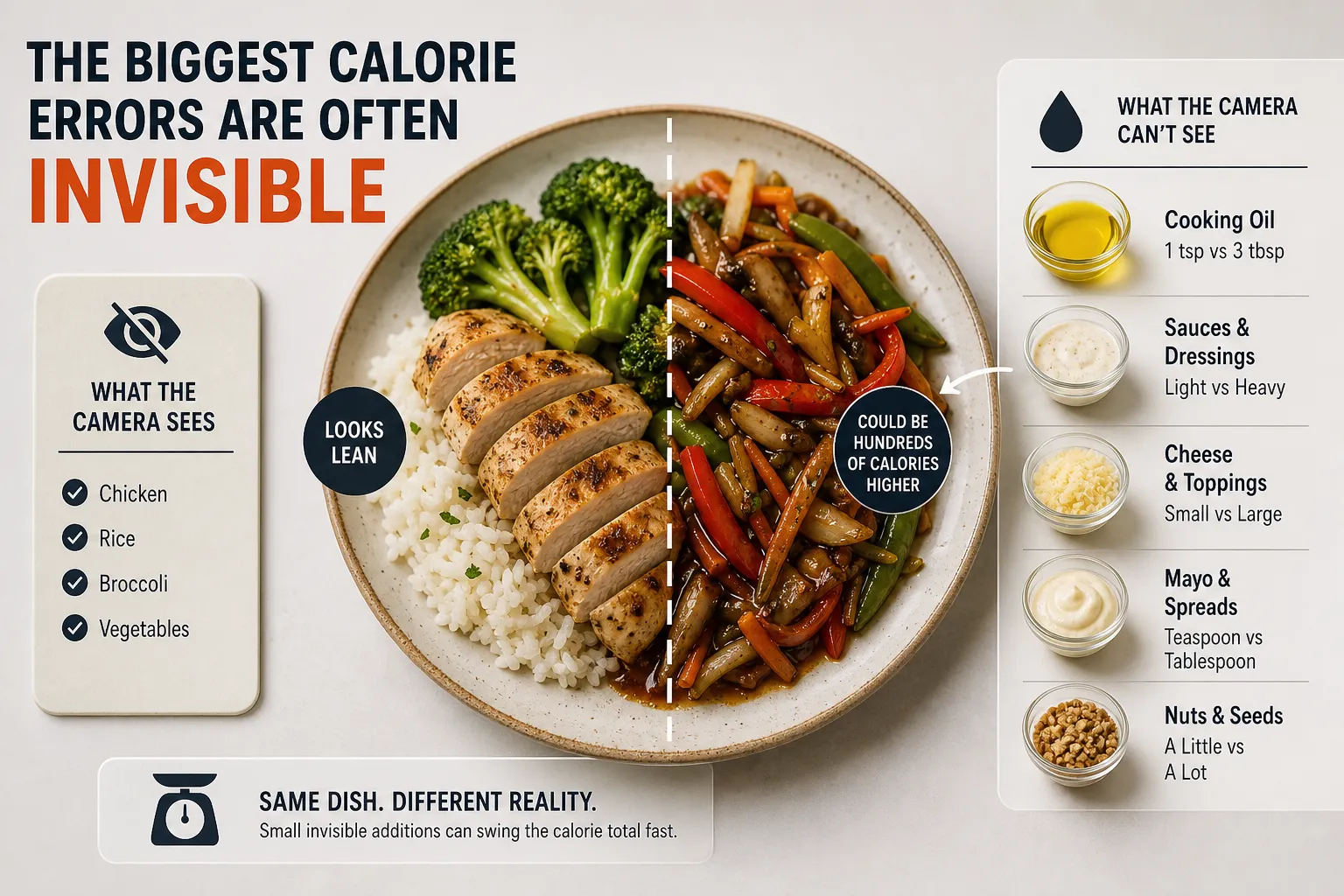
The hardest calories to detect are usually the ones you cannot see. A photo can often identify chicken, rice, broccoli, or pasta. It cannot reliably tell you whether that meal was cooked in one teaspoon of oil or three tablespoons, or whether the sauce was brushed on lightly or poured on heavily.
That gap matters because small invisible additions can swing the calorie total fast. Oil, butter, sugar, dressings, marinades, mayo, cream sauces, and cheese blends can add hundreds of calories while barely changing the appearance of the plate. A stir-fry can look lean and vegetable-heavy but still carry a large calorie bump from the oil left in the pan.
Why mixed dishes fool the camera
Mixed dishes are where photo-only calorie detection gets humbled. Once ingredients are layered, blended, chopped, folded in, or covered by toppings, the image stops telling the full story. The camera may see a burrito bowl, curry, casserole, smoothie, or soup, but it cannot inspect what is buried inside.
A smoothie is a perfect example. The photo shows color and volume, not the exact amount of peanut butter, syrup, protein powder, banana, juice, or full-fat dairy. Two smoothies can look nearly identical and land very far apart nutritionally.
- Sauces: visible glaze does not reveal sugar or oil content
- Dressings: a salad photo rarely shows how much dressing is mixed underneath
- Cooking fats: butter and oil used in the pan may leave little visual evidence
- Hidden extras: nuts, cheese, seeds, mayo, and spreads are easy to miss or underestimate
Restaurant meals are even messier
Restaurant calorie accuracy is inherently shaky, even before AI enters the picture. Recipes change by cook, location, batch, and serving style. A grain bowl that looks the same across two visits may come with more dressing, more cheese, a heavier scoop of rice, or a different hand with the oil bottle.
Even official restaurant numbers are standardized estimates, not a lab test of your exact plate. The FDA's menu labeling framework is built around nutrition information for standard menu items, which helps consumers but still reflects the reality of average preparation rather than the exact serving in front of you. See the FDA overview here: Menu Labeling Basics.
Nutrition databases have the same limitation. They often depend on average values for generic foods or standard recipes. That is useful for estimating, but it does not mean the database knows the real amount of oil in your stir-fry or the actual dressing poured into your bowl today.
This is the honest point most calorie trackers avoid: the uncertainty is not a failure unique to AI. It is a limitation of calorie tracking itself. If the ingredients were not weighed, the recipe was not disclosed, and the preparation was not controlled, then some of the most important calories were always going to be guesswork.
Portion size is where the photo starts guessing
Portion size is one of the biggest failure points in AI calorie detection accuracy. Food recognition and calorie estimation are not the same job. An app can correctly identify rice, lasagna, or chicken and still be wrong about calories because the portion in the photo is harder to measure than most people realize.
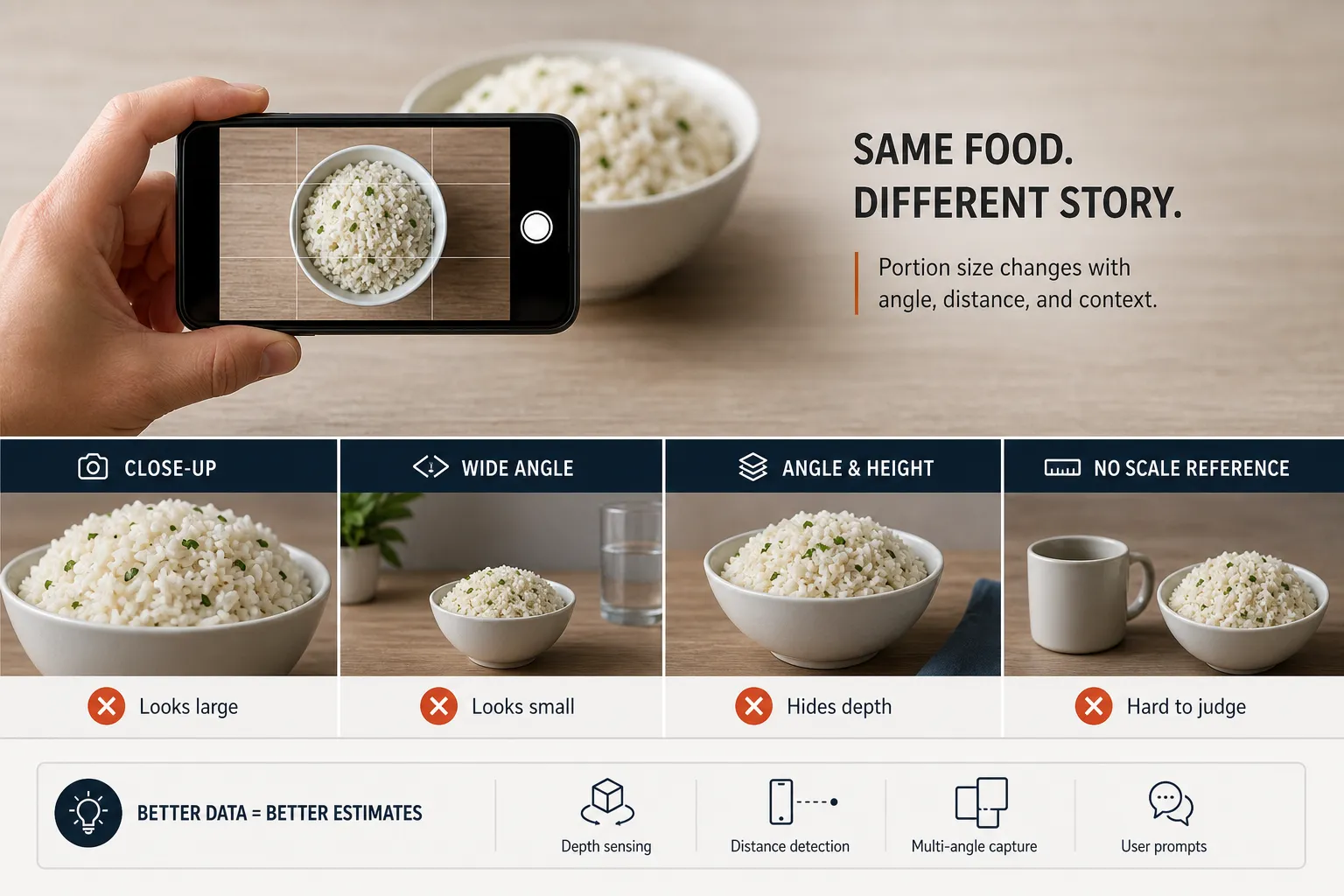
A single photo often has weak scale information. Without a reference object, depth data, or multiple angles, the camera has to infer volume from a flat image. Research on image-based dietary assessment has consistently pointed to portion-size estimation as a major technical bottleneck, even when food recognition is decent source.
Small visual changes can distort the estimate fast. Camera angle, bowl shape, plate size, and how food is stacked all affect what the model sees. A mound of rice in a deep bowl may look like one cup from above but actually be much larger.
Perspective also lies. A close-up photo can make a small portion look oversized, while a wide-angle photo can make a large plate look modest. A flat photo of lasagna cannot reveal thickness or the real ratio of pasta, cheese, meat, and sauce.
What helps
Some apps reduce the guesswork with better capture methods. Depth sensing, distance detection, multi-view images, and user prompts can improve portion size estimation. If the system knows how far the phone is from the plate, or sees the meal from more than one angle, it has a better shot at estimating volume.
- Depth sensors can improve 3D volume estimates
- Distance detection can reduce scale errors
- Multi-angle capture can reveal height and layering
- User prompts can correct obviously wrong serving sizes
What better volume still cannot tell you
Even a better portion estimate does not solve the full calorie problem. Volume is only part of the answer. A photo still cannot reliably tell whether the vegetables were sautéed in oil, whether the sauce includes cream or sugar, or how much butter was added during cooking.
That is the honest limit. Better portion estimation can make a food photo calorie estimator more useful, but it cannot uncover hidden ingredients or exact recipe composition from appearance alone. That is why the smartest standard is not perfect calories from a photo, but whether the estimate is consistent enough to be corrected and useful over time.
Some meals deserve more trust than others
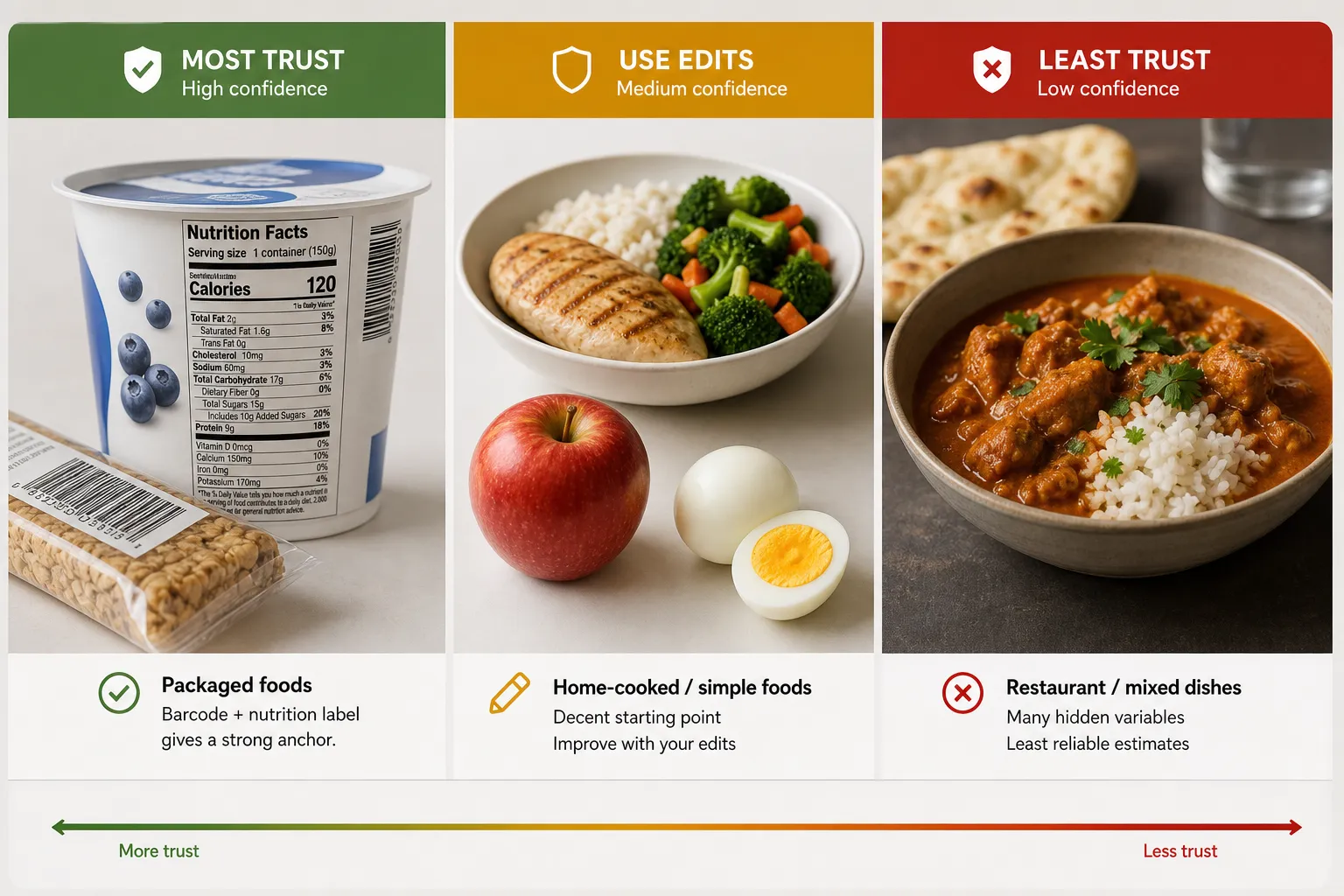
Do not ask for one universal accuracy score. AI calorie detection accuracy changes dramatically based on the food in front of the camera. A packaged yogurt with a barcode is simply a different problem than a restaurant curry photographed from above.
The most anchored estimates usually come from packaged foods. Barcode logging can connect a product to label data or a nutrition database, which gives the app a firmer starting point than a visual guess alone. That is why packaged foods often outperform photo-only estimates for calorie tracking, especially when the product has a clear Nutrition Facts label or matches an entry in USDA FoodData Central.
But barcode food logging is not magic. It still depends on the right serving size, a complete database match, and the user choosing the correct entry. Scan a cereal box and log one cup when you actually poured two, and the result is still wrong.
What usually earns more trust
Simple single foods are the next safest category. A banana, apple, boiled egg, or plain baked potato is easier for AI food recognition and portion size estimation than a burrito or curry. The visible food maps more directly to a common portion, and there are fewer hidden variables.
Home-cooked meals can become fairly useful when you correct them. If the app detects chicken, rice, and vegetables, you can improve the estimate by editing ingredients or portions you know were used. Changing "one tablespoon of dressing" to "three tablespoons" or adding cooking oil is not nitpicking. It is the difference between a rough guess and a useful log.
That correction step is not evidence that AI failed. It is how a food photo calorie estimator becomes practical in real life. The photo gives you a starting point, and your edits supply the context the camera cannot see.
What deserves the least trust
Restaurant meals and mixed dishes are the roughest estimates. Casseroles, curries, burritos, smoothies, sauced pasta, stir-fries, salads with dressing, and anything heavily cooked in oil or butter can hide a lot from the lens. Food recognition might identify the dish correctly while calorie and nutrient estimation still misses the preparation details.
Restaurant calorie accuracy is especially shaky because the app cannot observe the kitchen. Two identical-looking entrees can differ a lot based on oil, sugar, sauce volume, portioning, and recipe variation. A restaurant curry is almost always less trustworthy than a packaged yogurt scan, even if the photo looks clear.
The smart move is to trust different foods differently. Use more confidence for barcodes and simple foods, use edits for home cooking, and treat mixed restaurant meals as directional estimates. That is the honest standard, and it is also how tools like Kibora are most useful: not by pretending every meal total is exact, but by helping you log consistently enough to learn from it.
The useful number is the pattern, not the perfect meal total
The real test of AI calorie detection accuracy is whether it helps you spot patterns you can act on. A single meal estimate can be off and still be useful if the system is directionally consistent over time. That is a better standard than pretending one food photo calorie estimator can tell you the exact truth about a mixed dish, hidden oil, or restaurant prep.
Repeated estimates create signal even when individual entries contain noise. If dinners are consistently logged higher than lunches, that pattern matters even if each dinner is off by 100 or 200 calories. If weekend restaurant meals keep pushing your totals up, that trend is useful even when restaurant calorie accuracy is uncertain.
What consistent tracking can actually show you
Patterns are where behavior change starts. Once you log enough meals, even imperfectly, you can usually see the same issues show up again and again:
- Higher-calorie meal windows like heavy dinners versus lighter lunches
- Snack creep where small extras add up across the day
- Weekend drift when restaurant meals, drinks, and desserts change your usual intake
- Low-protein routines like breakfasts that leave you under target most days
- Liquid calories from coffee drinks, juice, alcohol, or smoothies that are easy to overlook
That kind of awareness is the point of tracking. The National Institute of Diabetes and Digestive and Kidney Diseases includes self-monitoring as part of weight-management behavior change support, because tracking can improve awareness and adherence, not because it produces magical precision NIDDK. Reviews in the research literature also link self-monitoring with better weight-management adherence, though not as a guarantee and not because every log entry is exact PubMed.
Why easier logging often beats “perfect” logging
A log you keep is more valuable than a perfect log you quit after four days. Manual tracking, barcode food logging, and weighing ingredients can be more anchored in some situations, but they also create friction. AI food recognition helps by generating a first draft from a photo, which you can correct instead of starting from zero.
That lower-friction workflow matters more than most people admit. If AI makes you 5 times more likely to log breakfast, snacks, and restaurant meals, you get a more honest picture of your habits. A perfectly measured lunch does not help much if you skip logging the latte, the appetizer, and the late-night bite.
This is where Kibora has the right framing. The honest pitch is not that every photo estimate is exact. It is that AI can identify foods, make a reasonable portion size estimation, and then help you see trends, patterns, and what to do next.
The better goal is better decisions over time. If your log shows dinners run heavy, breakfasts run low in protein, or restaurant meals are driving intake up, you already have useful information. That matters more than false confidence in one exact number for one imperfectly visible plate.

How to use AI calorie tracking without lying to yourself
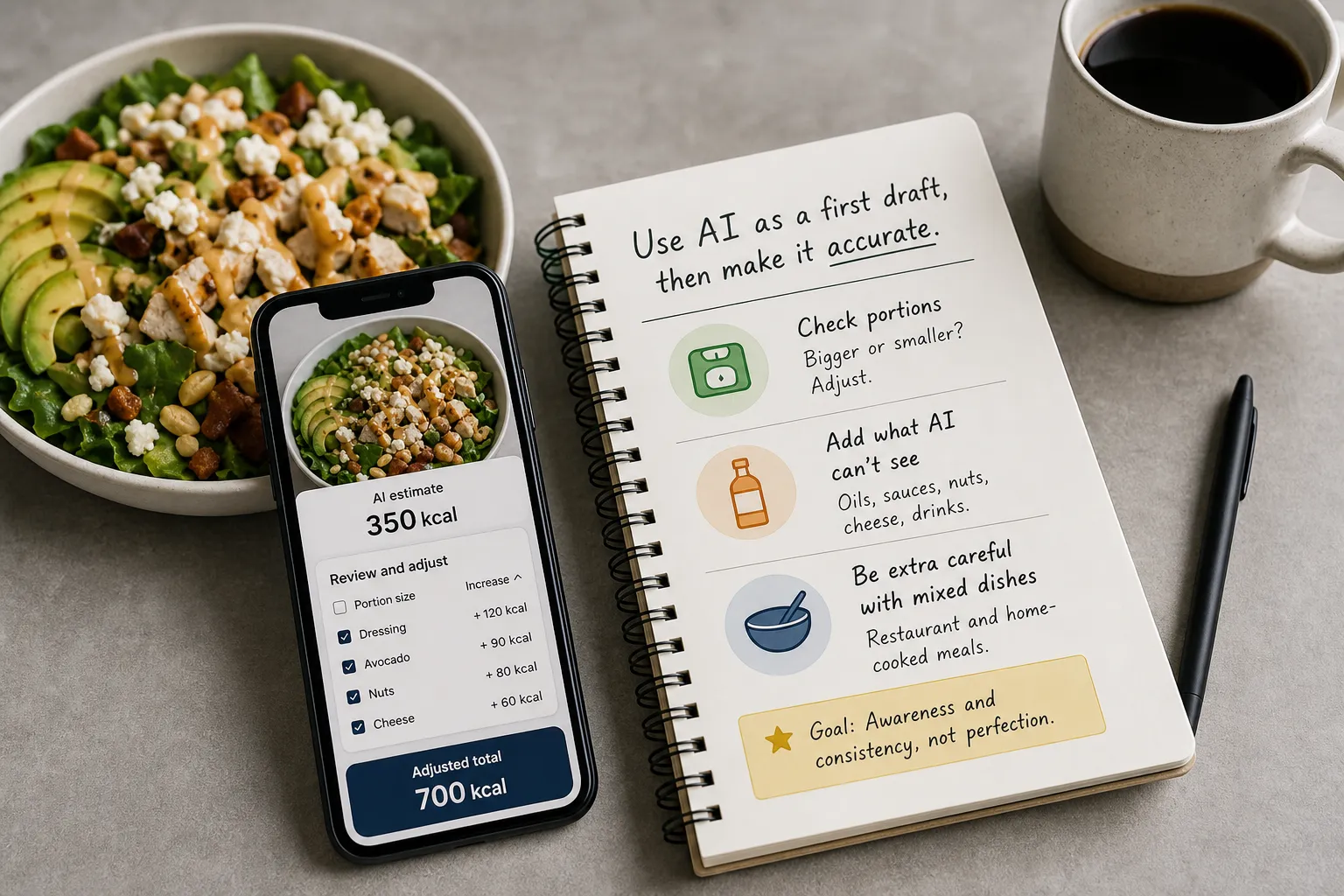
Use photo AI as a first draft, not the final truth. That one mindset change fixes most of the problem. A food photo calorie estimator can give you a fast starting point, but you should assume it needs a quick human edit before it becomes useful.
Correct the variables that actually move calories. Food recognition is only half the job. The bigger errors usually come from portion size estimation and the stuff the camera cannot reliably see or quantify.
- Adjust portions if the serving looks clearly bigger or smaller than the estimate.
- Add hidden calories from oil, butter, dressing, sauces, cheese, nuts, sugar, and drinks.
- Edit mixed dishes if the app identified the meal correctly but lowballed what went into it.
A simple example: if the app logs a salad at 350 calories, but you know it had creamy dressing, avocado, nuts, and cheese, push it up. That is not cheating. That is being less wrong.
Use barcode food logging when you can. If a packaged protein bar has a barcode, scanning it is usually more reliable than asking AI food recognition to guess the exact product from a wrapper photo. It is still not perfect, because serving sizes and databases can be messy, but it is more anchored than a visual guess.
Be suspicious of restaurant meals and anything cooked by someone else. Restaurant calorie accuracy is weak for a reason: you cannot see the extra oil, butter, sugar, or sauce in the pan. The same goes for casseroles, curries, pasta dishes, and other mixed dish calorie estimation nightmares.
If a meal is home-cooked, manually adding the cooking oil or sauce can make the estimate far more useful. That one correction often matters more than whether the AI recognized chicken versus tofu.
Do not judge the system by one meal. Judge it by whether consistent tracking helps you spot weekly patterns, recurring habits, and trend direction. If your late-night snacks, liquid calories, or oversized weekend meals keep showing up, the tool is doing its job.
Use targets as guides, not commandments. A Calorie calculator can help you set a reasonable starting point, but no calculator knows your exact biology and no app knows the exact calories in every plate. The honest goal is awareness and consistency, not fake precision.
Treat AI calorie tracking like a compass, not a scale
Judge AI calorie detection by whether it helps you see direction, not whether it guesses one meal perfectly. Perfect calorie detection from a photo is the wrong expectation because hidden oil, butter, sauces, recipe variation, and portion uncertainty make exact numbers impossible from the start.
The honest standard is simpler. Does the app recognize foods reasonably well, let you correct mistakes quickly, and help you notice patterns you would have missed on your own? That is far more useful than pretending a single photo can reveal the exact calories in every bite.
A compass can still be valuable without giving your exact coordinates. AI calorie tracking works the same way. It is not magic, not useless, and not a substitute for weighed ingredients or verified recipes. It is a low-friction way to reduce guesswork and become less blind to your own habits.
That is the real win. Not a flawless meal number, but better nutrition awareness over time. Kibora’s honest pitch fits that reality: competitive AI food recognition matters, but the bigger value is seeing trends, understanding what keeps repeating, and knowing what to do next.
- Key sources
- USDA FoodData Central
- FDA Menu Labeling
- NIH / NIDDK Weight Management and Self-Monitoring Resources
- Systematic review literature on food image recognition and dietary assessment
- PubMed search for 'food image recognition portion size estimation calorie estimation review'
- PubMed search for 'self-monitoring weight loss systematic review'
- FDA Food Labeling / Nutrition Facts