- What you'll learn
- How to start with a specific question so your food log leads to a decision, not just more numbers
- Which signals are worth tracking for hunger, weight trends, protein, fiber, meal timing, and workout energy
- Why food logs are estimates and how to clean up noisy data before drawing conclusions
- How to read for repeatable patterns instead of reacting to one high-calorie day or one missed target
- How to test one small change at a time and review whether it actually improves your next meal or next week
- When lighter tracking methods, weekly reviews, or non-numeric notes may be a better fit, especially if detailed tracking increases anxiety
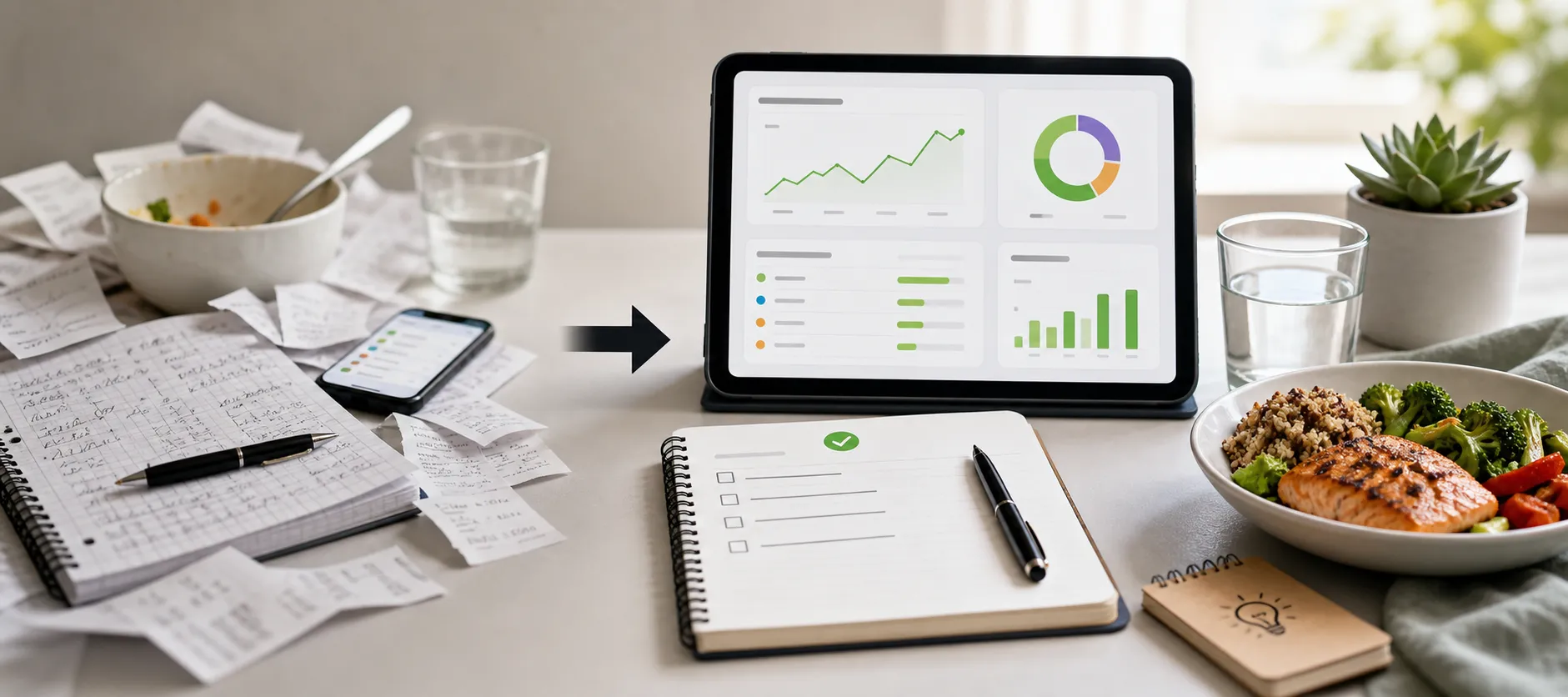
You log a week of meals, calories, macros, photos, or app entries, then stare at the screen wondering what any of it means for your next choice. Logging food is easy. Knowing what to do with the data is harder.
The useful shift is to stop treating food data like a daily grade and start using it as a feedback system. The point is not perfect tracking. It is noticing what seems to affect hunger, energy, progress, and consistency, which fits with the broader role of self-monitoring in behavior change described by the CDC.
A Tuesday total of 2,300 calories may tell you less than a pattern like low-protein breakfasts leading to afternoon snacking. One late dinner is just one day, but four late dinners followed by poor sleep and morning hunger may be worth testing.
This article walks through a simple workflow: ask a better question, clean up the signal, look for patterns, make one small change, and review trends instead of single days.
Start with the decision you want the data to improve
Broad tracking sounds thorough, but it often creates more noise than clarity. A full food log can collect dozens of details without helping you answer the one thing you actually want to change.
The first step is simpler: define the question before you decide what to track. That keeps food data tied to a decision, instead of turning it into a blank mandate to log everything.
A useful question is specific and practical. Not “How do I eat better?” but “Why am I hungry at 4 p.m.?” or “Why is my weight trend stuck?” or “Why do workouts feel flat on some days?”
Once the question is clear, the tracking method usually gets smaller. For many people, partial tracking is enough if it captures the signals that answer the question.
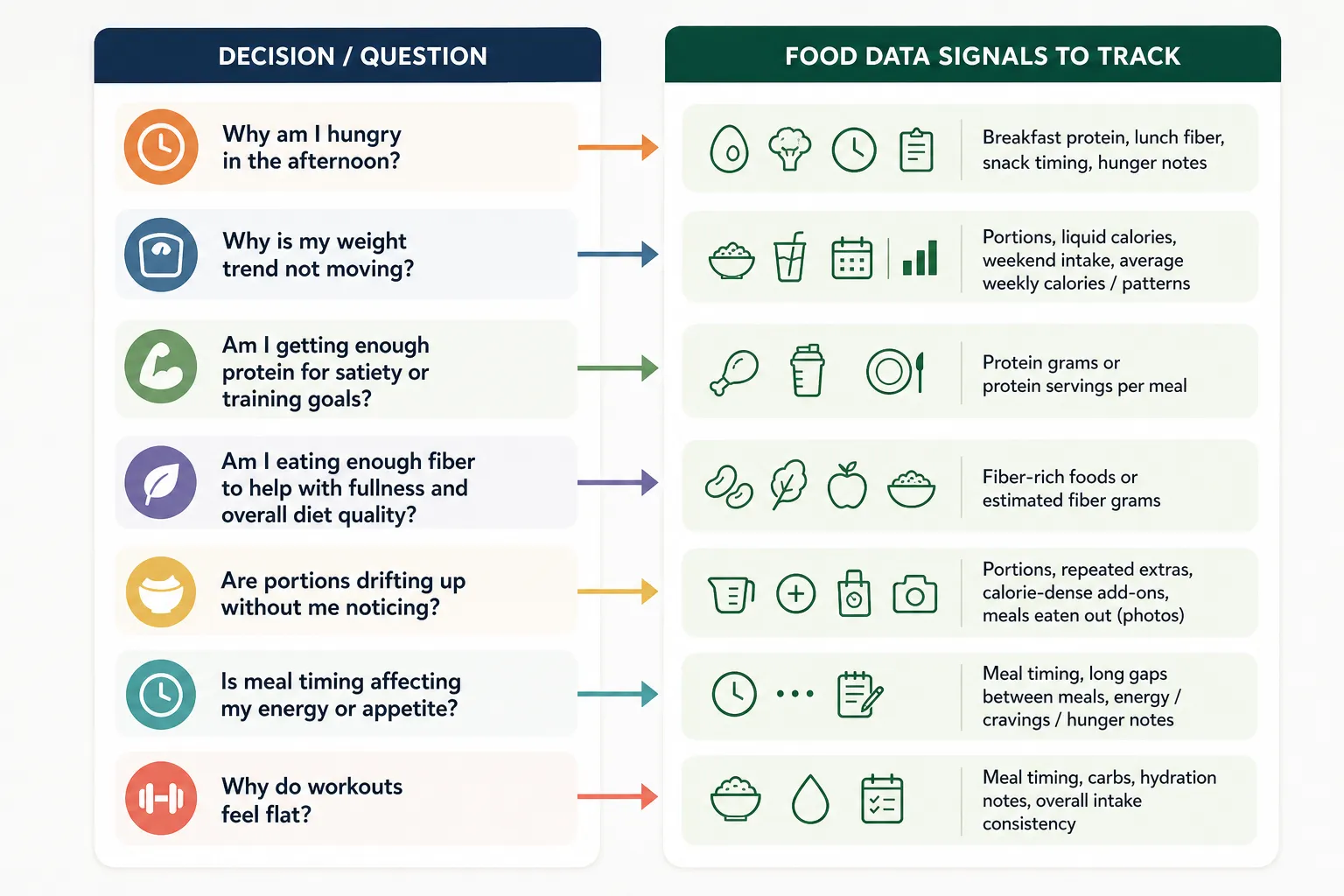
Here is a simple menu of decision-focused questions and the data points that match them:
- Why am I hungry in the afternoon?
Track breakfast protein, lunch fiber, snack timing, and a few hunger notes for several days. You do not need a perfect daily calorie record to test whether earlier meals are leaving you under-fueled.
- Why is my weight trend not moving?
Track approximate portions, liquid calories, weekend intake, and average weekly calories or intake patterns. Weekly trends are usually more useful than reacting to one high-calorie day or one restaurant meal.
- Am I getting enough protein for satiety or training goals?
Track protein grams or even simpler, protein servings per meal. If the goal is consistency, a rough count at breakfast, lunch, and dinner may tell you more than a highly detailed log that you cannot sustain.
- Am I eating enough fiber to help with fullness and overall diet quality?
Track fiber-rich foods, such as beans, vegetables, fruit, whole grains, and high-fiber snacks, or track estimated fiber grams if that feels manageable. The point is to see whether low-fiber meals line up with lower fullness or less consistency.
- Are portions drifting up without me noticing?
Track approximate portions, repeated extras, calorie-dense add-ons, and meals eaten out. Photos can work here if numbers feel tedious.
- Is meal timing affecting my energy or appetite?
Track meal timing, long gaps between meals, and brief notes on energy, cravings, or hunger. This is more useful than assuming one late dinner proves anything on its own.
- Why do workouts feel flat?
Track meal timing, carbohydrate-containing meals, hydration notes, and overall intake consistency. A few days of context can reveal whether the issue is under-fueling, long gaps without food, or something else worth adjusting.
This approach lines up with practical behavior-change guidance from the National Institute of Diabetes and Digestive and Kidney Diseases, which emphasizes sustainable habits and self-monitoring that support real-world decisions. The goal is not perfect measurement. It is getting enough signal to test a reasonable next step.
If you want more on using tracking to generate insight instead of just collecting numbers, this piece on when calorie tracking is useful may help. Tools like Kibora can also help connect logged meals to science-based next-step suggestions, but the framework works even with a notes app, meal photos, or a short checklist.
One important nuance: if tracking tends to increase anxiety, perfectionism, or disordered eating behaviors for you, less intensive methods are often better. A narrower question, fewer data points, or non-numeric notes can still give you patterns without turning the process into constant monitoring.
Clean up the signal before you trust the numbers
Food logs are not exact records. They are estimates, and that matters because labels, database entries, portion guesses, and self-reported intake all carry real error, especially once restaurant meals and memory are involved according to the research literature on dietary self-report.
That does not make tracking useless. It means you should use your log like imperfect but informative data: helpful for spotting trends, less helpful for declaring that one day was exactly 1,842 calories or that one low day proves your metabolism is the problem.
A home meal that you portion the same way each time is often more reliable than a restaurant entry pulled from an app database. A bowl you always fill halfway, the same yogurt cup, or chicken weighed the same way each week can produce better comparisons over time than a polished-looking number attached to a menu item.
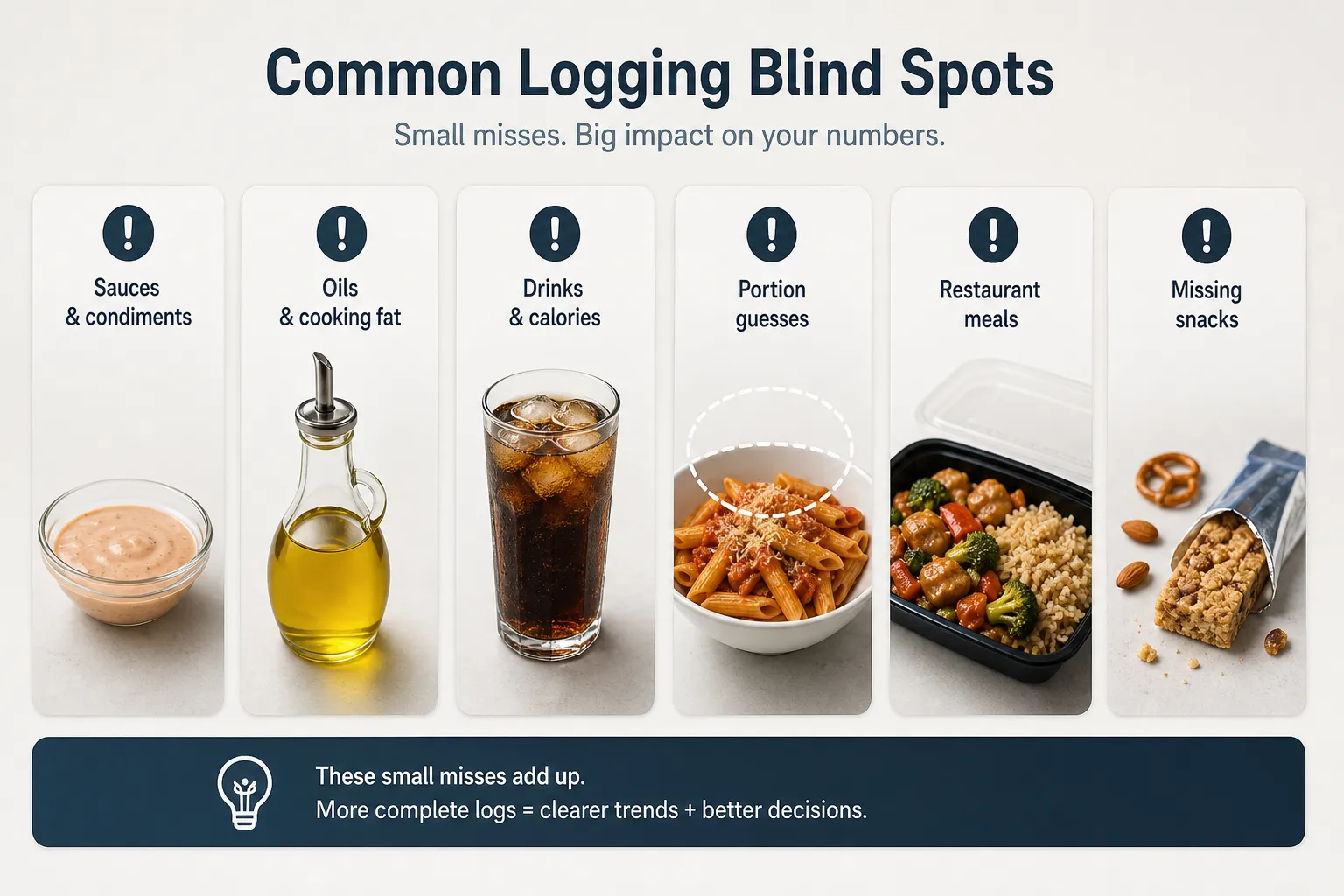
Common distortions are boring but powerful: unlogged bites while cooking, oils, sauces, drinks, weekend meals, shared dishes, and portions guessed when you were busy. If three days look low calorie but all three also include forgotten snacks or extra cooking fat, the data is too incomplete to support a big conclusion.
The goal is not perfect logging. The goal is consistent enough logging that your data can answer the question you started with.
A few habits improve reliability without turning tracking into a second job:
- Use the same portion method repeatedly, whether that is weighing foods, measuring some staples, or using the same visual estimate each time.
- Add quick notes when confidence is low, such as restaurant estimate, forgot snack, or portion guessed.
- Flag meals that are likely less precise, especially takeout, social meals, and anything built from generic app entries.
- Record missing items instead of pretending the day is complete. A note that says drinks not logged is more useful than false precision.
If it helps, classify entries by confidence: reliable, estimated, or missing. That simple label can stop you from overreading noisy days and makes it easier to compare like with like.
Be especially careful with app calorie targets. They are model outputs, not truths, so treating a small gap above or below target as meaningful can create false alarms. A better question is whether your weekly averages and repeated patterns line up with your goal, hunger, energy, or training needs.
That is why one day should rarely drive a major decision. Look at ranges, averages, and repeated situations instead: late-afternoon hunger on workdays, restaurant-heavy weekends, or protein dropping when breakfast gets skipped.
Messy data can still be useful if you know what it can and cannot tell you. It may not give you a perfectly accurate calorie total, but it can still show that your restaurant meals are harder to estimate, your weekdays are more consistent than your weekends, or your fiber intake drops when you travel.
If you want a deeper system for reducing noise before acting on your numbers, this guide to improving tracking accuracy can help. The key is not to chase perfect data, but to avoid confident conclusions from incomplete data.
Read your log for the signals that actually change meals
A useful food log is not a scorecard. It is a way to spot a few repeatable signals that help you make the next meal decision with less guesswork.
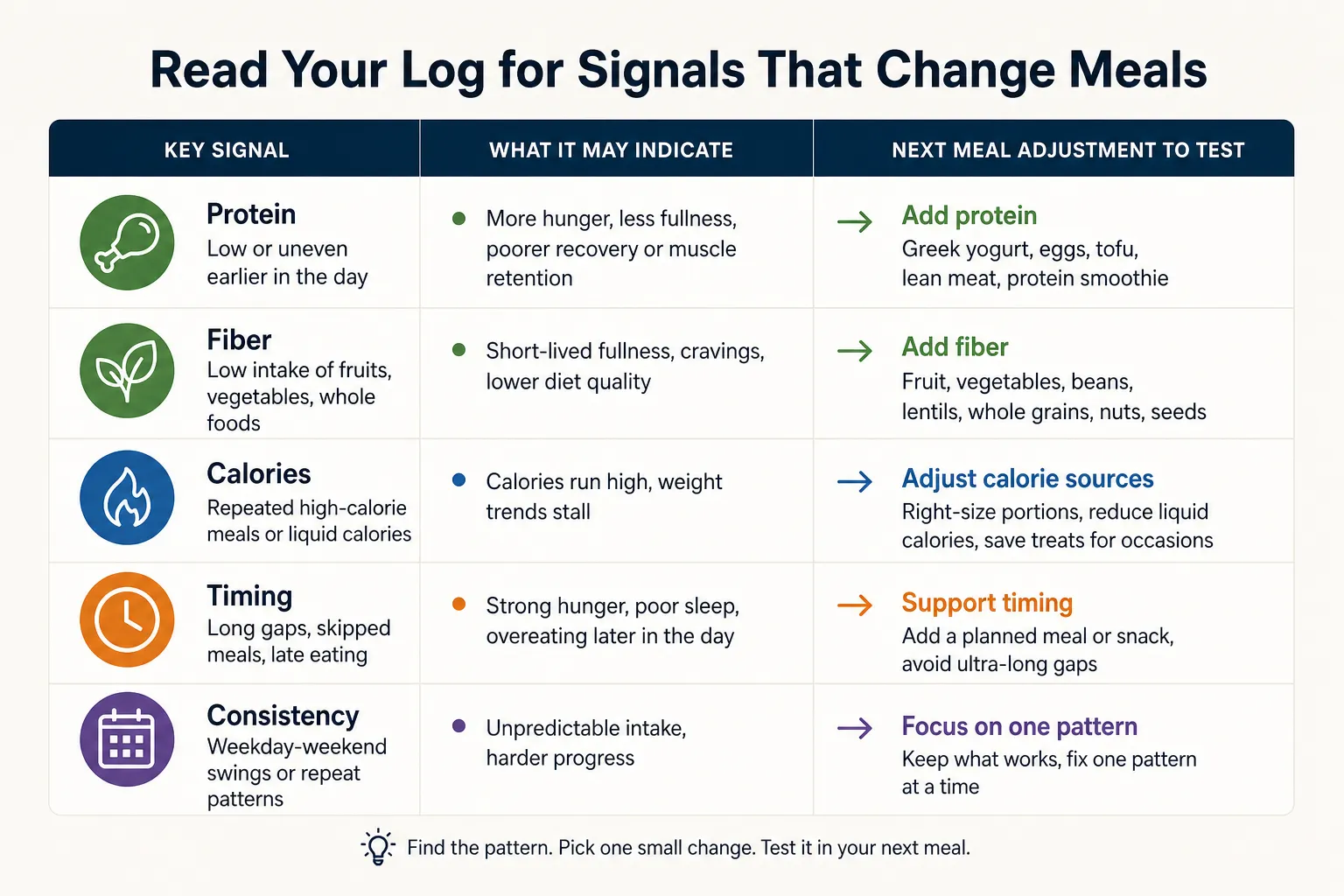
Start with the patterns that most often change appetite, food quality, and weekly intake: protein, fiber, calories, meal timing, and consistency. You do not need perfect numbers for these to be helpful. You need trends that show up often enough to test a small adjustment.
Protein and fiber are often the first levers
If hunger, recovery, or muscle retention is part of your goal, scan your log for meals that are light on protein, especially breakfast and lunch. Protein intake and distribution across the day can affect satiety and body composition, which is why these meals are often useful places to look first according to sports nutrition position statements.
A common pattern is coffee and toast at 8 a.m., then intense hunger by 11 a.m. The next test is not a full diet overhaul. It might just be adding Greek yogurt, eggs, tofu, or a higher-protein smoothie and seeing whether the morning feels easier.
Fiber is another high-value signal because it often tracks with both fullness and overall diet quality. If your log shows few fruits, vegetables, beans, whole grains, nuts, or seeds, that can help explain why meals feel short-lived or snack cravings hit hard later; the NIH fiber fact sheet and the Dietary Guidelines for Americans both support prioritizing these foods.
One practical example is a low-fiber lunch built around refined grains and little produce, followed by midafternoon snacking. A better next-meal decision could be simple: add beans or lentils, swap in a whole grain, or include fruit and vegetables before changing anything else.
Use calories, timing, and consistency as context
Calories still matter for weight trends, but they are usually more useful as a pattern than as a verdict on one meal. Look for repeated high-calorie meals, large portions, frequent liquid calories, or snacks that add a lot without keeping you full for long.
Liquid calorie patterns are especially easy to miss because they often feel separate from eating. If days that run high also include sweet drinks or alcohol, the next test might be reducing frequency, shrinking serving size, or saving those drinks for specific occasions rather than trying to cut everything at once.
Meal timing is worth scanning for, but not because there is one ideal schedule for everyone. What matters is whether your timing pattern connects to missed meals, long gaps, poor sleep, strong cravings, or overeating later in the day.
A classic example is skipping lunch, then grazing late at night. In that case, the useful decision is not “eat earlier” as a rule. It is testing a planned afternoon meal or snack and seeing whether dinner and evening eating become easier to manage.
Last, look for consistency across the week. Weekday-weekend swings, repeated missed meals, or a few meals that reliably keep the rest of the day on track are often more informative than daily averages.
If one breakfast repeatedly makes lunch easier, that is a strong signal worth keeping. If every Saturday starts with skipped meals and ends with takeout and grazing, that is also a signal, not a failure. The point is to find the pattern that suggests one practical change you can make next, then carry that into the experiment in the next section.
Change one lever, then watch what happens
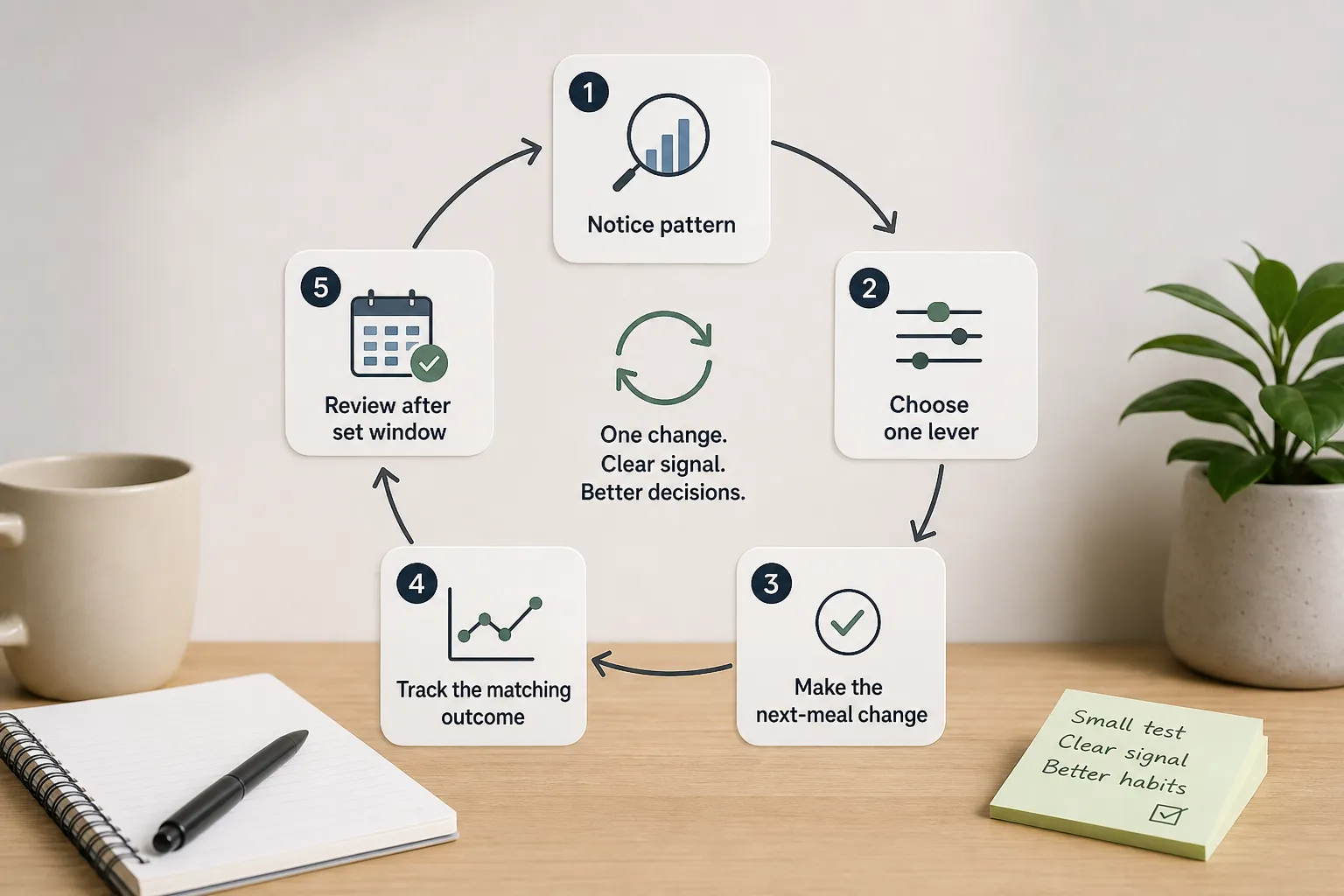
Once you have a pattern, the next step is not a total reset. It is a small testable change that you can repeat long enough to learn from.
The easiest structure is simple: pick one pattern, pick one lever, decide the next-meal or next-week action, choose what you will watch, then review after enough time has passed. If you change protein, meal timing, portions, snacks, and exercise all at once, it becomes much harder to tell what actually made the difference.
A useful lever is something specific you can repeat with low friction. That might be protein at breakfast, fiber at lunch, portion size on takeout nights, a planned afternoon snack, fewer liquid calories, or one meal-prep step that makes your default choice easier.
A simple experiment structure
- Choose one pattern: something that shows up more than once, not one random day.
- Choose one lever: protein, fiber, portion size, meal timing, snack structure, liquid calories, or meal prep.
- Define the action: make it concrete enough for the next meal or the next 7 to 14 days.
- Decide what to watch: hunger, energy, cravings, digestion, workout performance, meal consistency, or weight trend, depending on the question.
- Review after the window ends: keep it if it helps, or change the lever if it does not.
For example, if your log shows a low-protein breakfast and you are hungry by 11 a.m., test one change for seven breakfasts. Add a protein source you will actually eat, then track pre-lunch hunger instead of trying to judge the whole day.
If calories tend to spike on takeout nights, do not rebuild your entire routine overnight. Order the same favorite meal with one portion change, or add a vegetable side first, and see whether that changes fullness or total intake across the week.
If evening snacking keeps following skipped lunches, test the earlier part of the chain. Plan lunch or add a high-fiber afternoon snack for one to two weeks, then watch late-night hunger and cravings.
The same logic applies if your weight trend has been flat for several weeks. A modest adjustment based on actual progress is usually more informative than reacting to one weigh-in with an aggressive cut, which aligns with public health guidance that emphasizes self-monitoring and gradual behavior change over quick fixes from the CDC. If you want a practical framework for that kind of decision, this guide on adjusting intake based on progress can help.
The goal here is not to find a perfect rule. It is to turn a food log into a feedback loop: test one idea, watch the signal that matches the question, and only then decide whether to keep going, refine the change, or try a different explanation.
Review trends weekly instead of judging every meal
A food log becomes useful when you treat it like a feedback loop, not a scorecard. Day to day eating is noisy, and single meals are shaped by work stress, social plans, sleep, travel, and simple randomness.
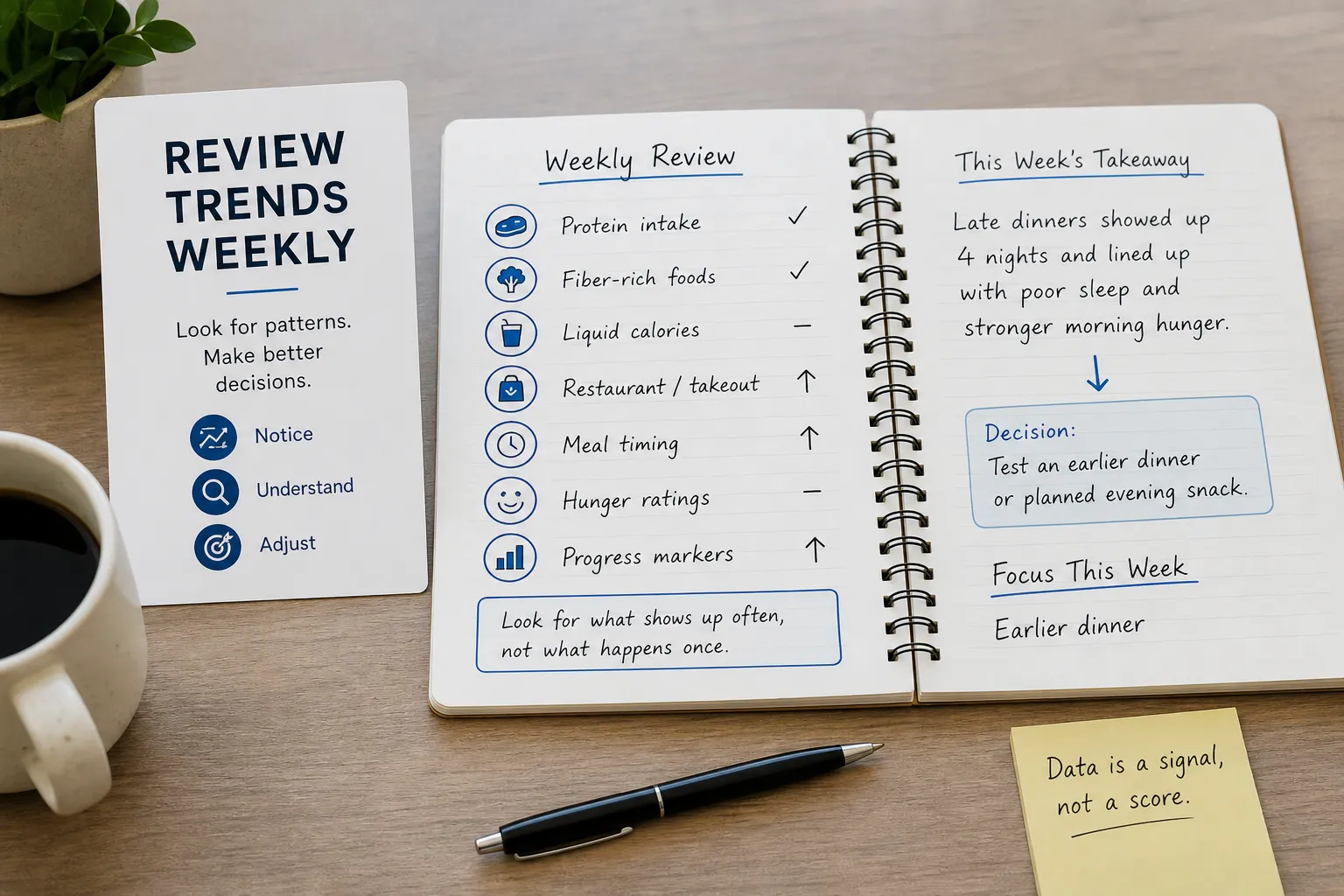
That is why a weekly review is usually more informative than constant judgment. You are not asking whether Tuesday was perfect. You are asking whether the same signals keep showing up often enough to justify a change.
This approach also lowers anxiety. If every high-calorie meal or missed protein target feels like evidence that the plan is broken, you will keep changing course before you have enough data to learn anything.
What to review each week
Keep the review simple and tied to the question you are testing. Look for averages, repeated situations, and correlations that show up more than once.
- How consistent protein intake was across the week
- How often meals included fiber-rich foods
- Whether liquid calories showed up regularly
- Whether restaurant meals or takeout clustered on certain days
- Meal timing patterns, especially if they connect with sleep, hunger, cravings, or energy
- Hunger ratings before or after meals, if you are tracking them
- Progress markers such as body weight trend, waist measurement, training performance, or appetite control
Ongoing self-monitoring tends to be more helpful when it supports consistency over time, which aligns with what the National Weight Control Registry has long observed in people who maintain weight loss. The useful part is not perfect logging. It is reviewing enough information to notice repeatable patterns and stay engaged with the process.
How to interpret a bad day
One high-calorie day, one late dinner, or one missed target is usually just noise. It becomes actionable only when it repeats and connects to an outcome you care about.
For example, if late eating happens once, ignore it. If it happens four nights in a week and lines up with poor sleep or stronger morning hunger, that is a pattern worth testing, maybe with an earlier dinner or a planned evening snack.
Meal timing fits this same rule. Research on time-restricted eating suggests that eating windows may help some people in some settings, but they are not universally decisive, so it makes more sense to evaluate timing as a pattern in your own life than as a rule everyone must follow based on the broader evidence. If you want a deeper example, see how meal timing can connect with sleep, hunger, and recurring patterns.
The same logic applies to weekends and scale fluctuations. If weekend intake repeatedly offsets steady weekdays, the answer may be to plan one flexible weekend meal, not to tighten weekdays further. If weight moves up and down daily but the four-week trend is still moving in the direction you want, the plan may not need changing at all.
A good weekly review usually ends with one of three decisions: continue, simplify, or adjust. Continue if the trend is working, simplify if you are tracking more than you need, or adjust one lever if the same pattern keeps showing up. That keeps food data in its proper role: a source of signals, not a trigger for overreaction.
Use the lightest tracking method that still answers the question
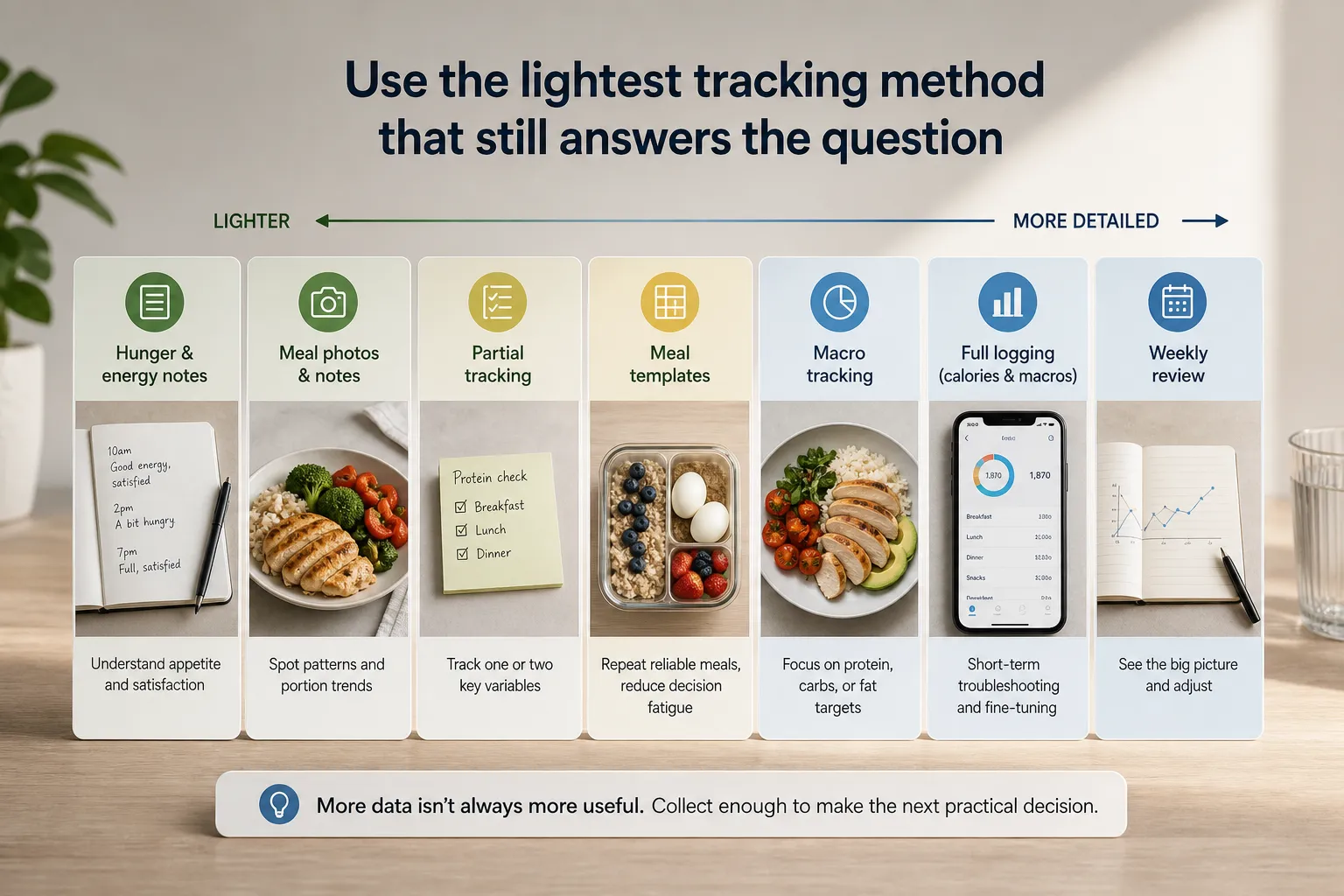
More data is not always more useful. The goal is to collect enough information to make the next practical decision, not to document every bite forever.
The right level of tracking depends on the person and the question. If you are trying to figure out why you are hungry by 4 p.m., a week of meal photos and hunger notes may tell you more than a perfect calorie log. If you are troubleshooting stalled weight loss, a short period of fuller logging might help surface portion, protein, or meal-pattern issues before you return to a lighter method.
Match the method to the problem
Different questions call for different kinds of data. You can scale tracking up or down based on what you are trying to learn.
- Full logging: Useful for short-term troubleshooting when you need a closer estimate of calories, portions, or macros.
- Macro tracking: Helpful if your main question is how to track protein, carbs, or fat without logging every nutrition detail forever.
- Photo logging: A simple option for spotting meal patterns, portion drift, or missed meals.
- Partial tracking: Track just one variable, such as protein at each meal or a daily fiber checklist.
- Meal templates: Repeat a few reliable breakfasts or lunches so you reduce decision fatigue and make comparisons easier.
- Hunger and energy notes: Useful for appetite control food tracking and for seeing whether meals keep you satisfied.
- Weekly reviews: Better than reacting to one late dinner, one restaurant meal, or one missed target.
For example, someone with a protein goal might simply count protein servings at meals instead of logging every ingredient. Someone focused on fiber might use a quick daily checklist for beans, fruit, vegetables, and whole grains.
This is also where sustainability matters. Detailed calorie and macro tracking can be useful for some goals, but it can become unnecessary once the pattern is clear, especially if a lighter system keeps you more consistent.
Tracking should inform, not punish
A good tracking method should help you notice signals and choose a next step. It should not make you feel like every meal needs a score.
If logging starts to increase anxiety, guilt, restriction, bingeing, compulsive checking, or perfectionism, it may be the wrong tool for you. People with an eating-disorder history or tracking-related anxiety may need to avoid detailed tracking altogether and seek professional support. The National Eating Disorders Association offers information and support resources on these risks.
For some people, a non-numeric method is safer and more useful. Meal photos, brief notes about hunger or energy, or working with a clinician or dietitian can provide feedback without turning food into a constant math problem.
If you do want help turning logged meals into practical nutrition insights, Kibora is one optional tool that can translate those patterns into next-step guidance while keeping the focus on decisions rather than perfect numbers. You can explore its features if that kind of support would make tracking feel more actionable.
The better decision is the real metric
Food data is doing its job when it makes the next choice clearer. If logging leaves you more confused, more rigid, or more reactive to single meals, the problem is usually not a lack of effort. It is that the process has drifted away from the question you actually need to answer.
The most useful logs do not prove that you ate perfectly. They reveal patterns you can use, like which breakfast helps you avoid a midmorning crash, which dinner keeps late-night snacking lower, or which lunches leave you full for hours instead of one. That is how to use food data well: not as a scorecard, but as feedback for real meals.
A strong decision process also beats perfect tracking. Estimates will always be imperfect, labels vary, portions change, and daily appetite is not mechanical. But you do not need flawless data or flawless eating to learn something useful from a week of consistent, focused observation.
If tracking tends to increase anxiety, perfectionism, or obsessive thinking for you, it may help to use a lighter method or step back entirely. More data is not always better, especially if it adds pressure instead of insight.
A simple next step is enough. For the next seven days, pick one question such as, “What makes lunch keep me full?” Then track only the few signals that help answer it, like protein, fiber, and hunger, until a pattern starts to show.
After that, make one small testable change. Add a higher-protein food to lunch, increase fiber, shift the meal timing slightly, or repeat the version that worked best and see what happens. If you use Kibora, it can help translate those meal logs into science-based next steps, but the core idea stays the same either way.
Food data is valuable only when it improves the next decision. You do not need perfect numbers or perfect eating today. Pick one question, track the few signals that answer it, and run one small experiment.
- Key sources
- CDC - Losing Weight
- NIDDK - Healthy Eating & Physical Activity for Life
- Food logging accuracy and underreporting literature
- Dietary Guidelines for Americans, 2020-2025
- NIH Office of Dietary Supplements - Dietary Fiber Fact Sheet
- Academy of Nutrition and Dietetics / International Society of Sports Nutrition protein position statements
- National Weight Control Registry
- Systematic reviews and trials on time-restricted eating
- National Eating Disorders Association