



- What you'll learn
- Why daily scale weight can be misleading because of water, glycogen, sodium, bowel contents, and cycle timing
- How to use weekly average weight or trend weight to judge whether fat loss is actually happening
- What to check in your food logs for hidden calories, loose portions, and weekend drift
- How lower steps, less movement, or a smaller body can make an old calorie target stop working
- When to keep calories steady, make a small cut, or raise intake if loss is too fast to sustain
- How to run a simple weekly review that ties calories, activity, hunger, and progress together
You followed the plan, stepped on the scale, and saw a higher number than yesterday. The usual reaction is fast and harsh: eat less immediately. That is the mistake this article is here to fix.
The scale is useful, but one day is not a trend. A salty restaurant meal, extra carbs, bowel contents, water retention, or menstrual cycle timing can push your weight up even when your weekly calorie deficit is still intact.
Useful calorie adjustment for weight loss comes from patterns, not panic. To figure out how to adjust calories based on progress, you need to look at trend weight, audit your food logs, review activity, check hunger and sustainability, and then make a small change only if the evidence supports it.
Sometimes the answer is to hold steady. Sometimes a real plateau comes from hidden calories, lower movement, or the fact that a smaller body may now need fewer calories. The goal is not to cut harder. It is to make the next correct change.
Do not change calories until the trend says something
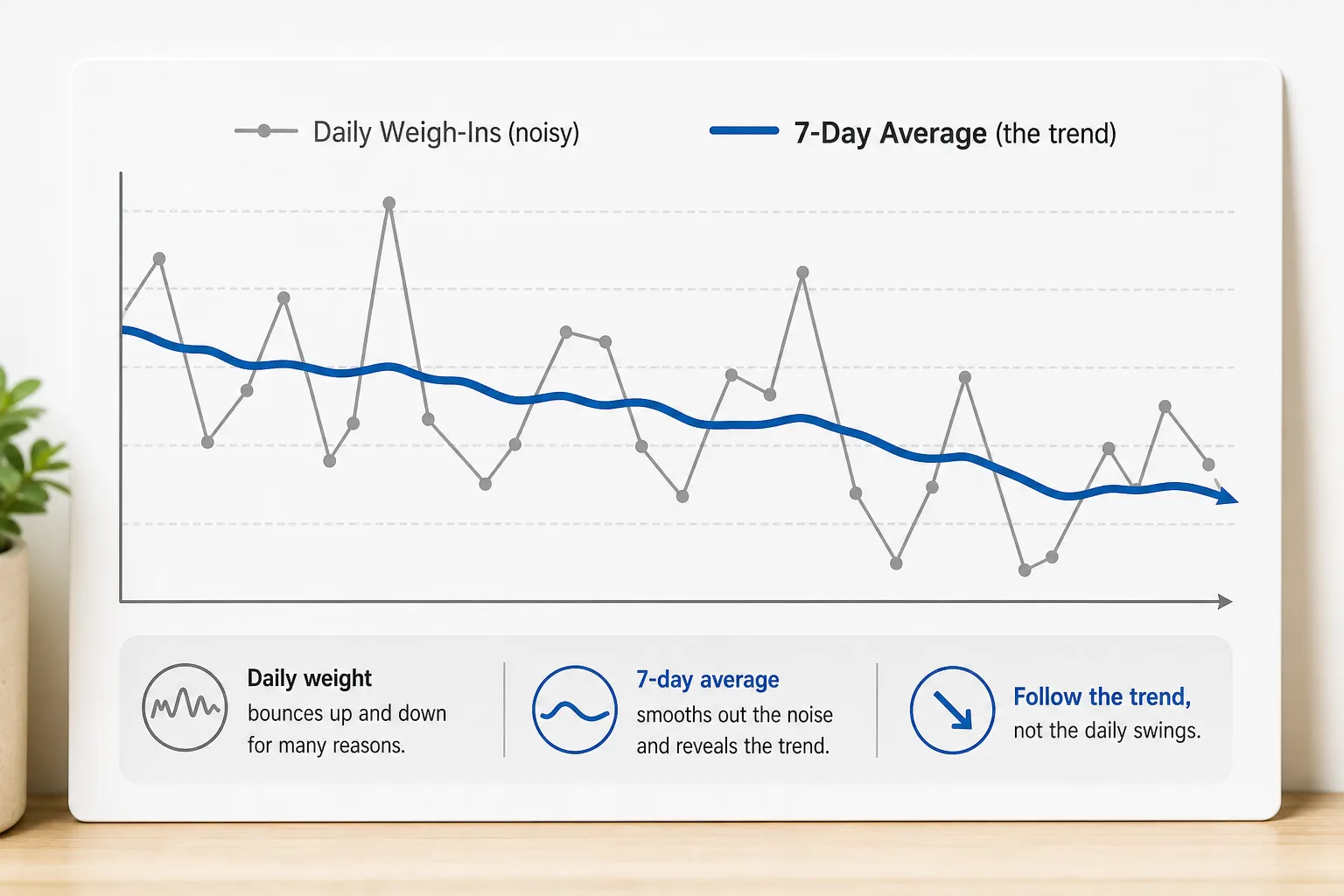
The scale is a noisy tool. Daily weight can jump around because of water retention, glycogen, sodium, bowel contents, training soreness, stress, sleep, and menstrual cycle timing, not because you suddenly gained or lost body fat. Research on short-term body weight fluctuation supports this, especially the role of water and glycogen shifts in day-to-day changes PubMed.
That is why one weigh-in should not drive a calorie change. A single higher morning does not mean your deficit stopped working, and a single lower morning does not prove your target is perfect.
The useful signal comes from a 7-day average or an app-calculated trend weight. If you can weigh yourself calmly, frequent weigh-ins usually give better data because they smooth out random swings. If daily weigh-ins make you spiral, use a consistent schedule and still compare averages rather than isolated numbers.
Keep the question simple before you adjust anything: is the trend down, flat, or dropping too fast? Answer that by comparing one week’s average to the next over at least 2 weeks. If your data are messy, adherence has been inconsistent, or menstrual cycle timing is affecting scale weight, 3 to 4 weeks is a better window.
For example, your Monday weigh-in might be up 1.5 lb after a higher-sodium weekend. If your 7-day average is still down 0.4 lb from last week, that is still progress. The trend matters more than the headline number.
On the other hand, two weeks of nearly identical weekly averages tell you more than one flat day ever could. That kind of pattern is worth paying attention to, because it starts to separate normal scale noise from a calorie target that may need review.
First decide whether your current target is actually working
Your calorie target is working if it is moving you toward the goal without making the plan hard to sustain. That means you do not judge it from one weigh-in. You judge it from weekly average weight, a real trend window, and how your body and routine are responding.
The CDC recommends aiming for weight loss that is gradual and sustainable, rather than aggressive short-term drops that are hard to maintain source. NIDDK makes the same broader point: safe weight management depends on consistent habits, monitoring, and a plan you can actually follow source.
Use this decision framework before changing calories:
- If weekly average weight is trending down and hunger, energy, sleep, mood, and training are still manageable, keep calories the same.
- If weight is dropping very fast and you also notice poor workouts, worse sleep, irritability, or binge urges, consider raising calories slightly or taking a short maintenance pause.
- If the trend is flat over a real window, wait to cut until you audit your logging and activity.
- If weekly averages are rising for multiple weeks and your logging is consistent, your intake may be above maintenance, your activity may have dropped, or both.
Scale trend is the anchor, but it is not the only signal. Water retention, glycogen changes, sodium, bowel contents, and menstrual cycle timing can all mask fat loss or inflate short-term gains, so waist measurements, how clothes fit, gym performance, and adherence quality matter too.
What “working” usually looks like
If you have lost about 0.5 to 1 pound per week for three weeks and hunger is manageable, that is a strong sign the target is doing its job. The right move is to hold steady, not chase faster loss by cutting more food.
A fast first-week drop needs context. If someone lowers carbs and loses 4 pounds in week one, that often reflects water and glycogen shifts more than pure fat loss, so it does not automatically mean calories are too low unless recovery, mood, hunger, or performance also worsen.
When to wait, and when to adjust
If your weekly averages have been flat for three weeks, that still does not mean an automatic calorie cut. If those weeks included several unlogged restaurant meals, inconsistent portions, or lower step counts, the smarter next move is to clean up the data and routine first.
If the trend is clearly rising across multiple weekly averages and your logging is tight, then your current target is probably no longer creating a deficit. In that case, a small calorie adjustment or a realistic activity bump may be appropriate, especially if your current target came from a calculator estimate rather than observed results. If you need a better starting point before judging progress, use a calorie target estimate and then refine from real-world trends.
The main idea is simple: keep calories the same when progress is real and sustainable, wait when the data is messy, lower only after a clean audit, and raise if the pace is too aggressive to maintain. That keeps your decisions tied to progress, not panic.
Audit your logs before you cut more food
If progress stalls, the first question is not “How low should I cut?” It is “Can I trust the intake data?” Before you make your calorie target stricter, make sure your logs are reliable enough to support that decision.
This matters because dietary underreporting is common, and it can easily make a normal calorie deficit look like it stopped working. Research reviews have found that intake misreporting is widespread enough to distort nutrition data and real-world weight-loss decisions according to the literature on dietary underreporting.
Logging does not need to be perfect. It needs to be consistent enough to reveal patterns. If your entries are close on some days and loose on others, you may not be seeing a true plateau at all.
Start with the usual hidden-calorie suspects
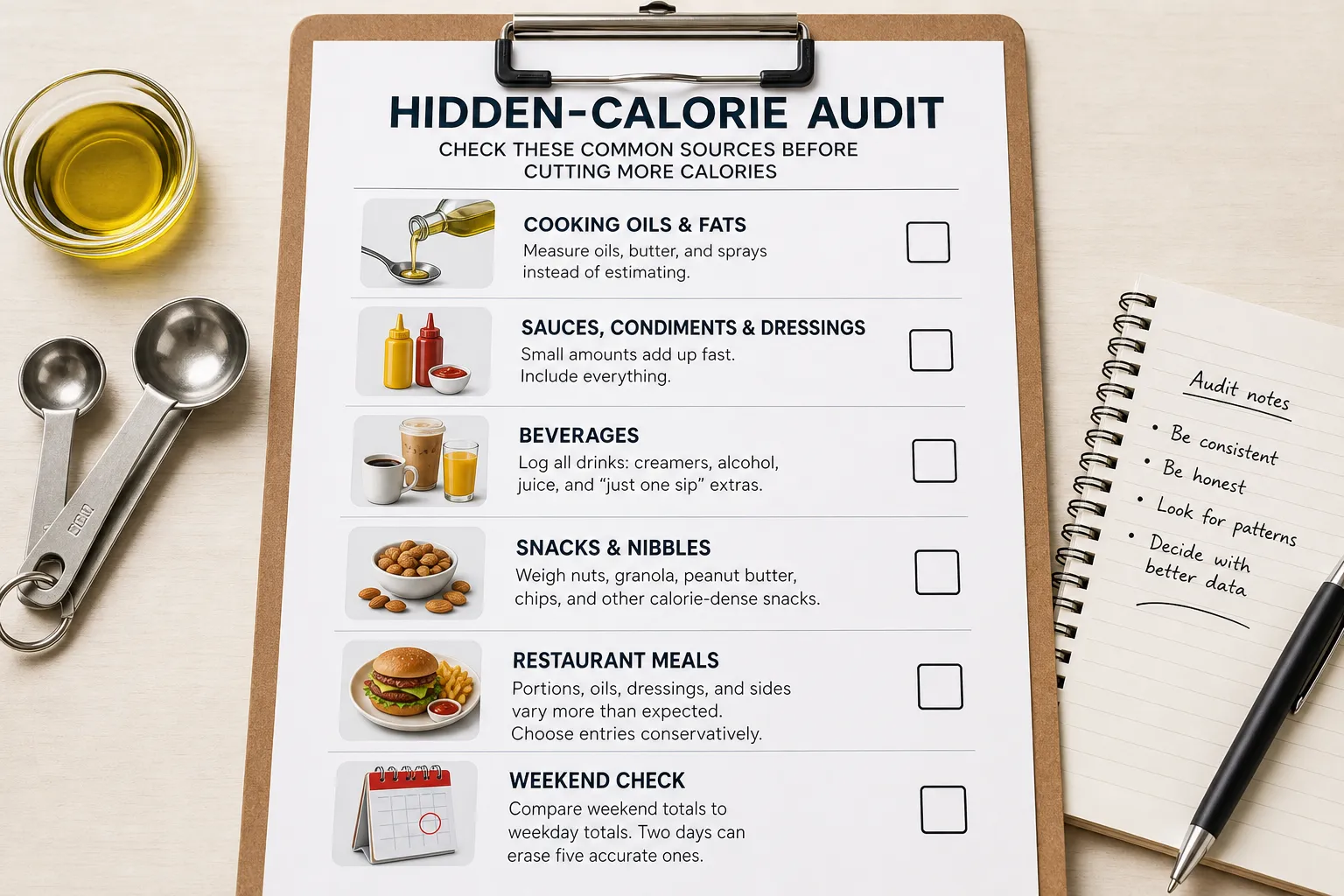
Most logging gaps come from small items that feel forgettable but add up fast. Cooking oils, sauces, condiments, beverages, bites while cooking, office snacks, handfuls of nuts, and “healthy” extras are common places where calories slip through.
Restaurant meals are another major trouble spot. The entry you pick in a tracker may be far lower than what was actually served, especially when portions, oils, dressings, and sides vary more than expected.
Weekend meals deserve their own check. Five accurate weekdays can be erased by two loosely tracked days, especially if restaurant meals, drinks, desserts, and unlogged snacks show up more often on Friday night through Sunday.
A simple one-week audit usually tells you a lot:
- Measure cooking oil instead of estimating it
- Log all beverages, including creamers, alcohol, juice, and “just one sip” extras
- Weigh calorie-dense snacks like nuts, granola, peanut butter, and chips
- Double-check restaurant entries and choose the closest match conservatively
- Compare weekend calorie totals to weekday calorie totals
Check whether your “usual meals” are still the same
Recurring meals often drift upward without feeling different. A breakfast you saved months ago at 350 calories may now be closer to 500 because the oats scoop got larger, the peanut butter spoon got heavier, the yogurt brand changed, or toppings became standard.
This is one of the most useful places to review patterns over time. If you use a tool like Kibora, recurring meals and weekly trends are easier to spot, which helps you catch portion creep, extra add-ons, or meals that show up more often than you realized.
Also check copied meals and saved favorites carefully. “Same lunch” may no longer mean the same bread, same protein amount, same sauce, or same snack on the side.
If your audit finds obvious gaps, tighten the logging first and keep calories where they are long enough to get cleaner data. If your logs look solid across weekdays, weekends, and recurring meals, then you are in a much better position to decide whether a calorie adjustment is actually needed.
That is also why calorie tracking works best as a decision tool, not a promise of perfect precision. If you want a clearer picture of what estimates can and cannot do, read how to use calorie estimates realistically.
Check whether your calorie needs changed
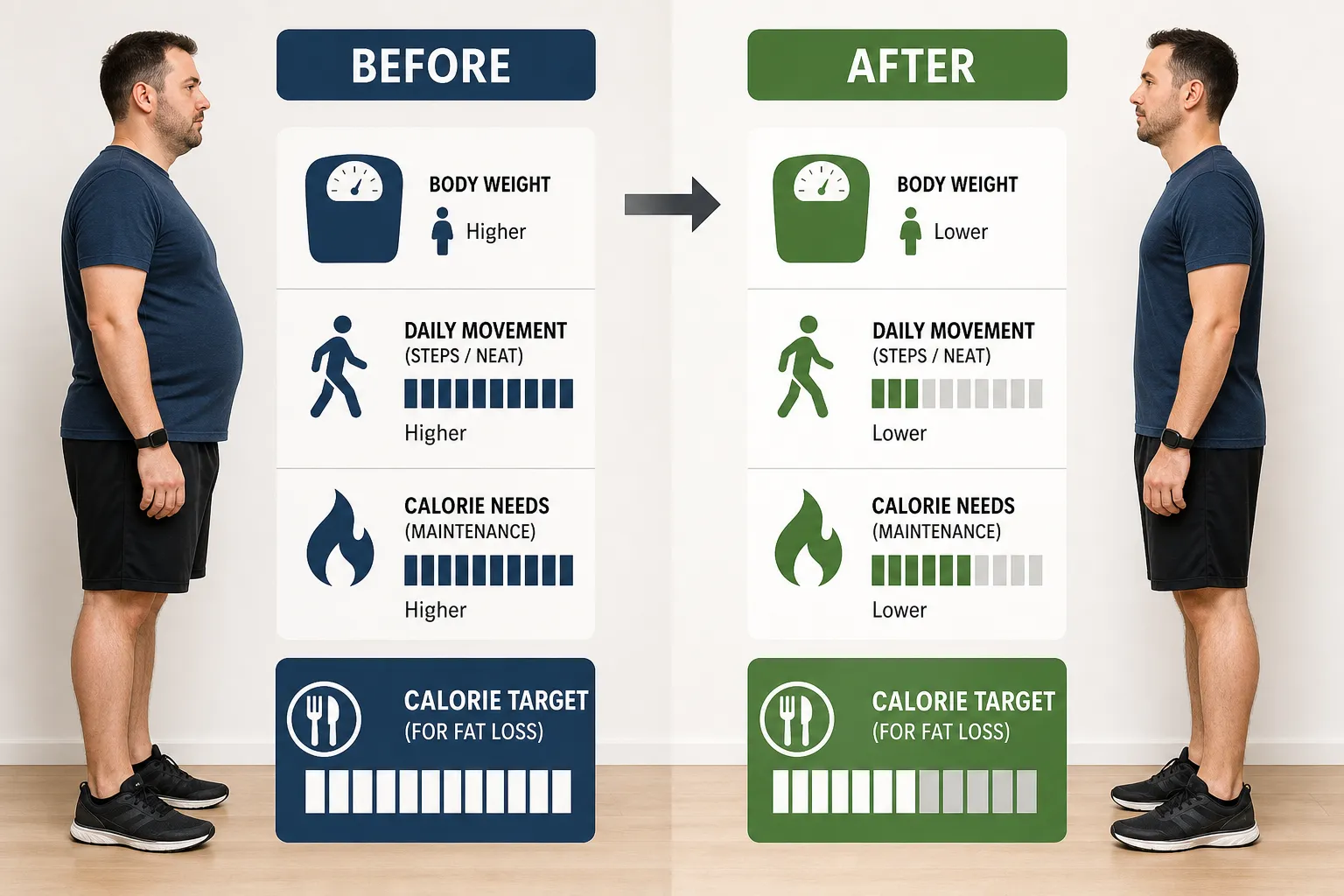
Your calorie target is not fixed forever. As body weight goes down, the body usually needs fewer calories to maintain itself and to move through the day, which is why a target that worked 20 pounds ago may now create a much smaller deficit. Tools like the NIH Body Weight Planner reflect this by recalculating needs as weight changes.
That does not mean your metabolism is broken. It means the math and your daily habits may have changed at the same time, with some normal adaptation during weight loss that has been described in research on adaptive thermogenesis, but usually not in the dramatic way people fear.
A common example is someone who loses 20 lb and keeps eating the same calories that worked at the start. The plan may still be decent, but the gap between intake and output is often smaller now, so progress slows even if nothing feels different.
Daily movement can also drift down without you noticing. If a new desk job drops your steps from 9,000 to 4,000, or dieting leaves you sitting more and fidgeting less, your NEAT drops and your old calorie target may stop working as well.
That is why workouts alone do not tell the full story. An hour in the gym can be helpful, but it does not always offset lower movement during the other 23 hours of the day.
Before you change calories, review four things together: weight lost so far, average steps, workout frequency, and your normal day-to-day movement. Wearables can help you spot patterns here, but treat calorie-burn numbers as rough estimates, not precise truth.
If your body is smaller and your activity is lower, a slower trend may be expected. A plateau is usually a mix of smaller body size, normal adaptation, tracking error, and behavior changes, not proof that nothing works anymore.
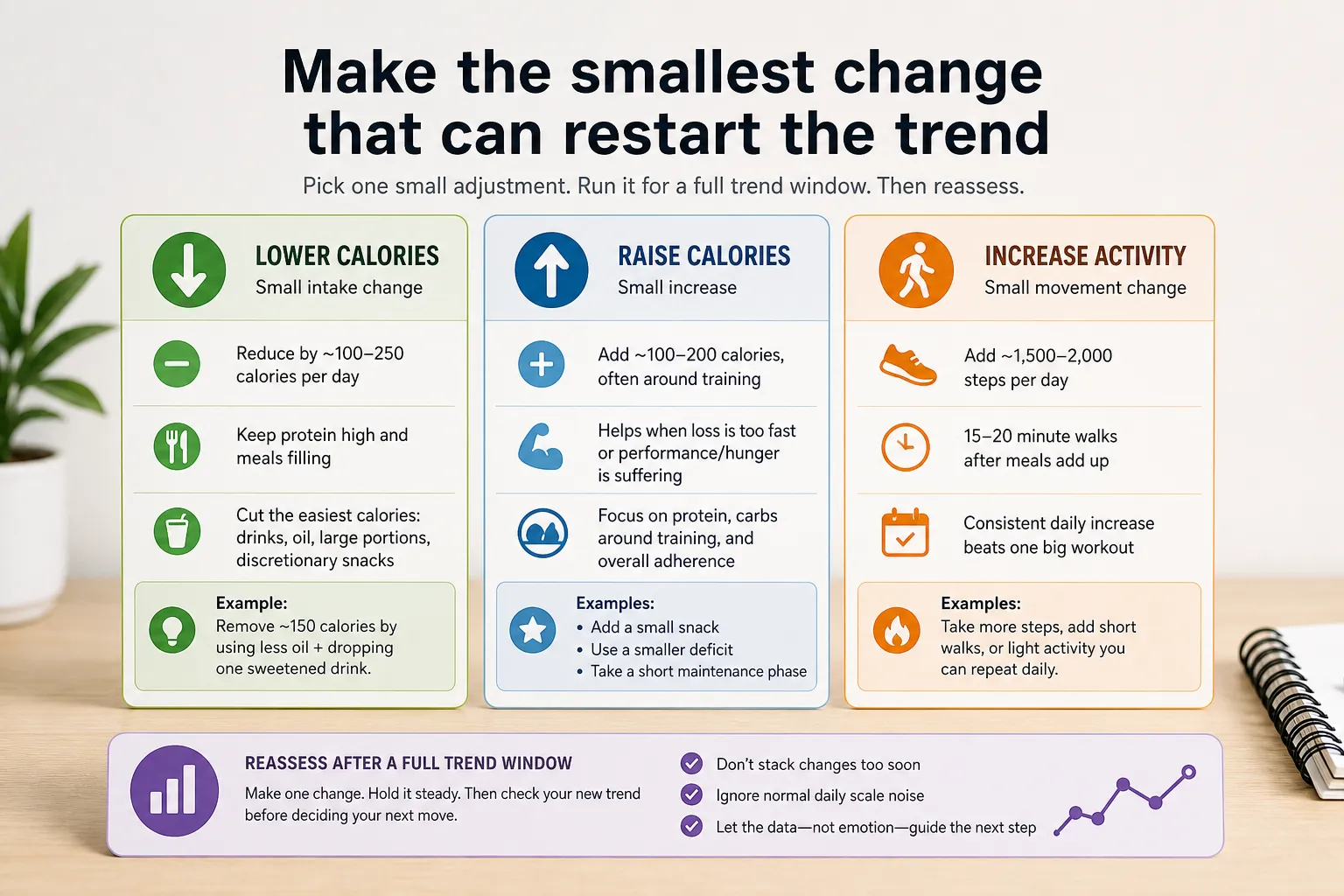
Make the smallest change that can restart the trend
Once you have a real trend window and your logging and activity look consistent, the next move should be small and deliberate. If your trend is flat, that usually points to a modest intake or activity adjustment, not a crash cut. Plateaus are common, and a practical response is often to adjust food intake, activity, or both in a sustainable way, as noted by the Mayo Clinic.
A useful example is reducing intake by about 100 to 250 calories per day, or adding a small repeatable activity increase. That range is not a rule. The right adjustment depends on your body size, current calories, hunger, training load, and how well you are already sticking to the plan.
If you lower calories, do not start by cutting protein. Keep meals filling where possible, and pull calories from the easiest places first: liquid calories, extra cooking oil, large portions of calorie-dense foods, or discretionary snacks that do not help satiety.
For example, you might remove 150 calories by using less oil in one meal and dropping one sweetened drink. That is usually easier to sustain than deleting a full meal and then fighting hunger all week. If you want help keeping your macros practical while making a small change, a macro calculator can help you adjust without letting protein slide.
If food feels hard to cut, use activity instead
Some people do better with a small movement increase than a tighter food target. A good option is adding 1,500 to 2,000 steps per day and keeping that change consistent, rather than relying on one brutal workout that is hard to repeat.
This works best when it fits your real routine. A 15 to 20 minute walk after lunch and dinner often beats an ambitious plan that lasts three days. The goal is not to “burn off” mistakes. It is to create a small, repeatable shift in your weekly output.
If loss is too fast, raise calories before adherence breaks
Sometimes the right adjustment is not lower, but higher. If your trend is dropping quickly and hunger, sleep, mood, or training quality are getting worse, a slightly higher target may help you keep going. The NIDDK emphasizes safe, sustainable weight management over aggressive restriction.
A practical example is adding 100 to 200 calories around training if performance is falling and your rate of loss looks too steep. You can also use a smaller deficit, improve protein and fiber, or take a short maintenance phase if adherence is fraying. Fast loss that leads to rebound is not better progress.
After any change, hold it long enough to collect new trend data. Do not stack another cut three days later because the scale bounced up from sodium, glycogen shifts, bowel contents, water retention, or menstrual cycle timing. Make one change, run it for another trend window, and then decide what the data actually says.
Turn the process into a weekly review
The easiest way to avoid panic changes is to review your data on a weekly cadence, not after every weigh-in. One day can be distorted by water retention, glycogen, sodium, bowel contents, poor sleep, or menstrual cycle timing, so your job is to judge the pattern, not the spike.
Each week, look at five things together instead of treating the scale as the whole story: weekly average weight, calorie consistency, recurring meal patterns, activity or steps, and hunger or energy. That combination tells you whether to keep calories where they are, audit your logging, lower them slightly, raise them, or wait another week.
A simple review template can look like this:
- Average weight for the week
- Average calories for the week
- Protein or macros, if you track them
- Steps and workouts
- Hunger and energy score
- Decision for next week
Monthly views help too, because a single week can hide patterns. You may find that progress stalls mainly on weekends, that restaurant meals push calories up more than expected, or that scale jumps line up with your cycle rather than a true change in body weight.
Keep a short decision log so you do not keep guessing. Write down what changed, why you changed it, and when you will reassess. That makes it much easier to tell whether a calorie adjustment actually worked or whether consistency was the real issue.
This is where tools can help, but they are still just tools. If you use a spreadsheet or notes app, the goal is the same: connect daily logs to trends and recurring patterns. If you want that connection built in, Kibora’s features can tie together logged meals, goals, calorie ranges, pattern detection, and progress insights so the next step is easier to see.
For example, if your weekly average weight is flat but your log shows higher-calorie recurring meals on weekends, the answer may be to fix those meals first. If calories were consistent, activity dropped, and hunger is still manageable, a small calorie reduction might make sense. If the trend is still moving and energy is poor, the best decision may be to wait or even raise calories slightly.
Make the next change boring on purpose
The best calorie adjustment for weight loss should feel almost uneventful. If you are reacting to one high weigh-in, one off-plan meal, or one bloated morning, you are guessing instead of reviewing patterns.
The order matters. Look at the trend weight vs scale weight first, then audit your last 7 to 14 days of logs, then check whether your activity changed, and only then decide whether calories actually need to move.
A good review process is simple enough to repeat for weeks:
- Compare weekly average weight, not single-day scale spikes
- Review logs for hidden calories, missing bites, drinks, or loose portions
- Check whether steps, training, or overall movement dropped
- Assess hunger, energy, and adherence
- Make one small change only if the trend supports it
- Reassess after another trend window
You do not need to punish yourself. You need a process you can trust. Start with your weekly average weight, audit the last 7 to 14 days honestly, and if the pattern still says progress has stalled, make one small change and let it play out long enough to mean something.
- Key sources
- CDC: Losing Weight
- NIDDK: Choosing a Safe and Successful Weight-loss Program / Weight Management
- NIH Body Weight Planner
- PubMed search: body weight fluctuations water glycogen review
- Systematic review literature on dietary misreporting and underreporting
- PubMed search: adaptive thermogenesis during weight loss reviews
- Mayo Clinic: Weight loss plateau


