


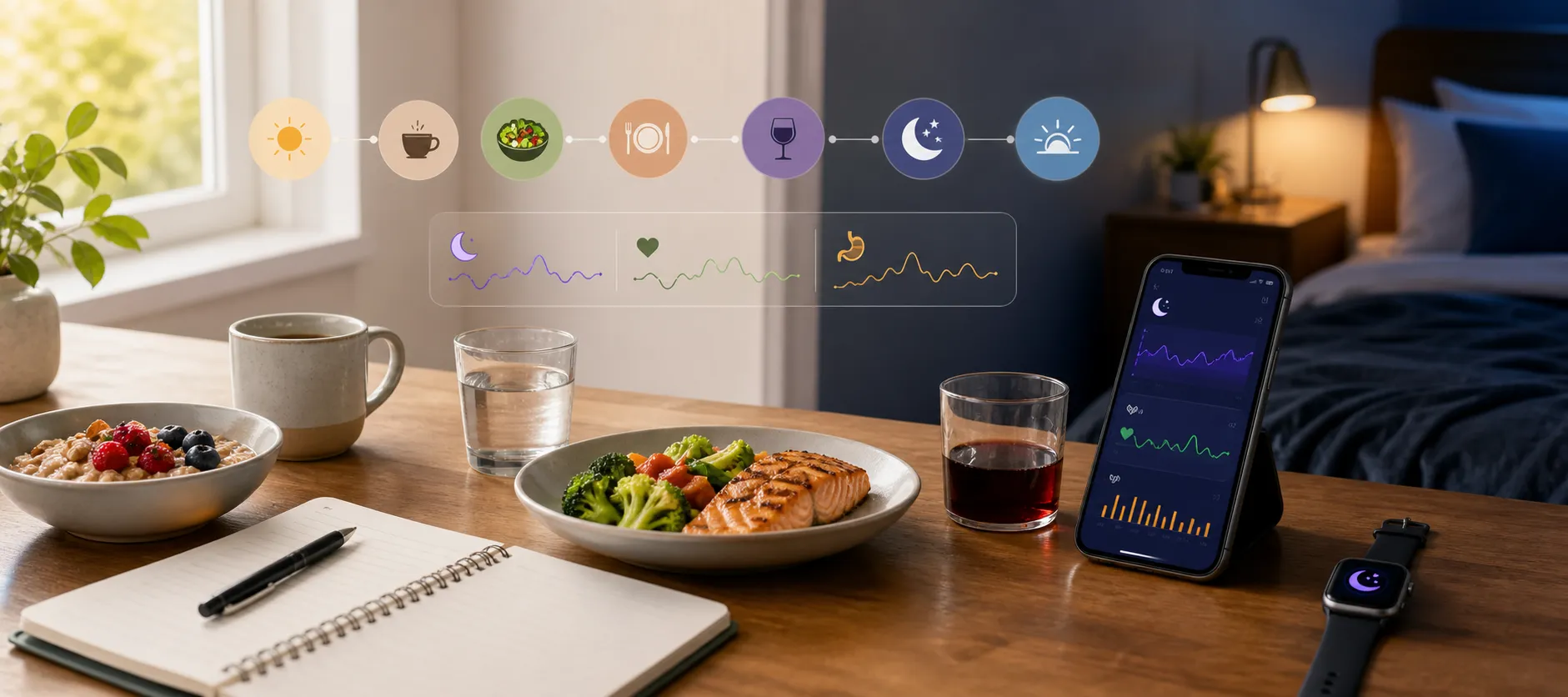
- What you'll learn
- How to tell when late eating is actually linked to worse sleep
- Why caffeine and alcohol timing need to be tracked separately from dinner time
- Which meal timing patterns to compare, including skipped breakfast, late snacks, and heavy dinners
- What to log for 1 to 2 weeks so you can spot repeatable hunger and sleep trends
- How sleep loss can raise next-day hunger and make dinner timing look like the cause
- How Kibora can help surface repeated timing patterns without overtracking every meal
You eat dinner late, sleep badly, and wake up the next morning hungry and craving everything. It is easy to blame the hour on the clock, but late eating is not always the whole story.
The better question is whether the same pattern keeps showing up when you look at meal timing, caffeine, alcohol, sleep duration, and next-day hunger together. A 9 p.m. light dinner might be completely fine, while a 9 p.m. heavy meal plus wine and an afternoon espresso could set up a very different night.
This article will help you read those signals as personal feedback, not a universal cutoff. Tools like Kibora can make that easier by connecting timing, sleep, and hunger in one place without turning tracking into a full-time job.
The clock matters, but the pattern matters more
Stop asking only, “Is eating after 7 p.m. bad?” A better question is: what tends to happen after I eat late, and what else was true that day? That shift gets you away from rigid rules and closer to something you can actually use.
There is no single cutoff time that works for everyone. A night owl with a consistent late schedule may handle a 9 p.m. dinner better than someone who wakes at 5:30 a.m. and eats a heavy meal an hour before bed.
Timing still matters, because your body does not respond the same way to food at every hour. Circadian rhythms influence metabolic and appetite-related processes, and research suggests meal timing can interact with glucose tolerance, insulin sensitivity, and hunger regulation, which helps explain why many people do better when more of their food lands earlier in the day NIDDK, PubMed.
But “late” is not the whole story. A late meal is more likely to matter when it is large, high-fat, spicy, very close to bedtime, paired with alcohol, or followed by reflux symptoms. If you already deal with insomnia or reflux, food near bedtime may show up more clearly in your sleep than it does for someone without those issues.
Look for categories, not one-off nights
The most useful patterns usually fall into a few repeatable buckets. These are the ones worth paying attention to before you blame the clock alone:
- Late-heavy dinner: a big meal close to bed, especially if you feel overly full, warm, restless, or get reflux.
- Late snack: a smaller evening snack that may be neutral, helpful, or disruptive depending on size, type, and timing.
- Skipped breakfast leading to evening overeating: eating very little early, then arriving at dinner overly hungry and eating fast or past fullness.
- Caffeine too late: poor sleep after an afternoon or evening coffee, energy drink, pre-workout, or strong tea.
- Alcohol near bedtime: feeling sleepy at first but waking more during the night or feeling less restored the next morning.
- Sleep debt driving hunger: a short night followed by stronger cravings, more snacking, or a bigger evening appetite.
These categories are more practical than a universal “don’t eat after X time” rule because they tell you what to compare. If two late dinners lead to different nights, the difference may be meal size, alcohol, caffeine, stress, bedtime, or how much you ate earlier in the day.
Use a better framework: timing plus context plus repeatability
The goal is not to judge a single meal. The goal is to see whether the same setup keeps leading to the same outcome.
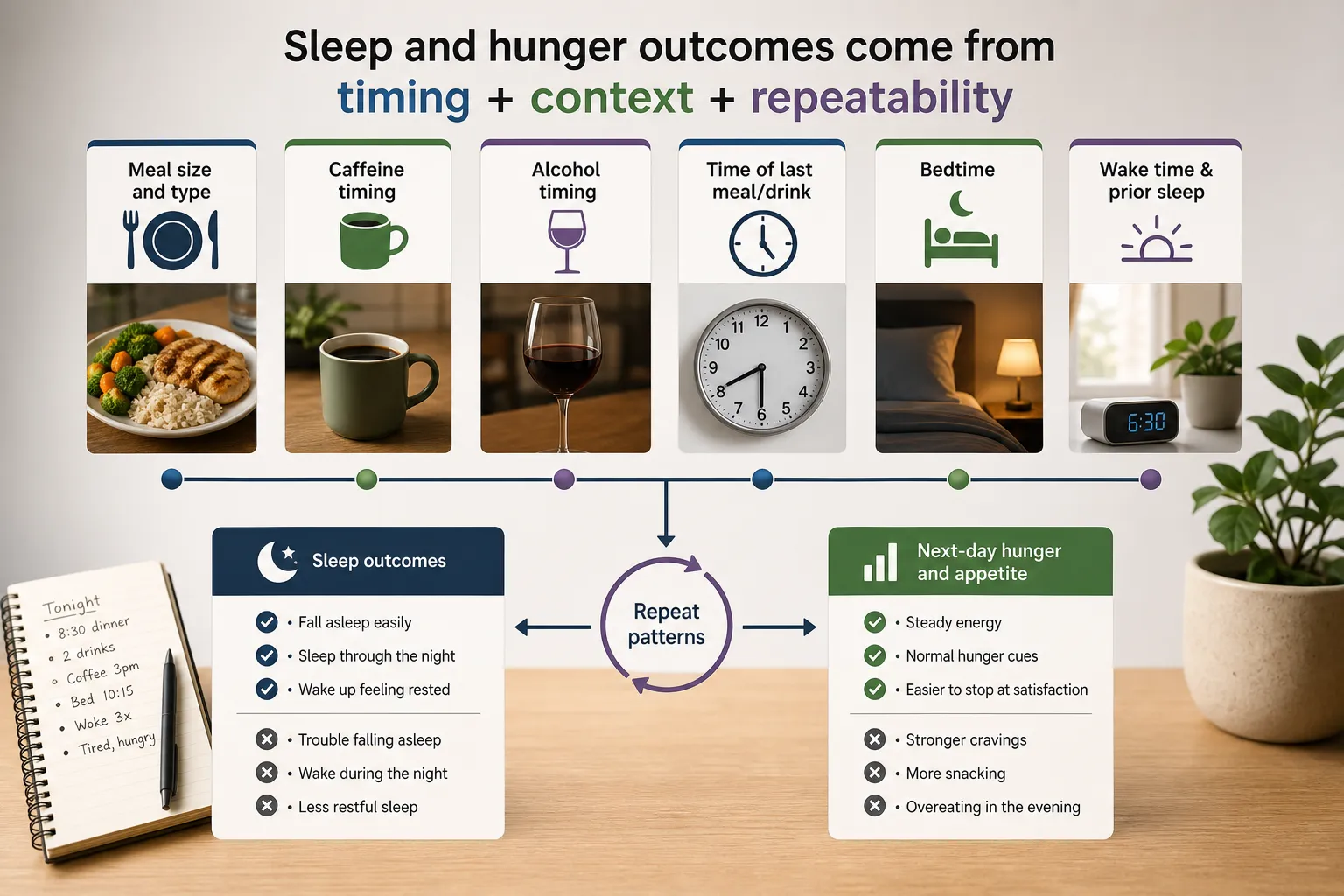
That is why the most useful interpretation framework is simple: timing + context + repeatability. Timing is when you ate or drank. Context is what else was true, like meal size, caffeine, alcohol, reflux, bedtime, or a short prior night. Repeatability is whether the same pattern shows up more than once.
For example, “I ate at 8:30” is weak data by itself. “I ate a large, spicy dinner at 8:30, had two drinks, went to bed at 10, and woke up uncomfortable three times” is something you can compare against future nights.
This is also where a tool like Kibora can help. Instead of forcing a rule, it makes it easier to line up meal timing, caffeine and alcohol timing, sleep outlook, and next-day hunger so you can spot repeated patterns without obsessing over every dinner.
One rough night is a clue, not a verdict. If the same late-heavy dinner keeps disrupting sleep, or the same short-sleep day keeps ending in evening overeating, that is the pattern to act on.
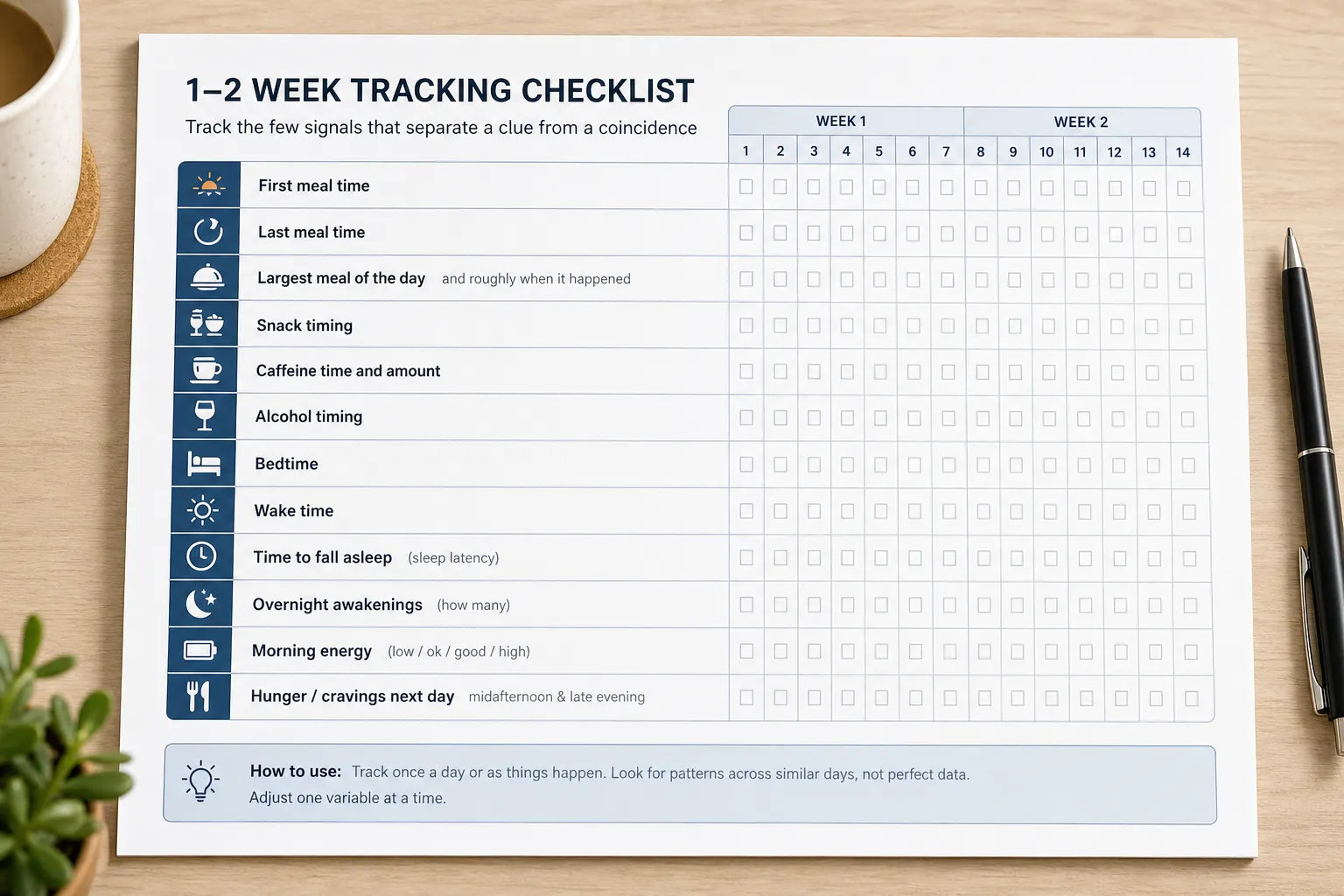
Track the few signals that separate a clue from a coincidence
The goal is not to log everything forever. It is to collect just enough context for 1 to 2 weeks so you can tell the difference between a real pattern and one rough night.
Start with a baseline before you try to fix anything. For the first few days, eat and sleep as you normally would so you can see what tends to happen on its own.
The minimum useful setup is simple. Track these items once a day or as they happen:
- First meal time
- Last meal time
- Largest meal of the day and roughly when it happened
- Snack timing
- Caffeine time and amount
- Alcohol timing
- Bedtime
- Wake time
- How long it took you to fall asleep
- Any overnight awakenings
- Morning energy
- Hunger or cravings the next day, especially midafternoon and late evening
That is enough to compare meal timing and sleep without turning your life into a spreadsheet. If tracking starts to feel tense or overly detailed, scale back and keep only the signals that help you make decisions.
Sleep timing belongs in the same log as food and drink timing because routines interact. The CDC recommends consistent sleep habits as part of healthy sleep, which is why bedtime, wake time, and sleep disruptions are worth tracking alongside meals, caffeine, and alcohol rather than in isolation.
What you are looking for
Look for repeated patterns across similar days, not perfect data. A single late dinner means very little by itself, but three or four similar nights can tell you something useful.
For example, you might notice that a last meal after 8:30 p.m. plus alcohol predicts more awakenings, while a late dinner without alcohol does not. Or you may see that caffeine after 2 p.m. lines up with longer sleep latency even when dinner timing stays normal.
Another common pattern is appetite drift across the day. If skipped breakfast regularly leads to intense 4 p.m. hunger, a much larger dinner, and then a later bedtime, that is a stronger clue than any one meal on its own.
Keep it useful, not obsessive
The point of self-tracking is to reduce guesswork, not create anxiety. If you want a simple way to spot these connections, Kibora can surface meal timing, caffeine and alcohol context, sleep outlook, and repeated patterns so you do not have to manually connect every late snack or restless night yourself.
If you prefer a general rule, use this one: track consistently enough to notice trends, then adjust one variable at a time. That is the same pattern-first mindset behind our take on when tracking becomes actually useful instead of obsessive.
Late dinner is only one suspect
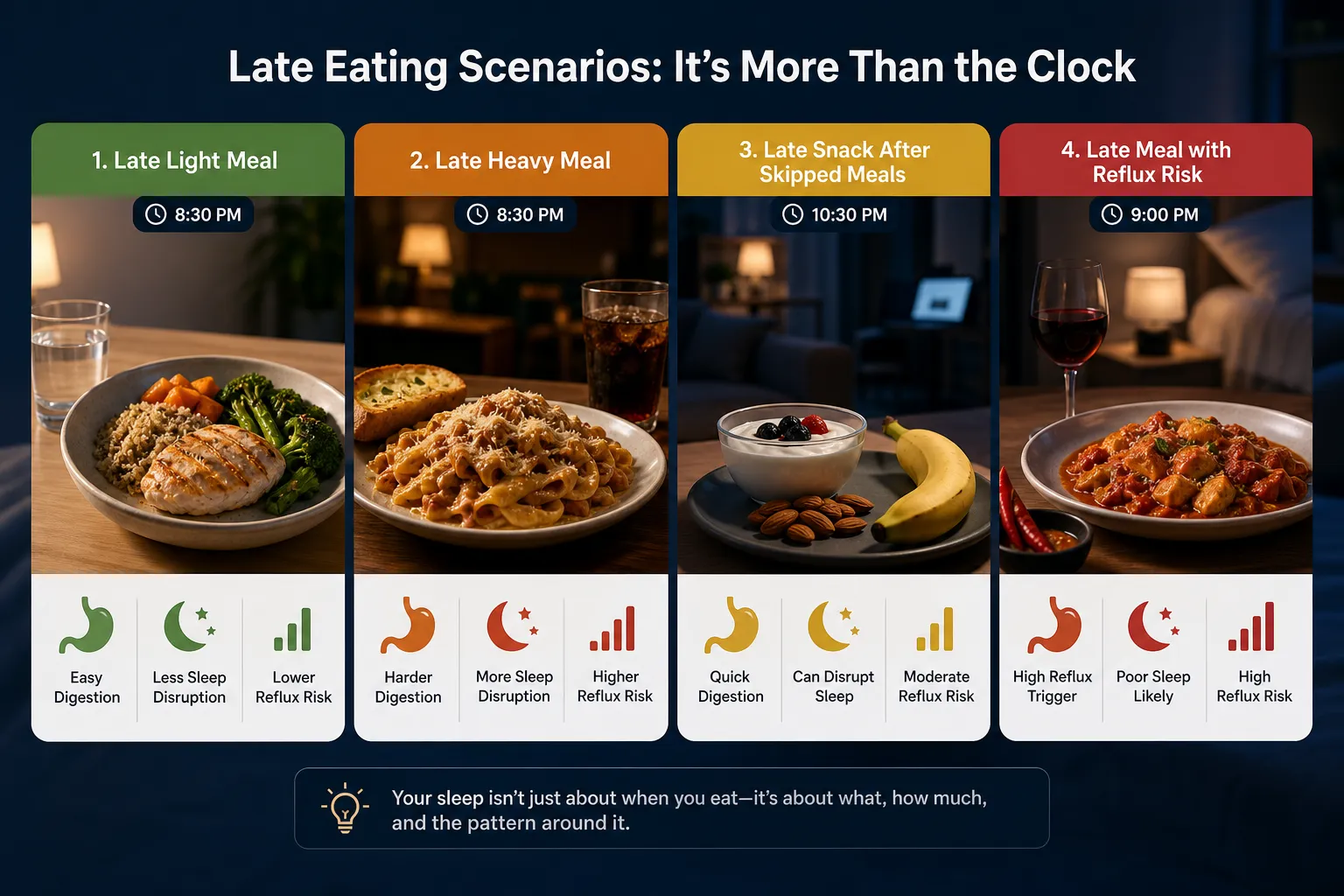
A late dinner can matter, but late eating and sleep is rarely just about the clock. A meal at 8:30 p.m. that is light and familiar may affect you very differently from a heavy restaurant dinner at the same time, especially if alcohol, rich food, or lying down soon after are part of the picture.
The biggest clue is often the pattern around the meal. If sleep is worse only after big takeout orders, celebratory dinners, or spicy meals eaten close to bed, meal size and composition may be the real issue more than dinner time alone.
This is especially relevant if you deal with reflux or GERD. Eating close to bedtime can make symptoms more likely, and reflux can easily show up as fragmented sleep, throat irritation, or that uncomfortable too-full feeling when you lie down.
Late light meal versus late heavy meal
A small planned snack is not the same as a late heavy meal. For some people, a modest evening snack is actually less disruptive than arriving at dinner overly hungry, eating fast, and overshooting fullness.
If your night hunger regularly shows up after a low-calorie day, skipped breakfast, or an underpowered lunch, the real fix may be earlier meal structure. A better lunch or a more satisfying afternoon snack can reduce the cycle of white-knuckling through the day and overeating at night.
That is why it helps to review dinner timing alongside what happened earlier. If Kibora keeps showing poor sleep after late dinners that also follow long gaps without food, that points to a different adjustment than simply forcing dinner earlier.
If meal size or composition seems to be driving the pattern, it may help to tighten up portions and overall intake rather than obsess over a specific dinner hour. A simple next step is using a macro calculator to check whether your meals are actually supporting steady hunger through the day.
A practical order for troubleshooting
Rather than blaming every rough night on dinner timing, work through the most common causes in order:
- Move heavy meals earlier if you can, especially restaurant meals, rich foods, or dinners that come with alcohol.
- Lighten dinner if late meals are unavoidable. Smaller portions and less rich or spicy food may be easier to tolerate close to bedtime.
- Adjust snack timing so you are not going into dinner ravenous. A planned afternoon snack can prevent the nighttime rebound.
- Consider a consistent eating window only if evening grazing is the recurring problem. Time-restricted eating can help some people create structure and reduce late-night snacking, but research on sleep benefits is mixed, so it is best treated as a tool, not a guaranteed fix according to the broader literature on time-restricted eating and circadian biology.
The goal is not to prove that eating late is always bad. The goal is to see whether your poor nights cluster around late, heavy, close-to-bed meals or whether dinner is getting blamed for a pattern that actually starts much earlier in the day.
Caffeine and alcohol can look like a meal-timing problem
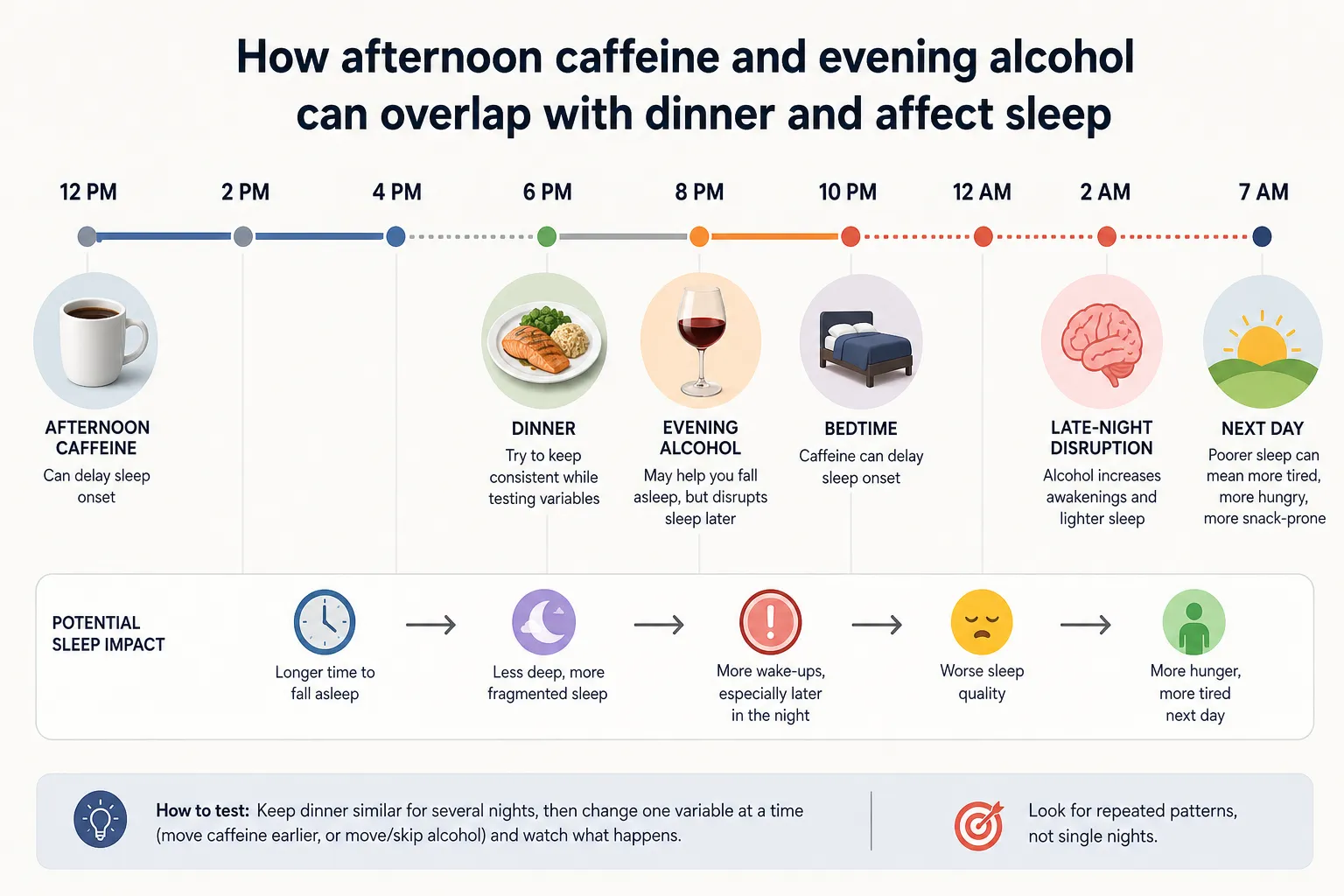
A late dinner is easy to blame, but it is not always the real reason sleep gets worse. Caffeine and alcohol often change sleep more than the clock on your plate, so they need to be tracked separately from meal timing.
Caffeine can delay sleep, shorten sleep, or make sleep feel lighter depending on dose, timing, and your personal sensitivity. Practical sleep guidance from Mayo Clinic and the American Academy of Sleep Medicine supports what many people notice in real life: even a coffee that feels “not that late” can still affect bedtime.
That is why a universal cutoff is less useful than your own pattern. If sleep latency gets worse on days you have a mid-afternoon coffee, even when dinner is early and fairly light, caffeine is the more likely lever to test first.
Alcohol can be just as misleading. It may make you feel sleepy at the start of the night, but it can also disrupt normal sleep architecture and increase awakenings later, which is why someone can fall asleep fast after wine and still wake up at 3 a.m. feeling restless or alert.
That later-night disruption matters the next day too. Poorer sleep can leave you more tired, more snack-prone, and hungrier than usual, which makes it easy to assume dinner timing caused the whole chain when alcohol timing may have started it.
A simple way to test this is to keep dinner similar for several nights, then change only one variable at a time:
- Move caffeine earlier in the day for a few nights and keep dinner timing about the same.
- Or keep the same dinner, but have alcohol farther from bedtime or skip it for a few nights.
- Watch what happens to sleep onset, overnight wake-ups, and next-day hunger.
Repeated patterns matter more than single nights. If your sleep improves when caffeine moves earlier, or when alcohol is farther from bedtime, you have a clearer answer than “late eating is bad for me.”
This is where context helps. Tools like Kibora’s tracking and pattern views can make it easier to see meal timing, caffeine, alcohol, sleep outlook, and next-day hunger together, so dinner does not get blamed unfairly for a problem driven by what you drank instead.
Next-day hunger is feedback, not a verdict
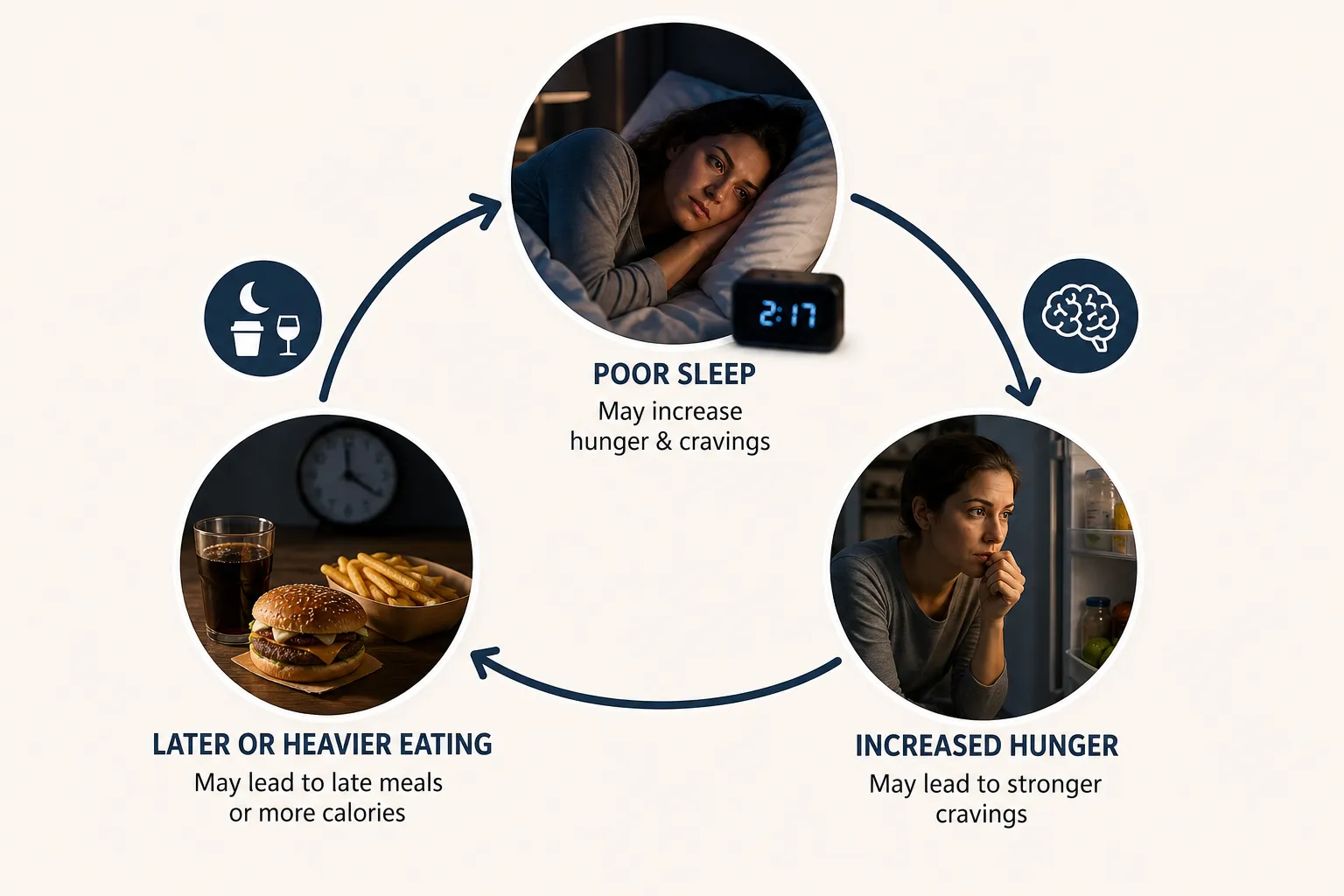
If you feel hungrier the day after a late meal, that does not automatically mean the meal timing was the problem. Short or broken sleep can raise hunger and cravings on its own, which makes late eating and next-day appetite easy to misread.
A simple way to think about it is this: meal timing may be the trigger, but sleep debt may be the amplifier. If dinner was late, but you also slept poorly, woke up a few times, or got less than 6 hours, the stronger signal may be the sleep loss rather than the clock time of the meal.
There is some biology behind this, but you do not need to memorize it. Poor sleep can shift appetite-related hormones like ghrelin and leptin and can also make high-reward foods feel harder to resist, which is one reason sleep deprivation is linked to changes in appetite and eating behavior according to the NHLBI.
That matters because people often blame the last meal they can remember. If you wake up unusually hungry, it is easy to assume dinner was too early, too small, or too late, when the better question is: how long did you actually sleep, and how rested do you feel?
Morning hunger is one of the easiest signals to misattribute. Intense hunger after a very early dinner might mean you genuinely need more food earlier in the day or a more solid breakfast, especially if sleep quality was good. In that case, a planned protein-rich breakfast may help more than pushing dinner later.
Afternoon cravings are even trickier. They can show up after poor sleep, under-eating at breakfast or lunch, stress, or a caffeine crash, so they are not clean proof that your eating window is wrong.
Evening overeating can follow the same pattern. If you slept badly, felt flat all day, and then got hit with strong evening hunger, that may reflect a long day of appetite disruption rather than a simple lack of willpower or one badly timed lunch.
The practical move is to compare hunger patterns against both sleep duration and sleep quality. Ask whether cravings are strongest after nights with fewer than 6 hours of sleep, whether morning hunger is worse after fragmented sleep, and whether evening overeating eases up when sleep improves even if your meal timing stays mostly the same.
That is how you avoid false conclusions. Before you decide that breakfast timing, late dinner, or fasting is the issue, check whether poor sleep is making the whole pattern noisier and harder to interpret.
Run a two-week timing test before you rewrite your routine
The useful move here is not guessing. It is running a short self-experiment so you can see whether meal timing and sleep are actually connected for you, and which timing choice matters most.
Start with 3 to 4 baseline days. Eat, drink caffeine or alcohol, and sleep the way you normally do without trying to be extra good. Your baseline only works if it reflects real life.
During those days, keep bedtime and wake time as consistent as you reasonably can. That matters because a stable sleep schedule makes it easier to tell whether a timing change helped, and the CDC includes consistent sleep and wake routines in its sleep guidance here.
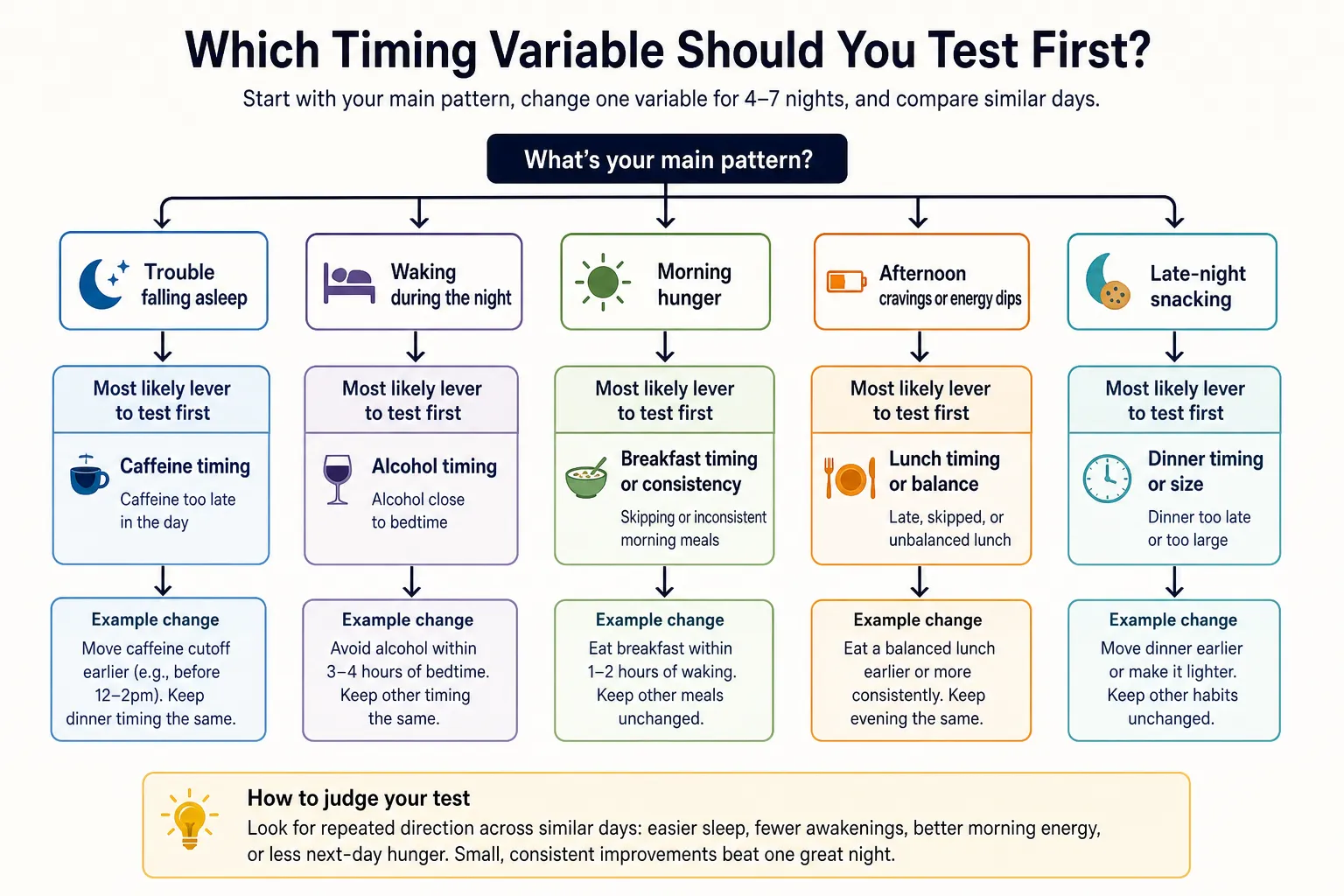
Then pick one likely suspect. Usually that means the pattern that shows up most often, like a late heavy dinner, caffeine too late in the day, alcohol close to bed, skipped breakfast, or late snacking.
Change only one variable for the next 4 to 7 nights. Keep the rest of your routine as similar as possible so you are not testing three things at once and calling it one result.
For example, you might move your caffeine cutoff earlier while leaving dinner timing alone. Or you might keep caffeine the same and shift dinner earlier or lighter. The point is to isolate the lever.
As you test, compare similar days with similar days. A weeknight after a normal workday is more useful against another normal workday than against a Saturday with drinks, less sleep, and a restaurant dinner.
Look for a small set of outcomes: how long it takes to fall asleep, whether you wake during the night, what time you wake up, your morning energy, and your next-day hunger. You do not need perfection. You are looking for repeated direction, not one unusually good or bad night.
Here are simple decision rules that keep the test practical:
- If sleep improves when caffeine moves earlier but dinner stays the same, caffeine timing was probably the better lever.
- If awakenings improve when alcohol is avoided near bedtime, do not blame dinner timing first.
- If next-day hunger settles down when breakfast or lunch becomes more consistent, the evening eating pattern may have started earlier in the day.
- If changing late eating does nothing across several similar nights, meal timing may not be the main issue right now.
After the test, keep the smallest change that improves sleep or hunger without creating stress. If moving dinner 30 to 60 minutes earlier helps, that may be enough. You do not need a rigid rule if a modest shift gives you a more repeatable pattern.
If nothing changes, that result is still useful. The real driver may be stress, total intake, an irregular sleep schedule, medication effects, reflux, or an underlying sleep issue rather than late eating and sleep alone.
If reflux, insomnia symptoms, or persistent sleep disruption keeps showing up even after a clean test, it is reasonable to get medical guidance. Self-tracking is good for finding patterns, but it is not a substitute for care when symptoms keep repeating.
This is where Kibora can lower the friction. Instead of trying to remember whether a rough night followed a late dinner, alcohol, or a long caffeine tail, you can review repeated patterns in one place and see whether your timing changes line up with a better sleep outlook, steadier energy, and less next-day hunger. If you want to compare options for tracking this kind of context, Kibora also has a guide to tools that capture meal timing alongside nutrition details.
The best meal-timing rule is the one your pattern can repeat
The useful answer is usually not a universal cutoff or one rough night. It is the pattern that shows up when you look at timing in context: when you ate, when you had caffeine or alcohol, how you slept, and how hungry or steady you felt the next day.
That is why meal timing can matter without becoming something to obsess over. A late dinner may be fine on some nights and a problem on others, especially if sleep was already short, caffeine ran late, alcohol was close to bed, or the meal was heavier than usual.
The most practical next step is simple: track for two weeks, then change one variable at a time. Before deciding you need a strict fasting window, test the smaller moves first, like moving caffeine earlier, reducing alcohol near bedtime, or shifting a heavy dinner earlier.
If one change helps, keep it. If it does not, move on and test the next variable instead of rewriting your whole routine around a single theory.
The goal is not perfect timing. The goal is better sleep, steadier hunger, and a routine you can actually live with.
Kibora can help make those repeated patterns easier to notice by showing meal timing alongside caffeine, alcohol, sleep, and next-day hunger. But the principle is the same either way: keep the smallest change that clearly helps, and let your own repeatable data guide the rule.
- Key sources
- National Institute of Diabetes and Digestive and Kidney Diseases (NIDDK) – circadian rhythms and health / eating patterns resources
- National Heart, Lung, and Blood Institute (NHLBI) – sleep deprivation and sleep health information
- CDC – sleep and sleep hygiene resources
- Mayo Clinic – caffeine and sleep / alcohol and sleep guidance
- American Academy of Sleep Medicine (AASM) – sleep and caffeine/alcohol guidance
- Review article on time-restricted eating and circadian biology (peer-reviewed; search in PubMed)
- Review/article on circadian misalignment, meal timing, and metabolic health (peer-reviewed; search in PubMed)


