- What you'll learn
- Why caffeine can still hurt sleep quality even if you fall asleep on time
- How caffeine half-life explains why afternoon coffee can still matter at bedtime
- Why an 8-hour cutoff is a cautious starting point, not a universal rule
- How dose, sensitivity, and metabolism change your personal caffeine cutoff time
- Which hidden caffeine sources can quietly push your total intake later in the day
- How to track caffeine timing alongside sleep to find your own pattern
That 2 or 3 p.m. coffee can feel harmless, then bedtime arrives and sleep is lighter, shorter, or just less refreshing. The real question in caffeine and sleep is not only whether coffee keeps you awake, but whether it quietly changes sleep quality.
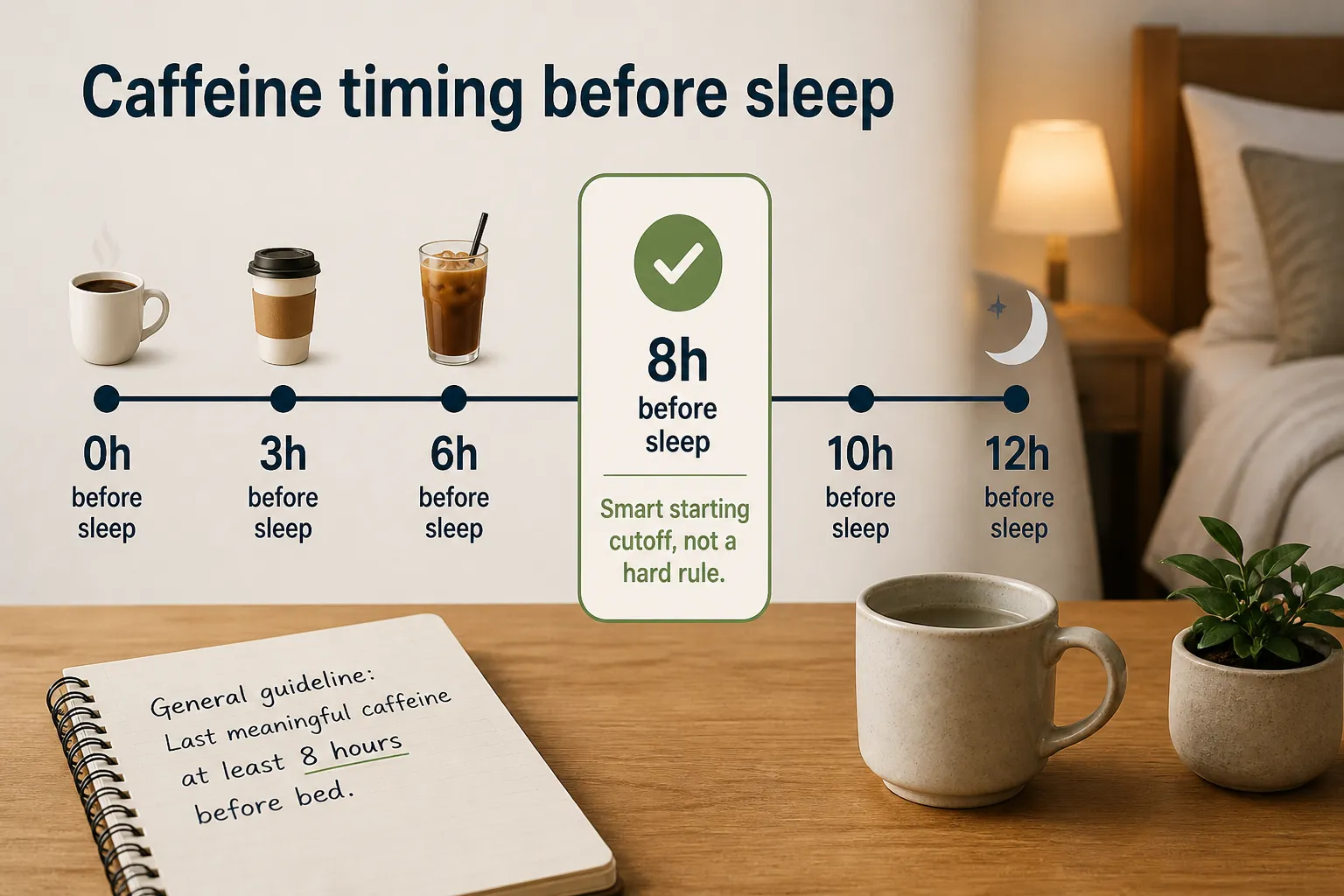
A practical starting point for many adults is to avoid caffeine about 8 hours before bed. If you sleep at 11 p.m., that means stopping around 3 p.m. But sensitive people may need 10 to 12 hours or more, which can push the safer cutoff back to late morning or lunch.
The reason there is no single perfect cutoff is that dose, caffeine half-life, individual sensitivity, and hidden caffeine sources all matter. Think of your caffeine cutoff as a starting hypothesis, not a fixed rule, and this article will show you how to find yours.
The safest answer is earlier than most people think
The strongest practical takeaway is not "never drink coffee after noon," but it is also not "3 p.m. is always fine." In a controlled study, 400 mg of caffeine taken 0, 3, or even 6 hours before bedtime significantly disrupted sleep, which means late-day caffeine can matter more than many people assume.
Caffeine taken 6 hours before bedtime significantly disrupted sleep.
That 6-hour finding is why an 8-hour cutoff is a sensible starting point for many people. It adds a buffer beyond the study result without turning one number into a universal rule.
If you want one practical guideline, make your last meaningful caffeine at least 8 hours before bed, then move it earlier if your sleep is still light, short, or restless. For someone who goes to sleep at 10:30 p.m., that cautious cutoff would be about 2:30 p.m.
Some people will need more room than that. If you are highly sensitive to caffeine, tend to sleep lightly, or already deal with insomnia symptoms, your better cutoff may be 10 to 12 hours before bed.
Dose matters too. A large coffee or energy drink late in the afternoon may be much more relevant to sleep than a smaller morning coffee, because timing and amount both shape how much caffeine is still active at bedtime.
You probably do not need to quit coffee. But if sleep has been off, moving caffeine earlier is one of the simplest changes to test. If you also want broader bedtime drink guidance, see our guide to foods and drinks to avoid before bed.
Why caffeine can hurt sleep even when you fall asleep
The common test people use is simple: “I had coffee and I still fell asleep, so it didn’t affect me.” That test misses a big part of the story. The real question is not just whether caffeine kept you awake, but whether it made your sleep shorter, lighter, or less efficient.
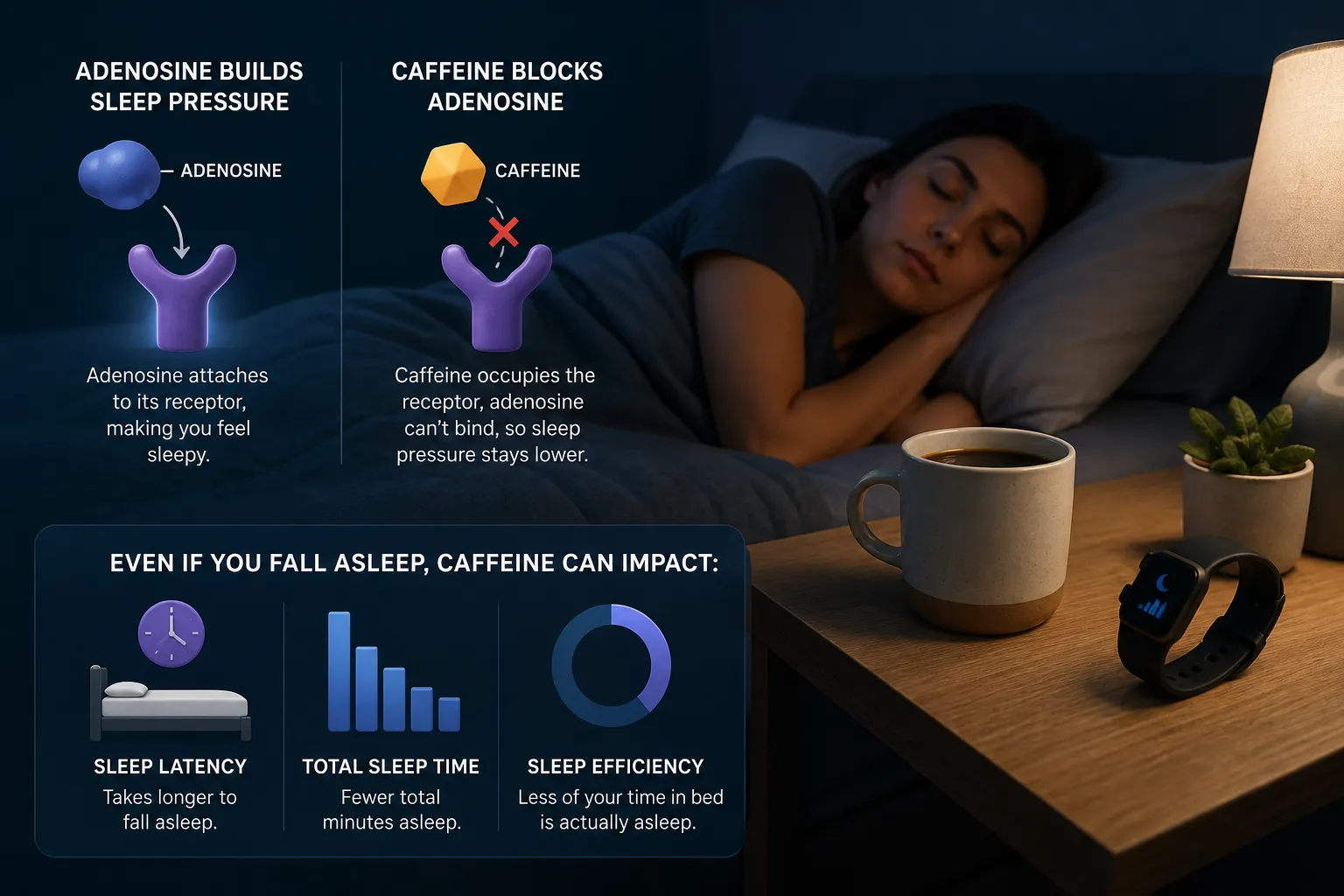
Caffeine works in part by blocking adenosine, a chemical signal that helps build sleep pressure through the day. In plain terms, adenosine is one reason your brain starts to feel ready for sleep, and caffeine can make that signal feel quieter for a while, which is why it promotes alertness and can interfere with sleep according to NIH MedlinePlus.
That matters because sleep quality is more than sleep onset. You might drift off at your usual time, but still have changes in sleep latency, total sleep time, or sleep efficiency. Sleep latency means how long it takes to fall asleep, while sleep efficiency means how much of your time in bed is actually spent asleep.
In sleep research, caffeine is more consistently linked with taking longer to fall asleep, sleeping fewer total minutes, and less efficient sleep than with any single change in sleep stages. Reviews of the evidence also suggest possible effects on sleep architecture, including deep sleep and REM, but those findings are less uniform and can vary by study, timing, and person in the broader sleep literature.
That is why “I can still sleep after coffee” can be misleading. Someone might have an afternoon coffee, fall asleep at their normal time, but wake up more often, spend more time lightly asleep, or feel less restored the next morning.
If you use a wearable or a simple sleep log, this is often where the pattern shows up. Not necessarily as obvious insomnia, but as a worse night overall: a little more time awake, a little less total sleep, or a lower sleep efficiency score.
So the useful question is broader than “Did coffee before bed keep me up?” It is also whether caffeine and sleep are colliding in quieter ways that you only notice the next day. That is what makes timing so important, even for people who believe caffeine does not affect them.
Half-life explains why afternoon coffee can become bedtime caffeine
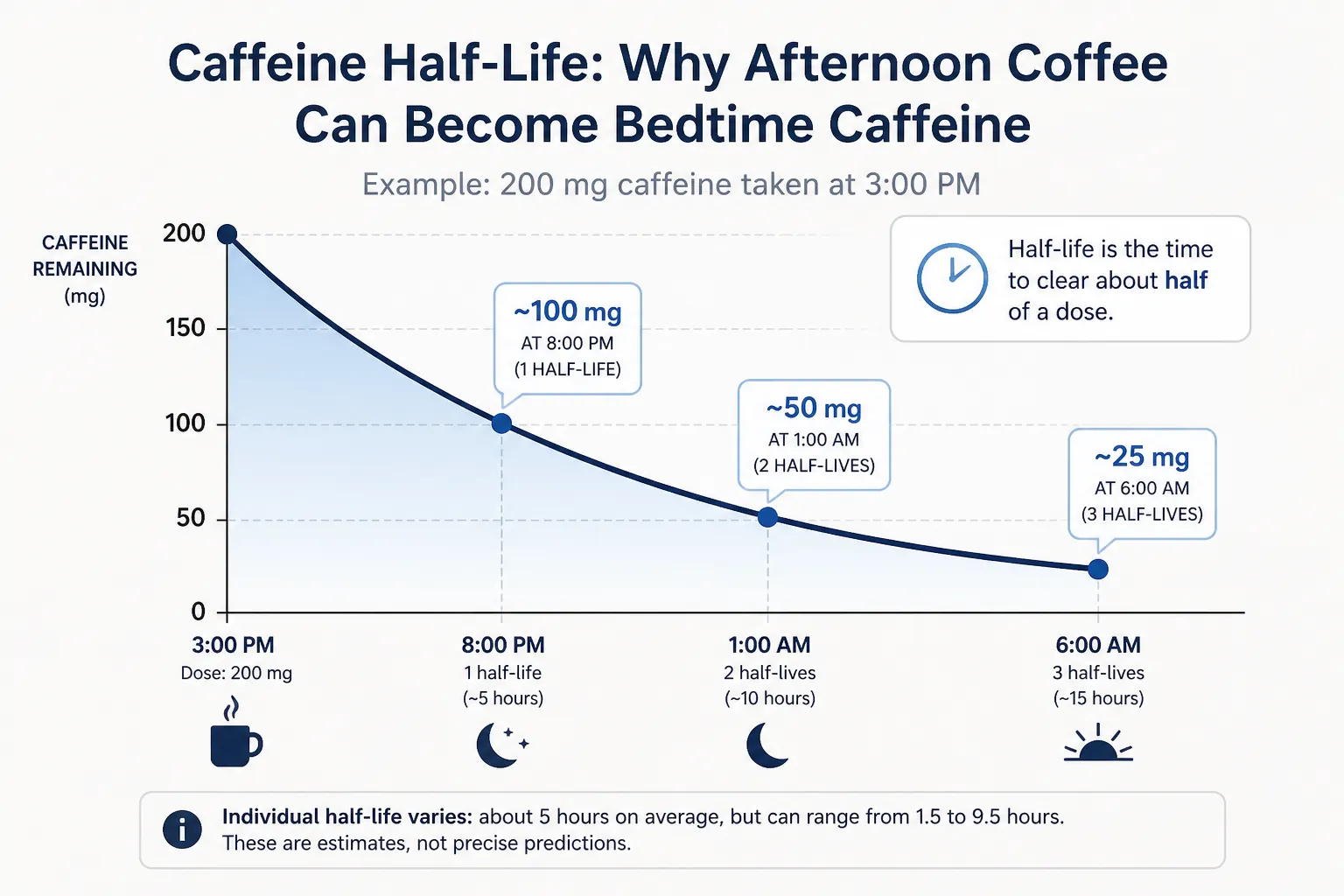
Caffeine half-life sounds technical, but the idea is simple: it is the time your body needs to clear about half of the caffeine you took in, not the time until caffeine is fully gone. According to NIH MedlinePlus, caffeine’s half-life is often around 5 hours, though it can vary widely from person to person.
The half-life of caffeine is about 5 hours, but it can vary from 1.5 to 9.5 hours.
That one fact makes lingering effects easier to picture. If you drink 200 mg of caffeine at 3 p.m. and your half-life is about 5 hours, you might still have about 100 mg in your system at 8 p.m. and about 50 mg around 1 a.m. These are rough estimates, not precise predictions, but they show why an afternoon coffee can still matter at bedtime.
Caffeine half-life does not tell you when caffeine is gone. It tells you why a dose from the afternoon can still be biologically relevant when you are trying to sleep.
Dose matters just as much as timing. Half of a large dose can still be a meaningful amount, and even 25% of a big energy drink or strong coffee may be enough to affect a sensitive sleeper. After two half-lives, you are not at zero. You are at roughly a quarter of the original dose.
So if coffee before bed sounds obviously risky, the less obvious problem is coffee hours earlier that still has some punch left. That is why your caffeine cutoff is not only about the clock. It is also about how much caffeine you had to begin with.
Your cutoff depends on your body, not just the clock
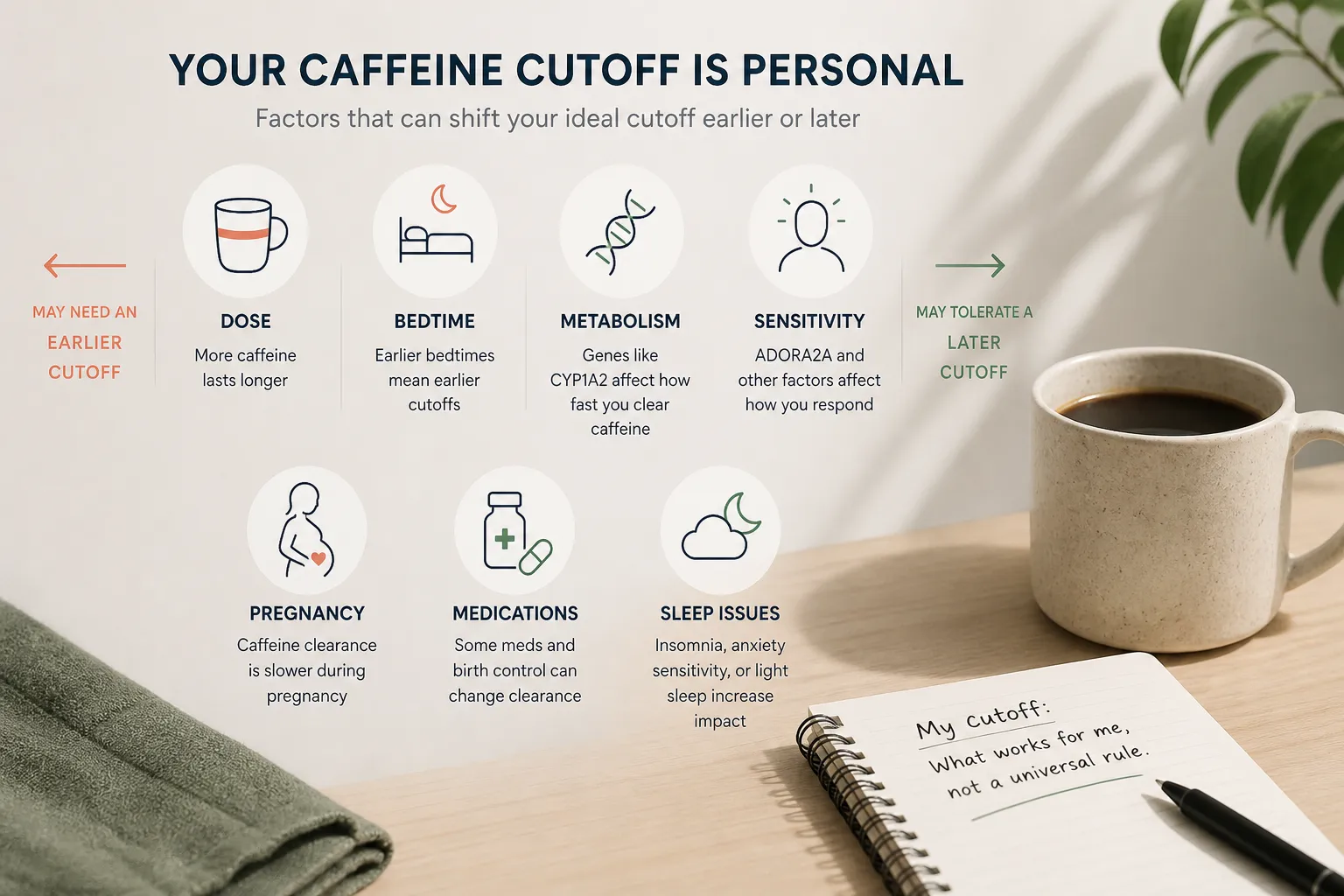
Two people can drink the same coffee at the same time and sleep very differently. One may do fine with a lunchtime cup, while another notices longer sleep latency, lighter sleep, or more wakeups from that same dose before noon.
A big reason is caffeine metabolism. People clear caffeine at different speeds, and research suggests genes including CYP1A2 and ADORA2A help explain some of that variation. CYP1A2 is involved in how quickly caffeine is broken down, while ADORA2A is more closely linked to sensitivity, including anxiety-like effects in some people.
That does not mean you need genetic testing to set a caffeine cutoff time. It just means one-size-fits-all advice often misses the real issue: your response may not match someone else’s, even if your habits look similar.
Life stage and health can matter too. Age, pregnancy, liver disease, smoking status, oral contraceptives, and some medications can all change caffeine clearance, which means caffeine may last longer or wear off faster depending on the person.
Tolerance adds another layer. Regular caffeine users often feel less wired after coffee, but feeling tolerant is not the same as being sleep-proof; your brain may feel normal while your sleep still changes.
That is why a late coffee can be misleading. A regular coffee drinker may not feel stimulated at night, yet still end up with shorter total sleep time or more nighttime waking.
If you have insomnia symptoms, anxiety sensitivity, or very light sleep, a more conservative cutoff is usually smarter. The practical takeaway is to base your caffeine and sleep decisions on your own patterns, not on a universal rule or on whether you “feel fine” after drinking it.
Coffee is not the only caffeine that counts
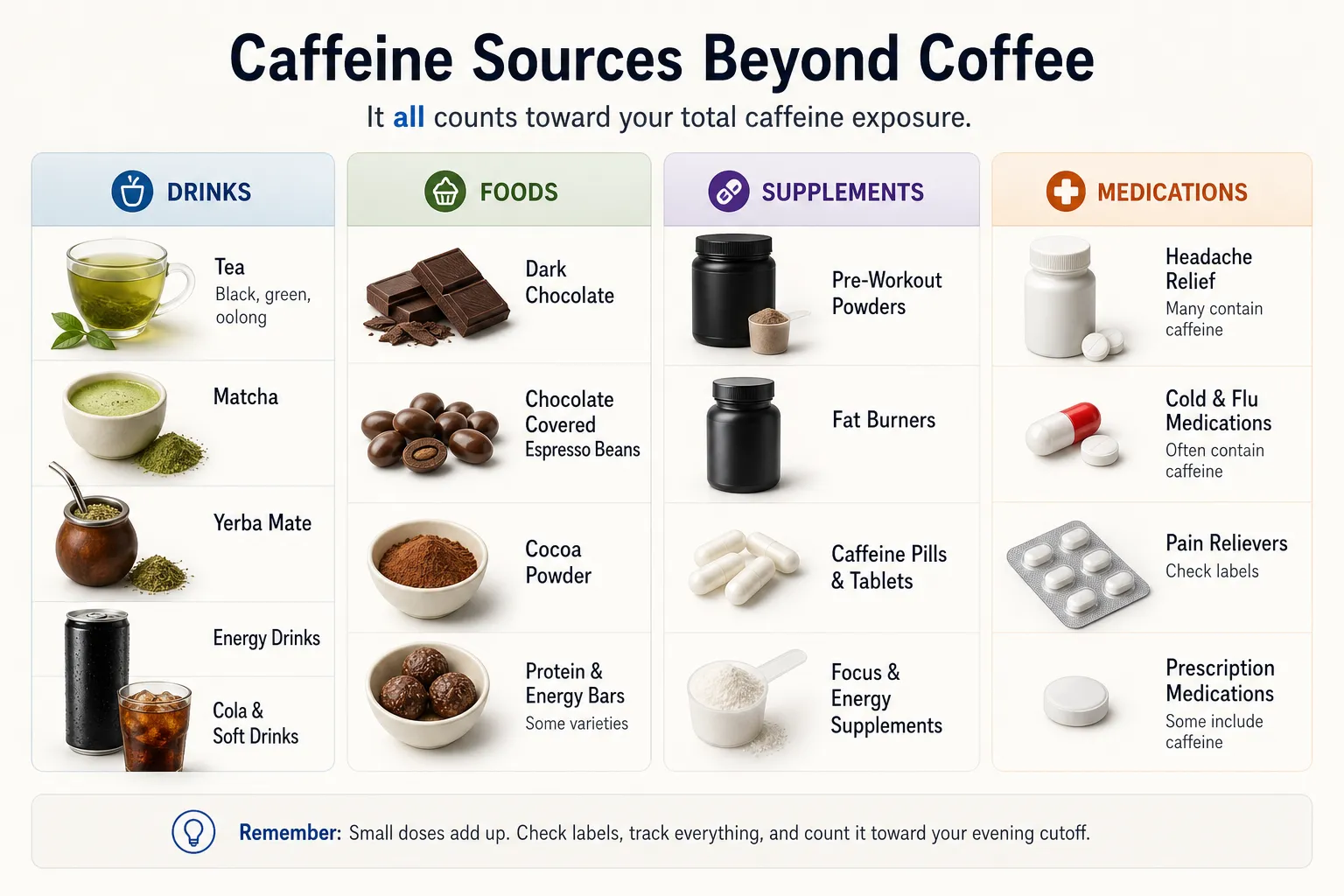
A caffeine cutoff only helps if you count all caffeine sources, not just coffee. Your sleep responds to total caffeine exposure, not to whether the caffeine came in a coffee cup.
That matters because late-day caffeine often arrives in smaller, easier-to-miss doses. Tea, matcha, yerba mate, energy drinks, cola, chocolate, pre-workout powders, fat burners, caffeine pills, and even some headache or cold medications can all add to the same bedtime caffeine load, as the FDA notes.
Here is a practical way to think about it:
- Brewed coffee, espresso drinks: obvious sources, but serving sizes vary a lot
- Tea, matcha, yerba mate: often perceived as gentler, but still count toward evening exposure
- Energy drinks and cola: easy to drink late and often used for an afternoon boost
- Chocolate: smaller amounts, but dark chocolate can still stack with other sources
- Pre-workout, fat burners, caffeine pills: can be surprisingly concentrated
- Some medications: labels may list caffeine, but many people do not think to check
- Decaf coffee: much lower than regular coffee, but not always zero
The stacking effect is where people get tripped up. An afternoon latte, a piece of dark chocolate after dinner, and an early-evening pre-workout can create more bedtime exposure than you realize.
Labeling also is not perfectly consistent across products, especially supplements and café drinks. If your cutoff is not working, audit the “small” sources first and log them alongside meals and sleep context, similar to how you might track late eating and sleep timing.
How to find your personal caffeine cutoff
The simplest way to answer how late is too late for coffee is to run a short experiment on yourself. Start with your usual bedtime, count back 8 hours, and use that as your first caffeine cutoff for the next 10 to 14 days.
This is a cautious starting point, not a universal rule. The best caffeine cutoff is not the latest coffee you can fall asleep after; it is the latest caffeine that still lets you sleep well and wake restored.
A 10- to 14-day tracking plan
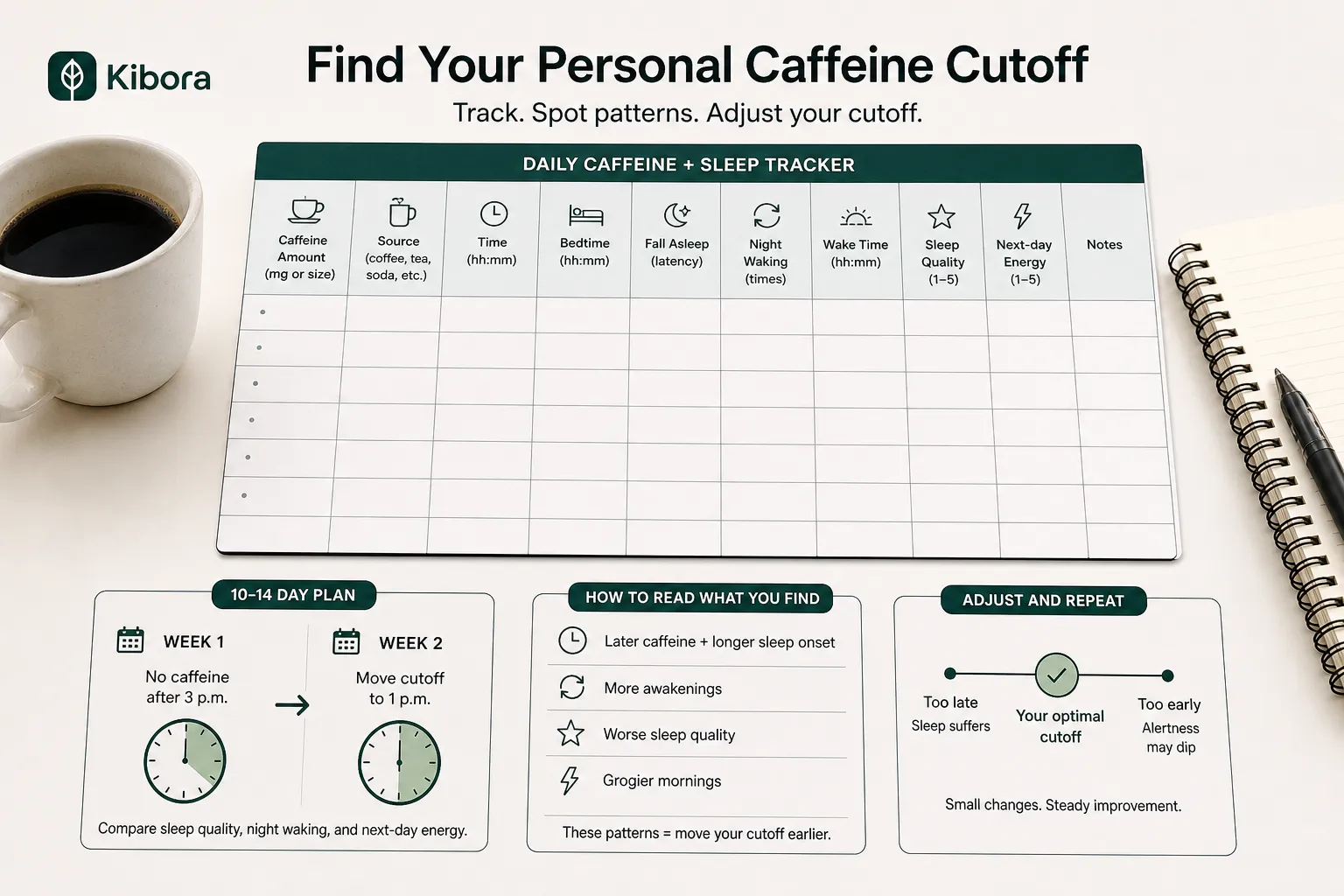
Keep the experiment simple enough that you will actually finish it. Log the same few details each day so you can compare patterns instead of guessing.
- Caffeine amount, or best estimate in mg or drink size
- Caffeine source, such as coffee, tea, soda, pre-workout, or chocolate
- Time you had it
- Bedtime
- How long it seemed to take you to fall asleep
- Night waking or how often you woke up
- Wake time
- Overall sleep quality
- Next-day energy
If you want a clean structure, try this: Week 1, no caffeine after 3 p.m. If sleep is still poor, Week 2, move the cutoff to 1 p.m. and compare your sleep quality, nighttime waking, and next-day alertness.
Do not change five things at once. If sleep is off, first move caffeine earlier by 1 to 2 hours or trim the afternoon dose before overhauling your full routine.
How to read what you find
Look for repeatable patterns, not one dramatic night. If your bedtime stays the same but later caffeine lines up with longer sleep onset, more awakenings, worse sleep quality, or groggier mornings, that is useful evidence that your cutoff needs to be earlier.
If sleep seems stable, test carefully rather than assuming late caffeine is safe forever. Stress, meal timing, dose, and hidden caffeine sources can all change the result from one week to the next, which is why keeping timing context together can help. If a simple tracker like Kibora helps you log caffeine timing alongside meals and sleep notes in one place, that can make patterns easier to see. You can also explore related timing patterns in meal timing, sleep, and hunger.
Consumer sleep trackers can be useful for spotting trends, but they are not medical devices, and sleep-stage estimates are not perfectly accurate. That cautious approach matches general sleep-health guidance from the American Academy of Sleep Medicine, which is a good reminder to use trackers for pattern finding, not diagnosis.
Let your sleep set the final rule
The practical answer is simple: caffeine can affect sleep long before bedtime, and caffeine half-life helps explain why. But the cutoff that works for you depends on timing, dose, and personal sensitivity, so copying someone else’s rule is rarely the best move.
A useful starting point is an 8-hour cutoff. If your bedtime is 11 p.m., make your last caffeine no later than 3 p.m. If sleep quality still does not improve, move it earlier to 1 p.m. or even noon, and count all sources, not just coffee.
This matters because falling asleep after caffeine does not prove your sleep was unaffected. Afternoon caffeine can still change sleep quality even when sleep feels “normal” the next morning.
Coffee does not have to be the enemy of sleep; poorly timed caffeine is the real problem. If you want a practical way to spot patterns, it can help to track sleep and nutrition together and see whether moving caffeine earlier changes the night that follows.
The goal is not to fear coffee. It is to place it where it supports your day without stealing from your night.
- Key sources
- Drake C, Roehrs T, Shambroom J, Roth T. Caffeine effects on sleep taken 0, 3, or 6 hours before going to bed.
- NIH MedlinePlus: Caffeine in the diet
- U.S. FDA: Spilling the Beans: How Much Caffeine is Too Much?
- Liu J, et al. Effects of caffeine on sleep quality and architecture: a systematic review / review literature on caffeine and sleep
- CYP1A2 and caffeine metabolism studies; ADORA2A sensitivity studies
- American Academy of Sleep Medicine or sleep medicine educational resources on caffeine and sleep