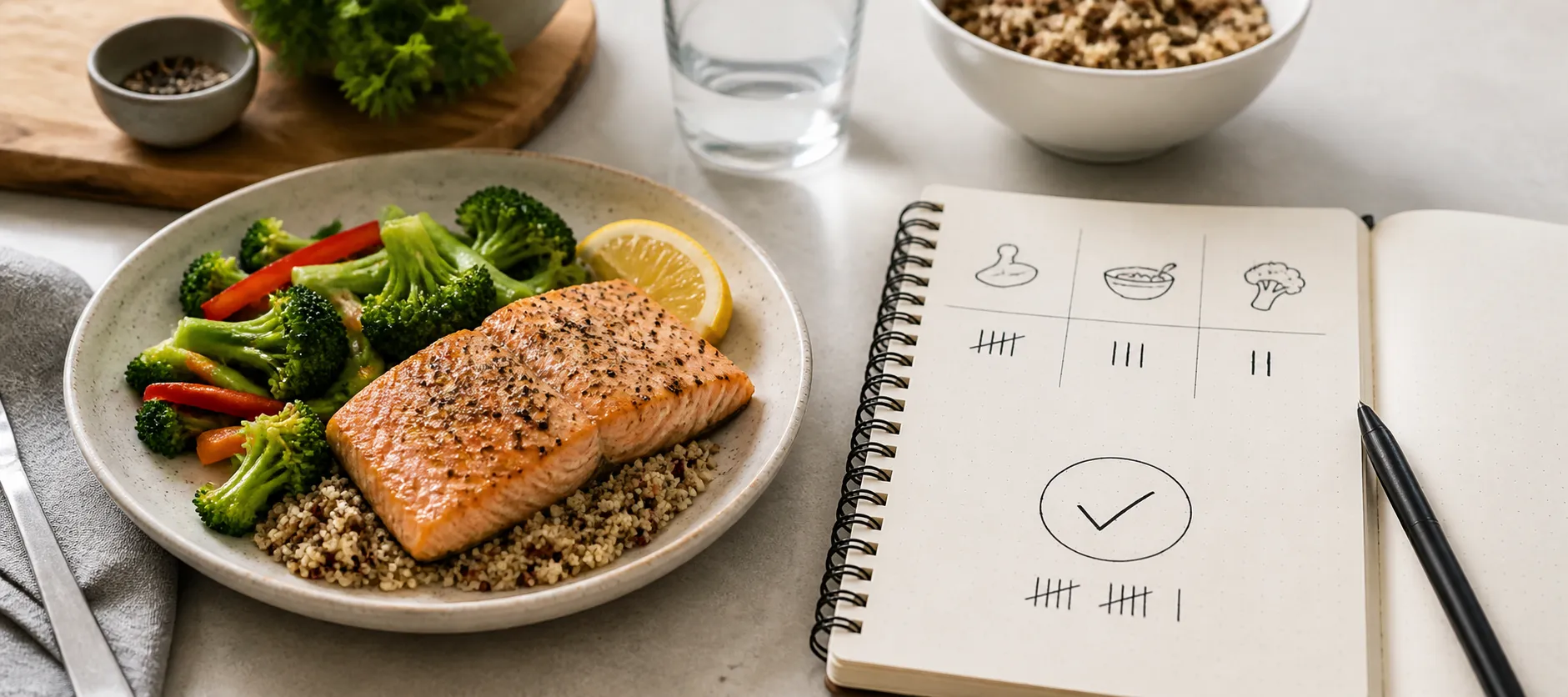
To track protein intake, choose a suitable goal, record food amounts and protein grams, and check your running total. Use a notebook, notes app, or food logger with this format: food | amount eaten | protein grams.
You can record a selected dietary component without setting targets for every macro. An app may calculate other nutrients even if protein is all you monitor.
The aim is a useful estimate that helps you decide what to eat, not a perfect dashboard. Below, you’ll find practical examples for labels and shared dishes, not a bodybuilding-style macro plan.
Choose a protein goal that fits your situation
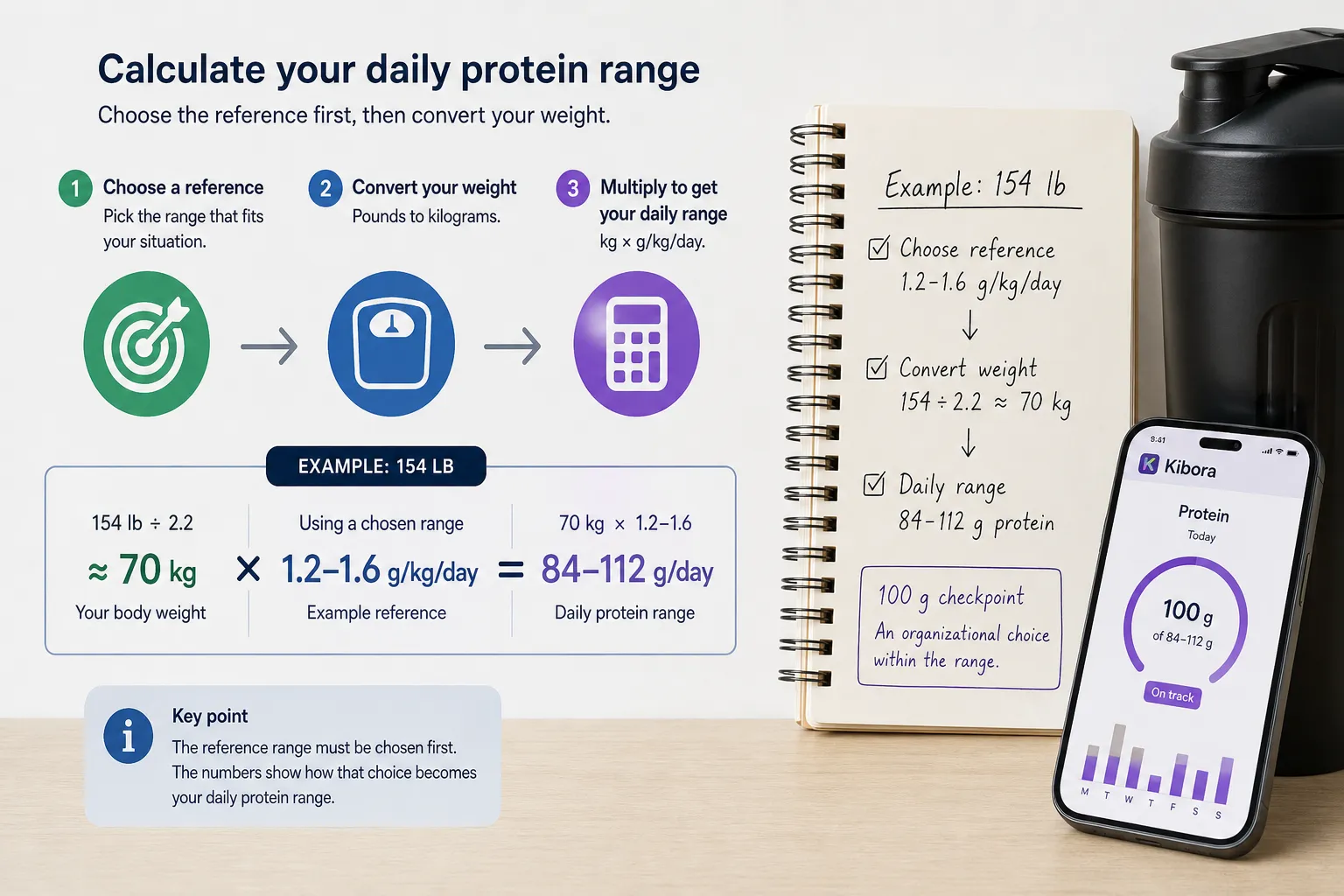
Use your clinician-set target if you have one. Otherwise, choose a reference that fits your health, activity, and purpose before multiplying by body weight. An RDA, an athletic range, and a clinical target answer different questions.
The established adult RDA is 0.8 grams per kilogram of body weight per day. An RDA is designed to cover nearly all healthy people’s requirements, not to define an athletic optimum or a maximum.
The 2025–2030 US dietary guidance gives a higher target of 1.2–1.6 g/kg/day. That is a separate framework, not a change to the RDA, and a universal higher-protein recommendation remains debated.
| Situation | Reference range | Important qualification |
|---|
| Maintenance/general health | Federal target: 1.2–1.6 g/kg/day | Distinct from the 0.8 g/kg/day RDA; not a universal individual prescription. |
| Intentional fat loss | Proposed range: 1.2–1.6 g/kg/day | Individualize the weight used in the calculation. |
| Casual muscle gain with resistance training | Athletic reference: 1.2–2.0 g/kg/day | Training-dependent; the upper end is not an automatic goal. |
The fat-loss range is discussed in a multisociety advisory on nutrition during GLP-1 therapy, which cautions that using actual body weight can overestimate requirements in obesity. The best weight basis remains unsettled, so do not automatically multiply your current weight by the highest factor.
For resistance training, NIH’s athletic range depends on training and energy intake. Casual lifters do not automatically need 2.0 g/kg/day; our guide to protein for building muscle explores that branch further. Protein tracking alone establishes neither a calorie deficit nor enough exercise fuel, and protein does not replace training.
Convert your weight after choosing the reference
For someone who weighs 154 lb, the calculation is 154 ÷ 2.2 ≈ 70 kg. If an appropriate, already-selected range is 1.2–1.6 g/kg/day, that gives 84–112 g of protein per day.
A 100 g checkpoint could make logging simpler in this example. It is an organizational choice within that range, not a biologically exact requirement or a recommendation for everyone.
Older adults and special circumstances need a separate check. Older-adult guidance distinguishes healthy aging from illness-related malnutrition risk. Pregnancy, breastfeeding, age under 18, kidney disease, and prescribed diets call for an age- or care-specific target rather than an adult fitness calculation; dialysis can increase protein needs, so kidney-related advice is not interchangeable.
Calculate protein for the portion you actually eat
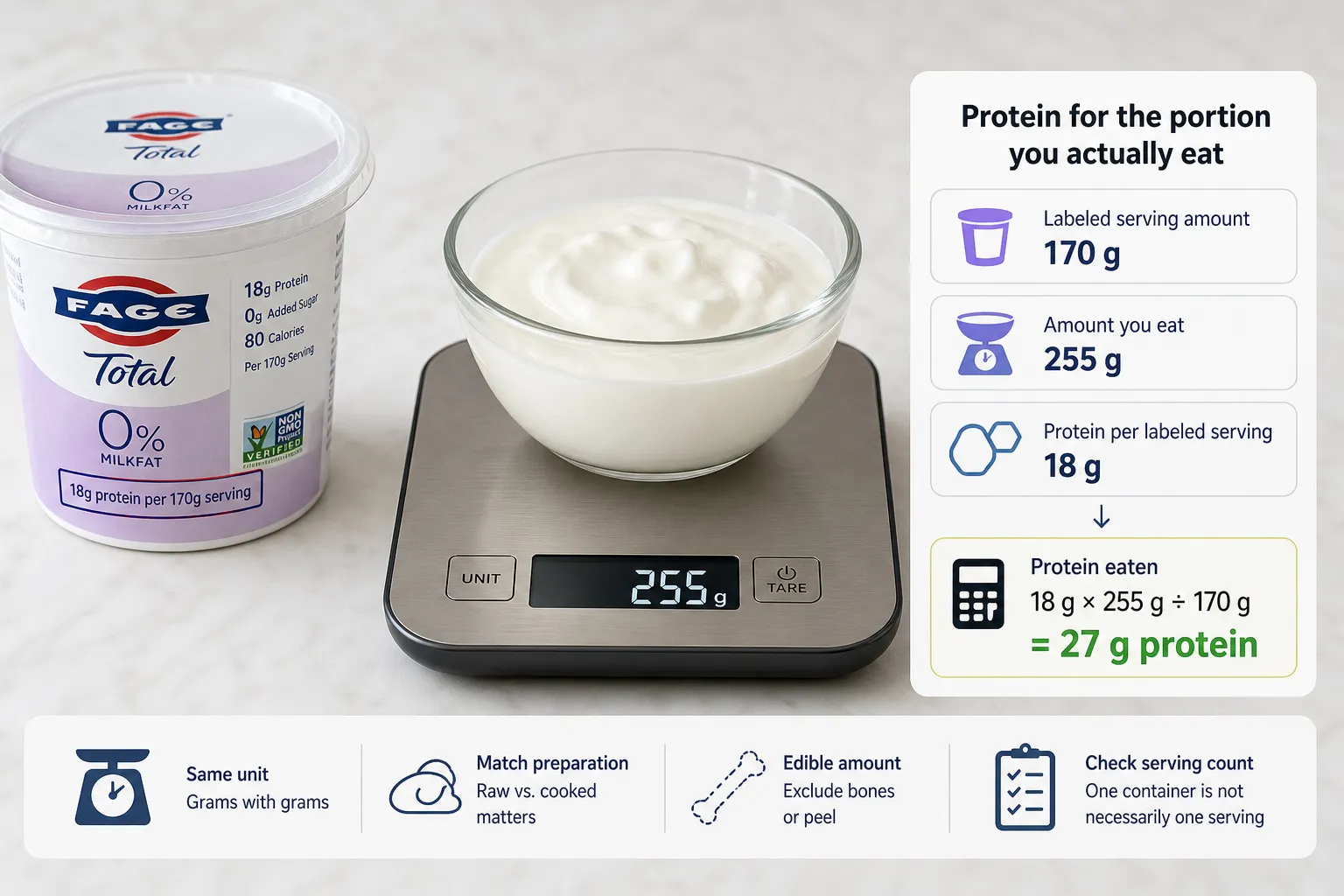
Protein eaten = protein per serving × amount eaten ÷ labeled serving amount. Use the protein grams on the label, not the percent Daily Value, and keep the amount eaten and serving amount in the same unit.
For example, FAGE Total 0% lists 18 g protein per 170 g serving. If you eat 255 g, that is 255 ÷ 170 = 1.5 servings, so you would log 18 × 1.5 = 27 g protein. Check your own package first, since labels and formulations can change.
Grams of food are not grams of protein. In this example, 170 g is the yogurt’s total weight; 18 g is the protein within it. Multiply the label’s protein by the fraction or number of servings you actually eat.
Also check servings per container: one package is not necessarily one serving. The FDA explains that Nutrition Facts values normally refer to one serving, and clarifies:
The serving size is not a recommendation of how much to eat or drink.
For unlabeled foods, match the entry to your portion
Use a food database such as USDA FoodData Central to find a suitable estimate. Its entries include both analytical food data and manufacturer-label information, so choosing the right match matters more than picking the first result.
Before logging, check these details:
- Food identity: match the food and cut or variety, plus the brand when relevant.
- Preparation state: choose raw, cooked, drained, or another state that matches what you measured.
- Edible amount: count the portion you eat, excluding discarded bones or peel.
- Matching unit: use grams with grams, ounces with ounces, or the entry’s specified portion.
For example, a chicken breast lookup should match both its preparation state and your portion unit. Do not pair a raw weight with a cooked-food entry: cooking changes meat’s weight through moisture and fat changes, as documented in USDA cooking-yield tables.
If a total looks surprising, check serving count, units, and raw-versus-cooked state before changing anything else. Measuring a familiar portion once can help you establish a reusable estimate; you do not need to weigh every meal indefinitely when the food and portion stay unchanged.
Count smaller contributors too: grains, legumes, soy foods, dairy, nuts, seeds, and snacks can all add protein. Logging only your main protein foods is a shortcut, not a complete daily total.
For mixed meals, calculate the batch and then your share
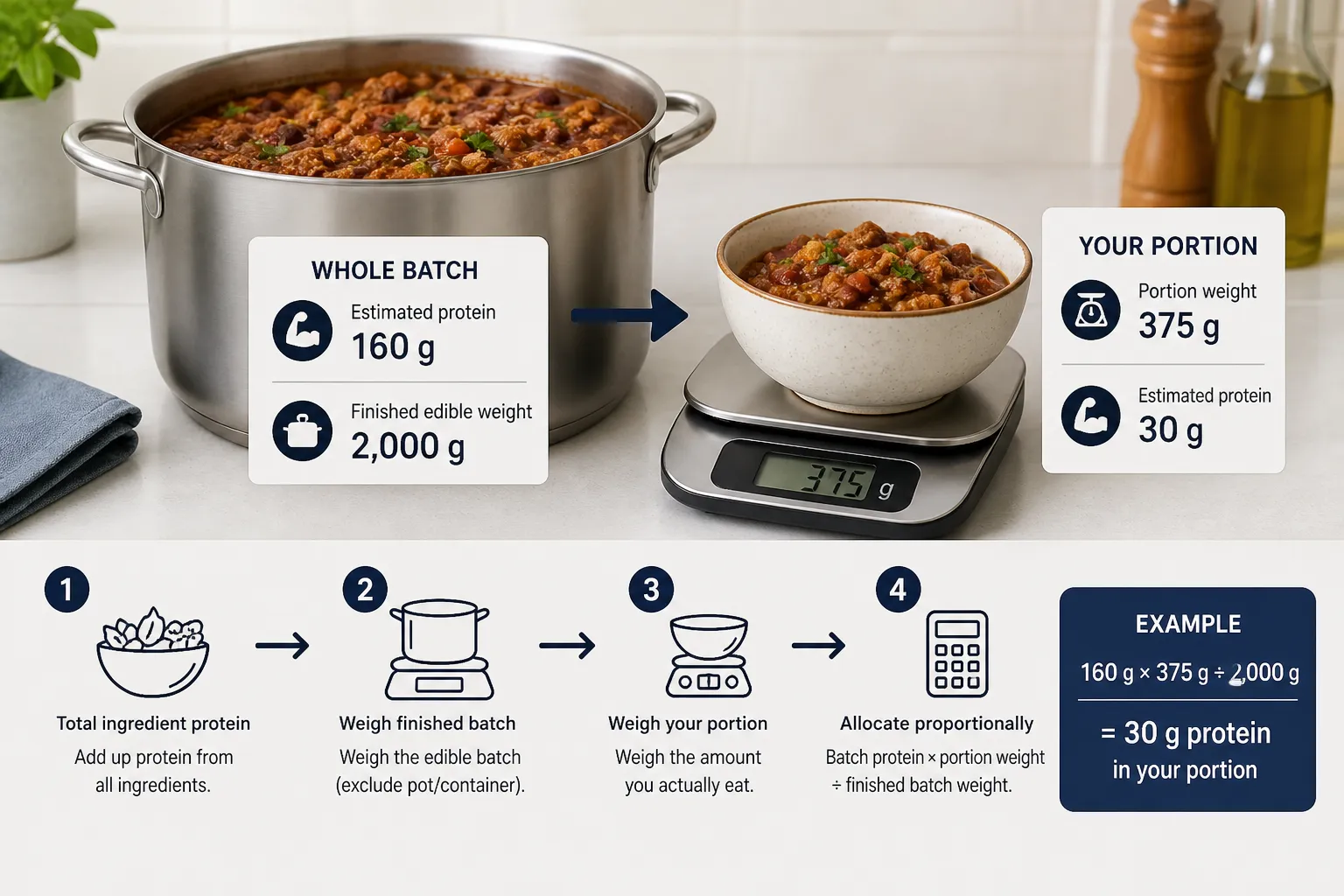
For a shared dish, calculate protein for the whole edible batch first, then assign the fraction you actually eat. This gives you a reusable estimate for casseroles, soups, curries, and other homemade meals without treating every bowl as an identical serving.
The FAO’s recipe-calculation guidance supports estimating nutrients from ingredients and using the finished cooked yield to allocate portions. The result is still an estimate: cooking, discarded ingredients, and uneven distribution can affect what ends up on your plate.
Use this sequence whenever you make a batch:
- Total the ingredient protein. Calculate each ingredient’s contribution for the amount used, including grains, vegetables, dairy, and other ingredients, not just the main protein food.
- Weigh the finished edible batch. Exclude the pot or storage container by subtracting its empty weight.
- Weigh your portion. If weighing is impractical, estimate your share, recognizing that this adds uncertainty.
- Allocate the batch protein proportionally. Multiply total protein by your portion weight, then divide by the finished batch weight.
A worked example with hypothetical numbers
Suppose four ingredients contribute 80 + 40 + 24 + 16 = 160 g protein, and the finished edible dish weighs 2,000 g. These are hypothetical inputs to demonstrate the calculation, not verified values for a particular recipe.
If you eat 375 g of that dish:
Portion protein = 160 × 375 ÷ 2,000 = 30 g.
Dividing the same batch into four genuinely equal portions would give 40 g protein per portion. But the 375 g serving is not automatically one quarter: a quarter of this batch would weigh 500 g.
Weight allocation works best when the mixture is reasonably uniform. A bowl with disproportionately more meat or beans may contain more protein than its weight-based share, while straining or discarding components can also change the estimate.
Leftovers can use the same protein-to-weight ratio while the recipe and mixture still match. Save the batch total and finished weight so you only need to weigh the next portion, rather than calculate every ingredient again.
For restaurant meals, use matching official nutrition when available, checking the dish, size, and customizations. Otherwise, choose a plausible matching dish and mark the entry as an estimate; a photo or unfamiliar recipe cannot establish an exact protein amount.
Keep a running total in notes or a food logger
A notebook or phone note is enough: record food, amount eaten, and protein grams, then add each entry to your running total. Include protein from plant foods, grains, dairy, and snacks, not just the main protein food.
The two worked examples would look like this, using the FAGE label for the yogurt:
| Entry | Amount | Protein |
|---|
| FAGE yogurt | 255 g | 27 g |
| Hypothetical mixed dish | 375 g | 30 g |
| Subtotal | Not applicable | 57 g |
For the example reader’s already-selected 100 g checkpoint, 100 − 57 = 43 g remains. That helps plan later meals, but it is arithmetic for this demonstration, not a universal target, a complete diet, or an instruction for everyone to eat another 43 g.
If you prefer a logger, Kibora offers photo, voice, text, barcode, and manual nutrition entry in its documented workflow. Choose an input method, enter the meal and amount, then review the estimate before saving.
Check food identity, brand, protein-containing ingredients, quantities, and mixed-dish assumptions. Correct portion or nutrition errors, then save; treat photo results as estimates rather than measurements.
Other nutrients may still appear even if protein is your only monitored target; public documentation does not establish a protein-only display. Missing foods make the protein tally incomplete and also leave calorie and other nutrient totals incomplete.
Reuse your usual meals without reusing old mistakes
Save a few breakfasts, lunches, or batch recipes you already eat, whether in notes, a spreadsheet, or a food logger. A saved meal is a shortcut, not a fresh measurement: check the food and portion before reusing its protein total.
Before copying an entry, make four quick checks:
- Same brand: the saved 255 g yogurt entry provides 27 g protein only for the matching FAGE Total 0% label, which lists 18 g per 170 g. Your packaging takes precedence.
- Same recipe: revise the batch total and portion calculation if ingredient quantities or finished yield change.
- Same preparation state: keep raw and cooked entries distinct.
- Same amount: edit the quantity when you eat a different serving.
Optionally, Kibora’s favorites and past-meal reuse can reduce repeat entry, with editable amounts. You still check what changed. If a saved entry is wrong, correct it before copying it again.
Review the pattern, then fix one recurring gap
Review several complete, representative days rather than reacting to one total. A weekly check is optional, not a prescribed protocol, and its average does not prove that very low and very high days are interchangeable.
Before fixing a low protein total, check whether it reflects a real food pattern or an incomplete record. Work through these questions:
- Missing food, including snacks, drinks, or side dishes?
- Wrong serving amount?
- Raw weight paired with a cooked-food entry, or vice versa?
- A genuine gap that repeats after those corrections?
A small numerical miss is not a meaningful failure. Food composition, label precision, portion estimates, and omissions prevent gram-level certainty; food-record validation studies also document underreporting.
If breakfast repeatedly contributes little protein, make one practical adjustment rather than redesigning every meal. Success means useful records, fewer repeated calculations, and a clearer next-meal decision. For tomorrow, record your usual foods, verify one recurring portion, and use the result to choose one meal adjustment.
Protein totals do not establish overall diet quality, an energy deficit, or enough carbohydrate to fuel training.
Stop numerical tracking and seek individualized support if it encourages anxiety, restriction, compulsive checking, or compensatory behavior. Research finds associations between tracking-app use and disordered eating, not proof that tracking causes it. A log should make food decisions easier, not more distressing.
- Key sources
- USDA/HHS — Eat Real Food
- NIH ODS — Dietary Supplements for Exercise and Athletic Performance
- Mozaffarian et al. — Nutritional Priorities to Support GLP-1 Therapy
- FDA — Serving Size on the Nutrition Facts Label
- FAGE USA — Total 0%
- USDA FoodData Central — Data Documentation
- FAO — Food Composition Data
- NCI — Food Record at a Glance