- What you'll learn
- Why macro percentages are only guardrails, not a rule you have to hit exactly
- How to set calories first so your protein, carbs, and fats have a clear job
- Why protein works best as a daily anchor, not just a percentage target
- How to keep fat adequate while letting carbs flex around training and preference
- Why fiber matters for fullness and meal quality, especially during fat loss
- How to build simple meals and adjust your macro balance based on real results
You see exact macro splits everywhere and start to assume balance means hitting perfect numbers. For most people, it does not. The real problem is that macro advice often makes eating feel more complicated than it needs to be.
You are not failing because you have not found the ideal 40/30/30 split. In practice, macros matter because they shape hunger, energy, training, food quality, and whether your plan is realistic enough to follow.
This article uses a simpler order of decisions: calories first, then protein, a fat minimum, enough fiber, and flexible carbs around real meals. That is how to balance macros without turning every plate into a math test.
Macro balance starts with priorities, not percentages
A macro split is a tool, not a rule. If you want how to balance macros to feel simpler, start with a clear order instead of chasing a perfect protein carbs fat ratio.
Official macro ranges are broad for a reason: balance is a range, not a bullseye.
The simplest macro hierarchy is calories, protein, fat minimum, flexible carbs, then fiber and food quality. After that, you adjust based on results, hunger, training, and what meals you can actually stick with.
That flexible approach fits the official Acceptable Macronutrient Distribution Ranges for the general population: carbs at 45% to 65% of calories, fat at 20% to 35%, and protein at 10% to 35%. Those ranges are wide on purpose, which means healthy macro balance does not require percentage perfection.
That also explains why rigid templates like 40/30/30 can work for some people without being a universal best split. A template can give structure, but it is not automatically superior to other setups that meet energy needs, protein, adequate fat, and fiber.
For example, one person who trains hard might eat higher carbs to support performance and still stay within a reasonable macro distribution. Another person might prefer moderate carbs and slightly higher fat, while still getting enough protein and fiber, and that can be just as reasonable.
The big idea is simple: use percentages as guardrails, not marching orders. Once readers understand that framework, the next step is setting calories so each macro has a clear job.
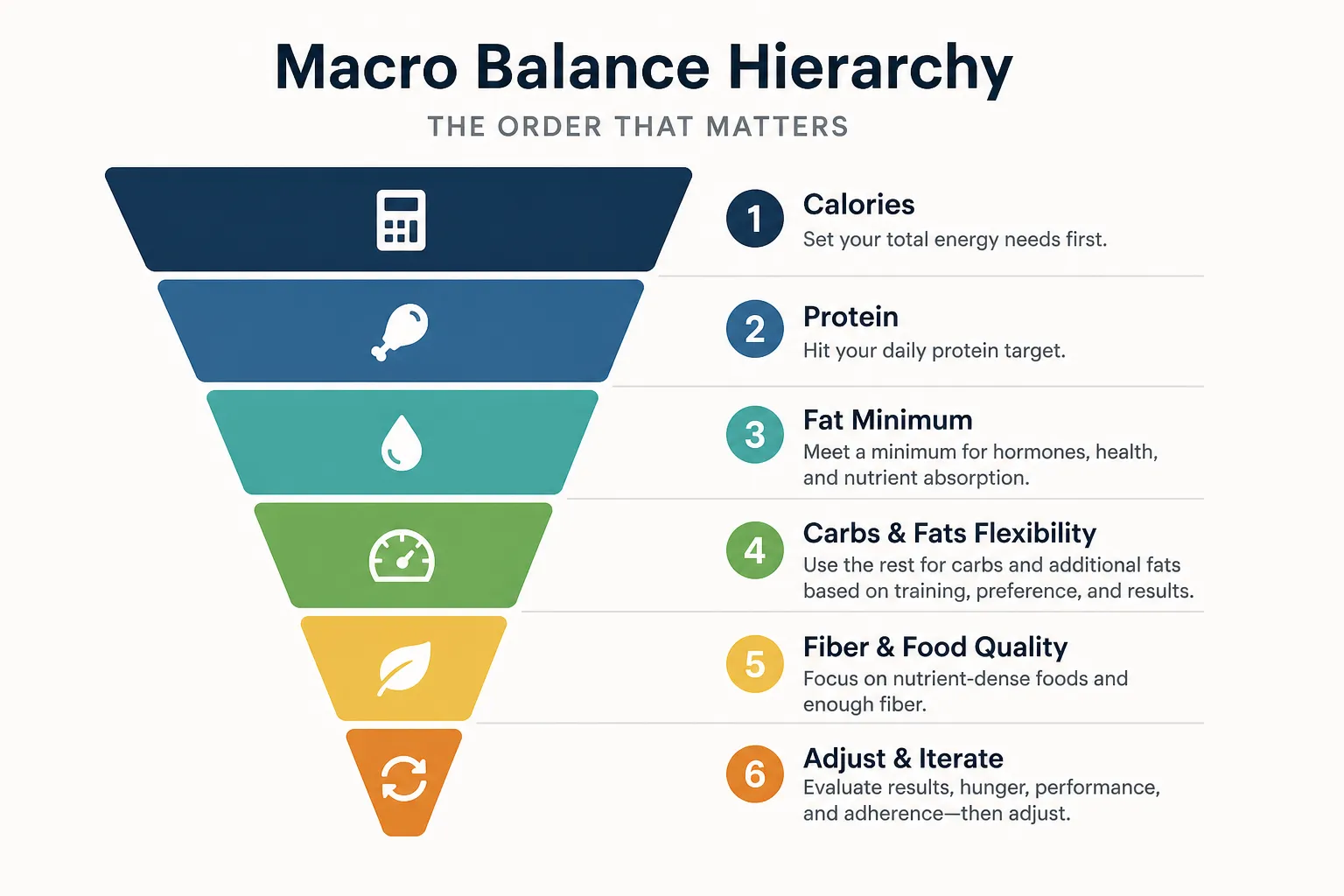
Set calories first so your macros have a job
Macros are made of calories, so a macro plan without an energy target can look balanced on paper and still miss the goal. Calories are the boundary, and macros are how you spend that energy.
For fat loss, the main driver is a sustainable calorie deficit, which aligns with the basic energy balance framework described by the CDC. Macro balance still matters, but mostly because it can make that deficit easier to follow by improving hunger, fullness, food satisfaction, and training energy.
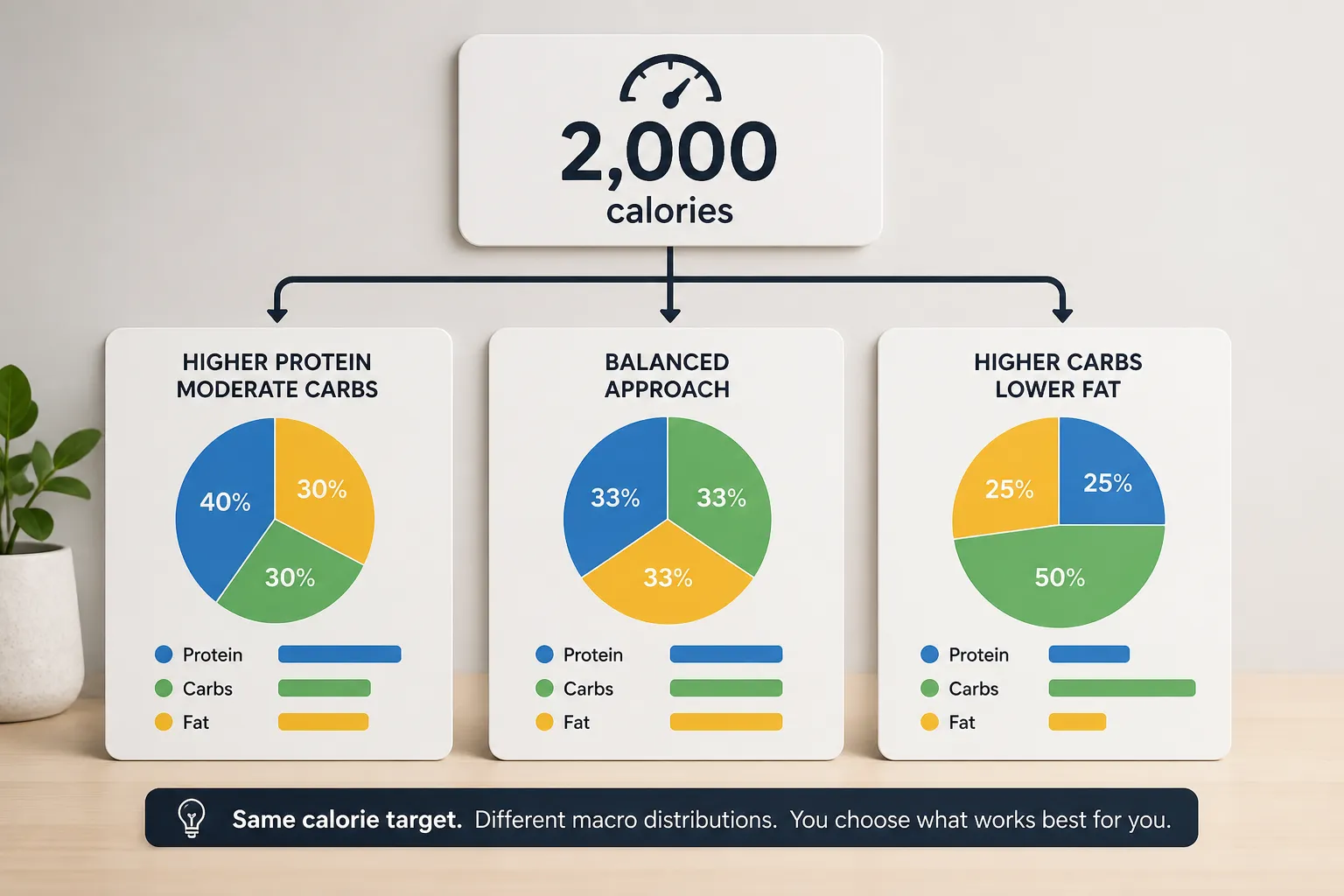
A simple example: two people can both eat 2,000 calories, but one might feel better on higher protein and moderate carbs while another prefers more carbs and a little less fat. Research from the International Society of Sports Nutrition supports that different macro splits can work when total intake and adherence fit the person.
Calories decide the direction of weight change; macros decide how sustainable that calorie target feels. That is true for maintenance and muscle gain too. Calories define the goal context, while macros shape how well your plan fits your appetite, routine, and training.
If you need a starting point, use a calorie calculator to estimate intake, then adjust based on real results. If weight is not changing after several weeks, the issue is usually total intake, consistency, activity changes, water retention, or tracking accuracy, not automatically the carb-to-fat ratio.
Make protein the anchor of each day
If calories set the boundary, protein is usually the first macro to set on purpose. It helps with fullness, supports muscle maintenance, and tends to improve diet quality because protein-rich meals are often more structured and satisfying.
That matters even more when calories are lower. A diet can be technically “balanced” on paper, but if it leaves you hungry and makes it harder to preserve muscle, it is harder to stick with. If you want a deeper look at that link between protein and appetite, see why protein helps with fullness and weight-loss adherence.
Protein contributes to muscle maintenance and growth.
The NIH Office of Dietary Supplements lists the adult RDA at 0.8 g per kilogram of body weight per day. That is a useful baseline, but it is not a perfect target for every goal. People who are dieting, getting older, doing resistance training, or simply very active may benefit from higher intakes, which is one reason sports nutrition guidance often uses higher ranges in those contexts according to the International Society of Sports Nutrition.
This is also why protein is often more useful in grams relative to body size than as a percentage of calories. A 25% protein intake at 1,600 calories gives you about 100 grams of protein, while 25% at 2,600 calories gives you about 163 grams. Same percentage, very different intake.
For macro balance, protein works best as a daily floor, not a percentage you chase at the expense of the rest of your diet. Once that floor is in place, carbs and fats can move around more easily based on food preference, training, schedule, and what makes meals feel normal.
The simplest first move
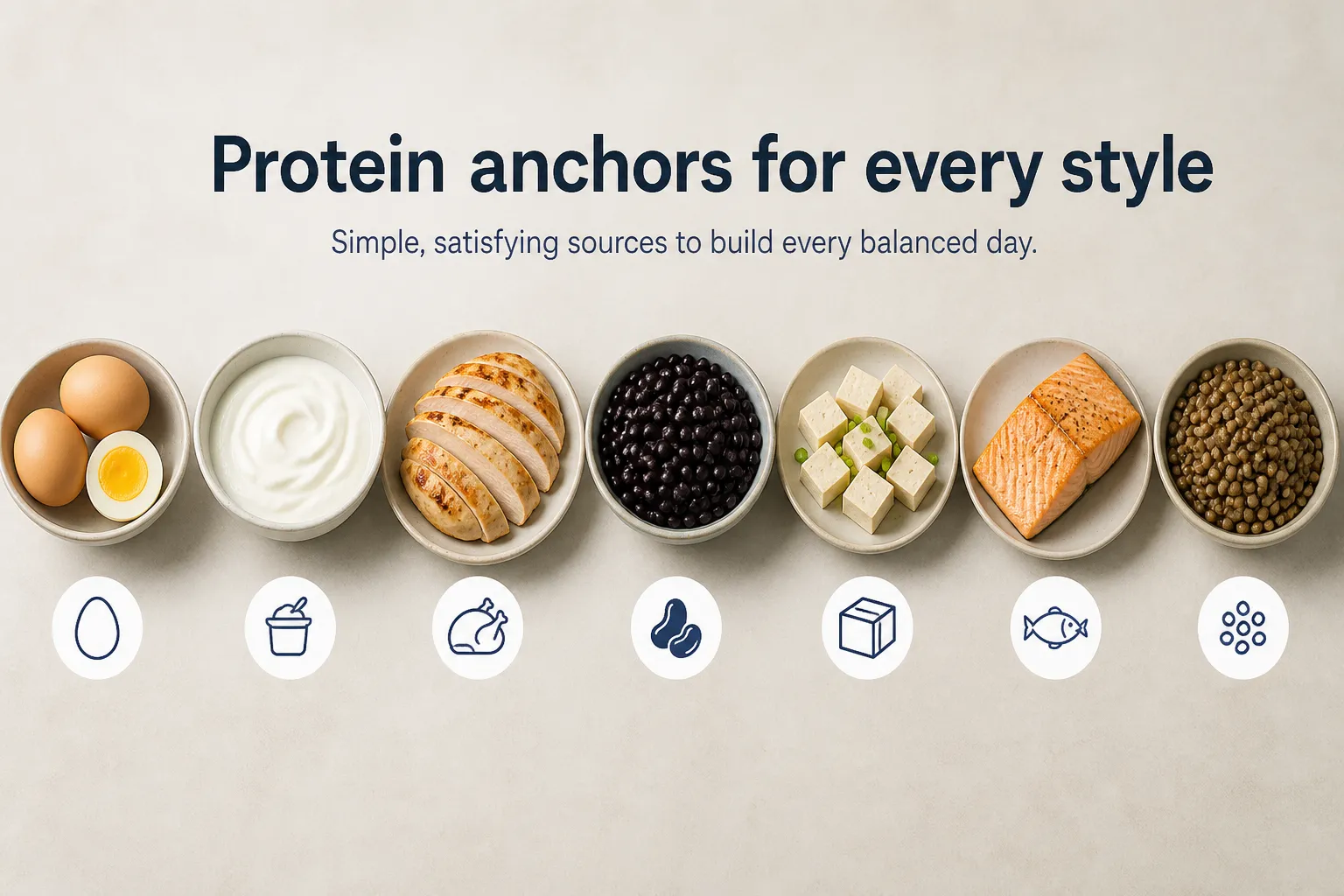
Before worrying about your carb-to-fat ratio, make sure each meal has a clear protein source. This keeps macro balancing practical instead of mathematical.
- Breakfast: Greek yogurt, eggs, cottage cheese, or soy yogurt
- Lunch: chicken, tuna, tofu, tempeh, lentils, or beans
- Dinner: fish, lean meat, tofu, eggs, edamame, or a bean-based meal
You do not need a bodybuilding meal plan to do this well. Just set protein intentionally first, then build the rest of the meal around it. That one step makes the next part of macro balancing much easier: getting enough fat while letting carbs flex.
Keep fat adequate, then let carbs flex
After calories and protein are set, carbs and fats become the main adjustment knobs. This is where many people get stuck, but you do not need to pick a low-carb or low-fat identity to balance macros well.
Fat should not be pushed too low as a default. It helps provide essential fatty acids and supports absorption of fat-soluble vitamins, which is one reason broad nutrition guidelines include a meaningful range for fat intake rather than treating it as optional National Academies.
That does not mean more fat is automatically better. Fat is calorie-dense, so it can use up your calorie budget quickly and make it harder to fit enough protein or carbohydrate if you are not paying attention.
Carbohydrates usually have more room to move. The Acceptable Macronutrient Distribution Ranges allow for a fairly wide intake range for both carbs and fats, which reflects a practical reality: different splits can work when the basics are covered National Academies.
Once protein and calories are set, carbs and fats are preference levers, not moral categories. A higher-carb approach can make sense for active people because training tends to increase carbohydrate demand, while a lower-carb, higher-fat split may feel better for someone with lower activity or different food preferences ISSN Position Stand.
Two balanced ways to split the rest
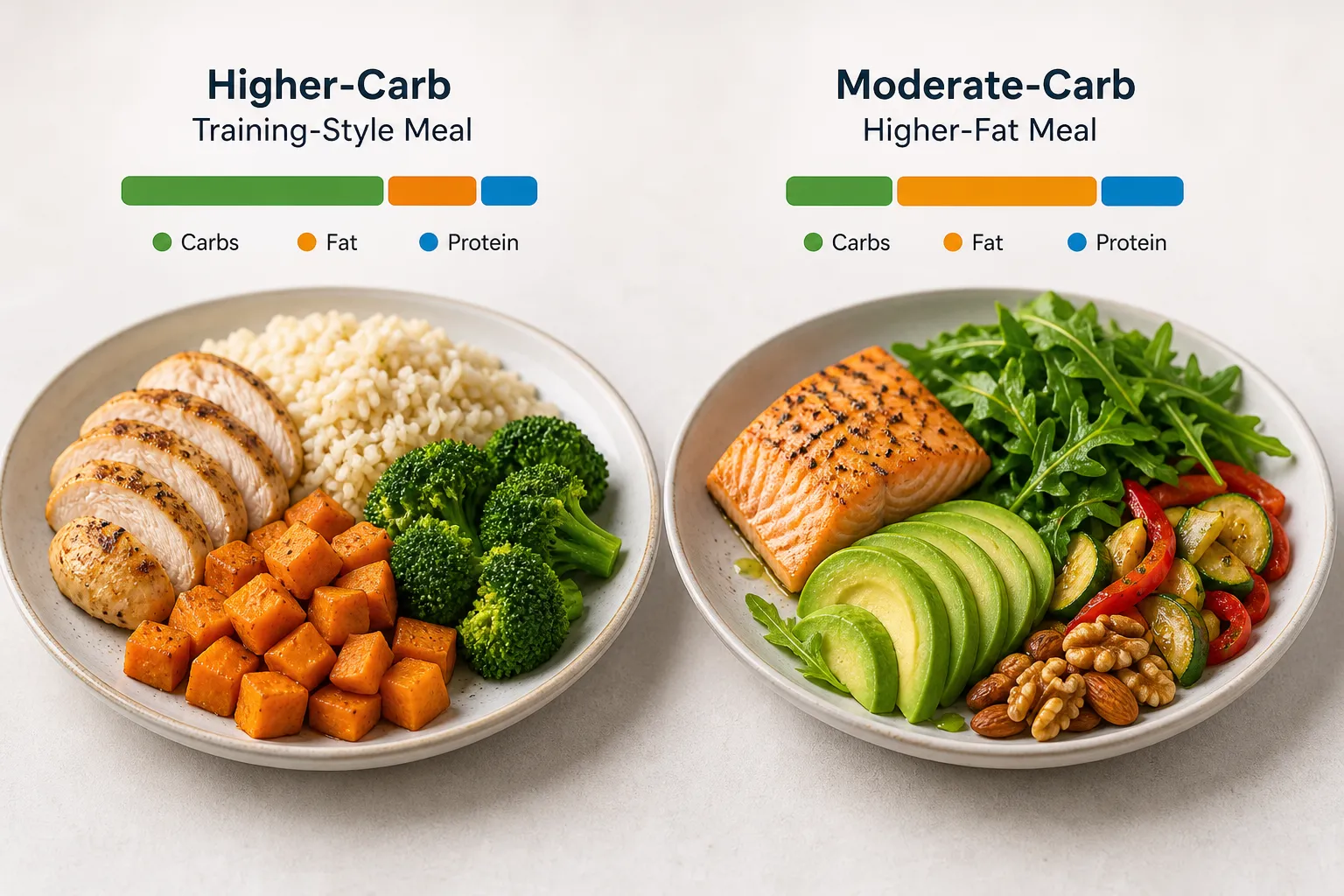
A higher-carb day often fits well around a workout. You might build meals around oats and fruit at breakfast, rice or pasta at lunch, and potatoes with dinner, while still keeping some fats in the day.
A moderate-carb, higher-fat day can also work, especially on a rest day or if that style helps you stay satisfied. That might look like eggs, avocado, olive oil, nuts, vegetables, and a smaller portion of starch across the day.
Neither pattern is automatically superior. Both can be balanced if total calories make sense, protein stays in place, fat is adequate, and meals still include enough fiber-rich foods.
How to choose your split
A simple test is to look at how you feel and how consistently you can eat that way. If you train hard and feel flat, sluggish, or constantly hungry, more carbs may help. If you prefer richer meals and are less active, a bit more fat and fewer carbs may be easier to sustain.
The best macro balance is often the one that supports energy, appetite, food enjoyment, and consistency. You are not trying to find the perfect ratio on paper. You are trying to build a way of eating you can repeat without overthinking every meal.
Add fiber so your macros actually keep you full
Fiber is technically a carbohydrate, but it deserves its own attention because it changes how satisfying your meals feel. Macros tell you where calories come from; fiber helps determine whether those calories feel like enough food.
This is a common gap in macro planning. A day can look balanced on protein, carbs, and fat, yet still be low-satiety and low-quality if most carbs come from refined foods and there are very few plants.
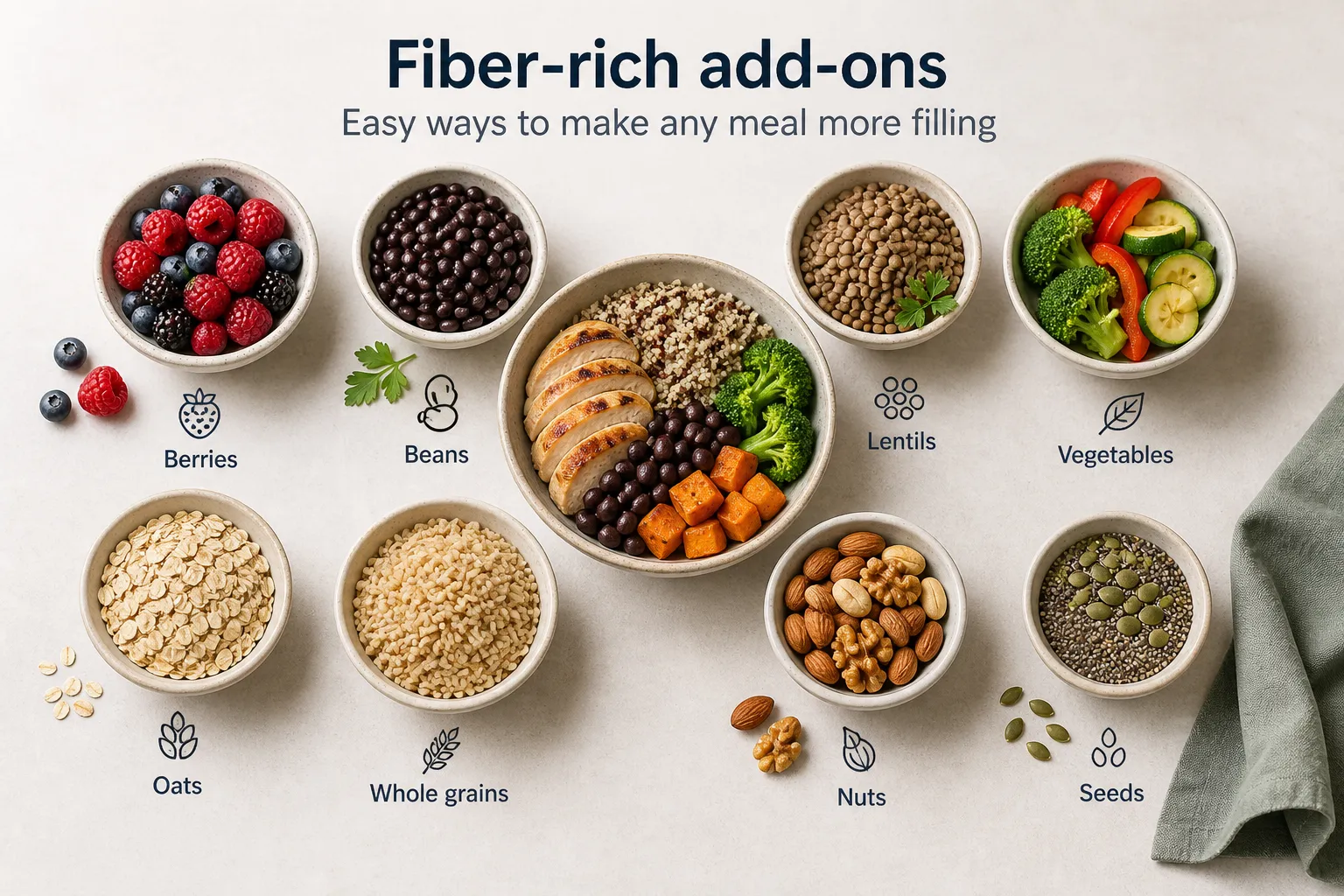
Fiber-rich foods like fruits, vegetables, beans, lentils, whole grains, nuts, and seeds tend to support fullness and overall diet quality, which is why they show up consistently in healthy eating guidance from the Dietary Guidelines for Americans and Harvard’s Nutrition Source. That matters even more during fat loss, when calories are lower and meals need to work harder.
A practical rule is simple: most meals should include a protein anchor plus a fiber-rich food. Think berries with yogurt, vegetables with eggs, beans in a grain bowl, lentils in soup, oats at breakfast, or whole grains instead of refined grains.
You can see the difference in snacks too. A macro-friendly bar may fit your numbers, but Greek yogurt with berries or an apple with nuts often brings more volume, texture, and staying power at similar calories.
Fiber is not a magic weight-loss lever. It is more like a macro-plan stabilizer that makes balanced eating easier to stick with. If your intake is low now, build up gradually and drink enough fluids. For a simple next step, this guide to getting more plant variety each week can help.
Build meals around anchors, not perfect daily math
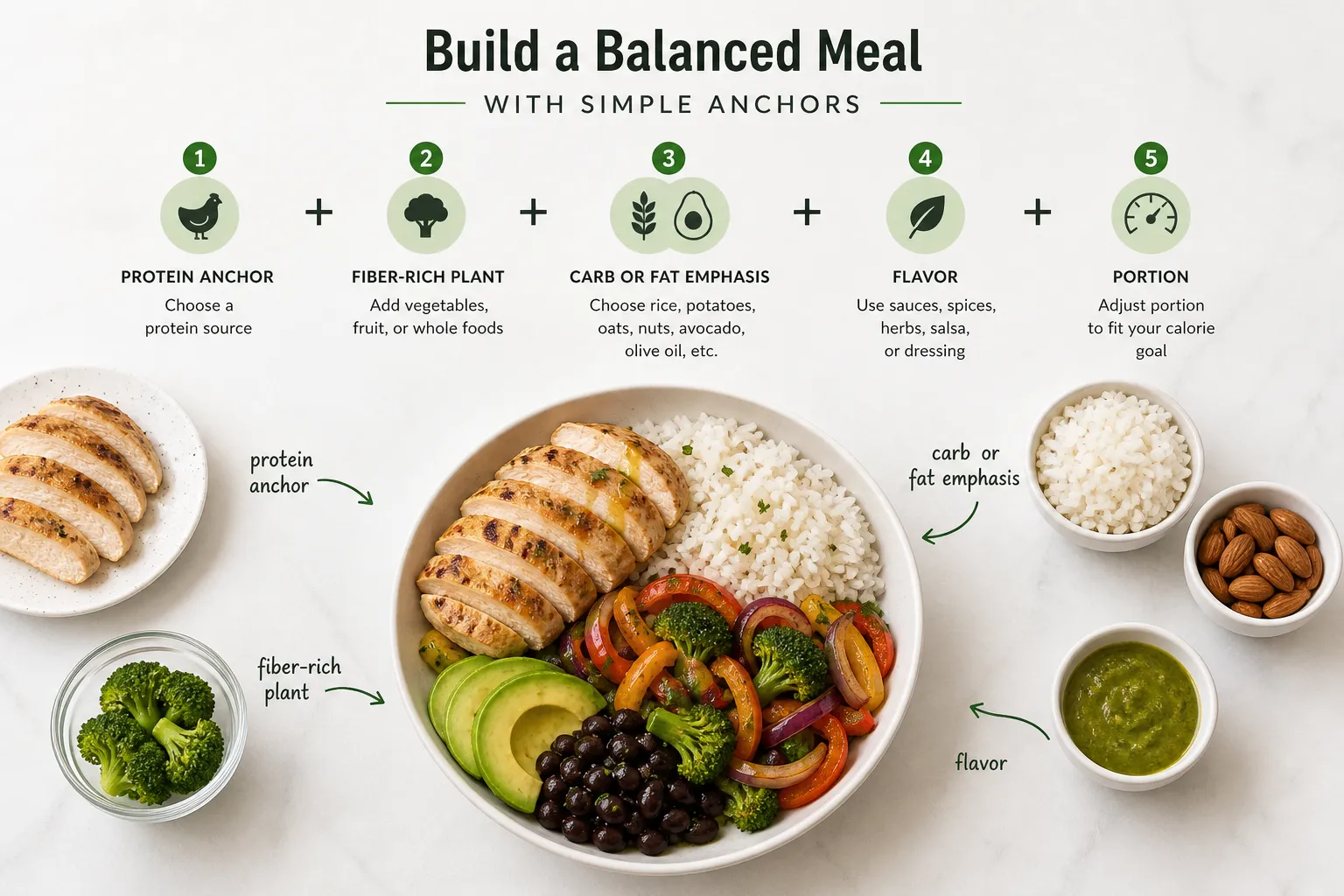
The easiest way to practice how to balance macros is to build each meal from a few anchors instead of trying to make every day look perfect on a spreadsheet. Start with a protein source, add a fiber-rich plant food, choose whether that meal leans more on carbs or fats, then adjust the portion size to fit your calorie goal.
A balanced macro meal does not need equal parts protein, carbs, and fat. It needs a clear protein source, enough fiber, and portions that fit the day’s energy needs.
This approach makes real life easier. One meal can be higher in carbs and another can be higher in fats, and your overall macro balance can still work well across the day or even across the week.
A simple meal formula
Think of meals in this order:
- Protein anchor: Greek yogurt, eggs, chicken, tofu, salmon, cottage cheese, beans, or a protein shake
- Fiber-rich plant: fruit, vegetables, beans, lentils, oats, or potatoes
- Carb or fat emphasis: rice, bread, oats, pasta, potatoes, nuts, avocado, cheese, olive oil
- Flavor: sauces, spices, herbs, salsa, yogurt sauce, dressing
- Portion: more food if calories are higher, less if you are in a calorie deficit
You do not need every meal to hit the same protein carbs fat ratio. If lunch is rice-heavy because you train in the afternoon, dinner might naturally be a bit higher in fat and still fit your macro targets.
What that looks like in real meals
Breakfast could be Greek yogurt with berries, oats, and a small handful of nuts. That gives you a protein base, fiber from fruit and oats, and a mix of carbs and fat without much calculation.
Lunch might be a chicken or tofu bowl with rice, vegetables, and an olive-oil-based sauce. If you want more carbs, keep the rice portion generous. If you want the meal more filling with fewer carbs, reduce the rice and keep the vegetables and sauce.
Dinner can be salmon, potatoes, and vegetables with a little oil or avocado. That is a good example of macro distribution not needing to be equal, since the salmon already brings protein and fat while the potatoes handle most of the carbs.
Snacks follow the same logic: cottage cheese and fruit, eggs and toast, hummus and vegetables, or a protein smoothie with fruit and oats or chia. The goal is not to make snacks perfect. It is to make them helpful.
Eating out works the same way. Pick a protein-forward entrée, add vegetables if you can, then decide whether the main carb or the main fat is more worth it to you that meal. That one choice often simplifies the whole plate.
If you track, use it to notice patterns rather than judge every food choice. And if you want the step-by-step workflow for logging and reviewing intake, see our guide to tracking macros. Daily numbers can vary. Consistency across the week usually matters more than exact hits every single day.
Adjust your targets by results, not day-one precision
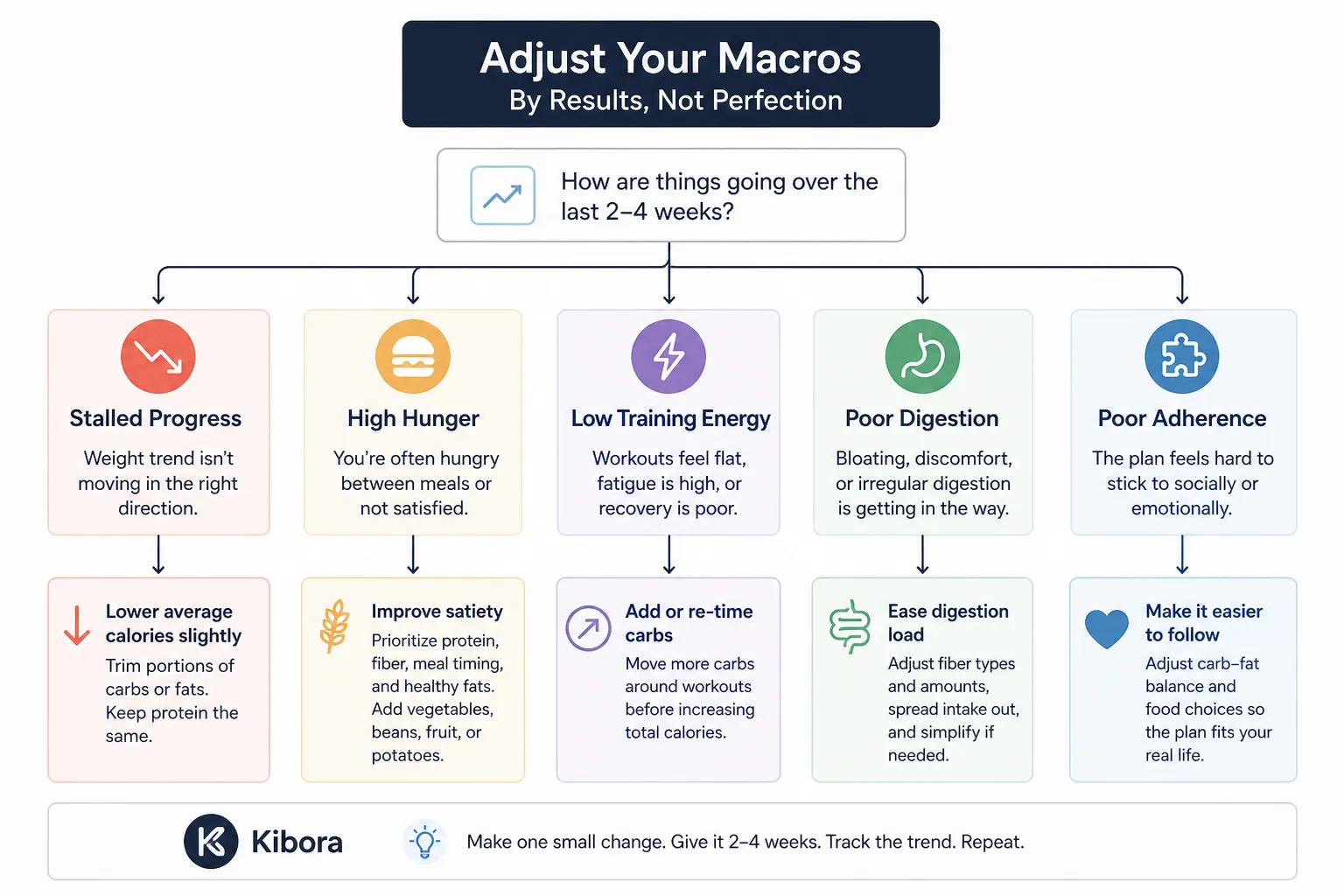
No calculator or formula knows your exact needs on day one. A macro target is a starting estimate, not a verdict, so the real test is how it works in your actual life over the next 2 to 4 weeks.
Use trends, not single days. Look at your weight trend, hunger, energy, workouts, digestion, and how consistently you can follow the plan. That outcome-based approach lines up with sports nutrition guidance, which emphasizes judging diet setups by adherence, performance, and body composition results, not just the planned ratio on paper ISSN Position Stand.
If your goal is fat loss and progress stalls, check consistency first. Before blaming your protein carbs fat ratio, ask whether calorie intake has drifted up, weekends look different from weekdays, or portions have quietly grown.
If you do need an adjustment, keep protein steady and make a small change to average calories by trimming portions of carbs or fats. If hunger is high, review protein, fiber, meal timing, and fat intake. Adding vegetables, beans, fruit, or potatoes often helps more than just “using willpower.”
If training feels flat, your carbs may be too low for your activity level. Try moving more carbs around workouts before increasing total calories. And if meals feel technically “on target” but still unsatisfying, shift the carb-fat balance until the plan feels easier to repeat.
If the setup looks good on paper but feels socially or emotionally impossible, it is not balanced in the way that matters. That is often an adherence problem, not a math problem, and it may help to troubleshoot why the diet is hard to stick to.
The macro split that works is the one you can repeat
Macro balance is not about finding one perfect ratio. The best split is the one that fits your goal, appetite, training, food preferences, and what you can actually repeat next week.
You do not need exact percentages at every meal to do this well. Think in order: calories first, then protein, then enough fat, then flexible carbs, then fiber, then simple meal anchors, and finally adjustment based on real results.
That means a balanced dinner can be very ordinary. If it has protein, vegetables, a carb or fat source, and portions that fit your goal, it is balanced even if the numbers are not mathematically perfect.
Consistency beats precision here. Set up meals you can stick with, watch how your energy, hunger, and progress respond, and adjust instead of rebuilding the plan every day.
A simple first step for today: choose a protein anchor for each meal and add one fiber-rich food before worrying about exact percentages.
- Key sources
- National Academies of Sciences, Engineering, and Medicine - Dietary Reference Intakes / Acceptable Macronutrient Distribution Ranges
- NIH Office of Dietary Supplements - Protein Fact Sheet for Health Professionals
- CDC - Healthy Weight, Nutrition, and Physical Activity
- International Society of Sports Nutrition (ISSN) Position Stand: Protein and Exercise
- ISSN Position Stand: Diets and body composition
- Dietary Guidelines for Americans, 2020-2025
- Harvard T.H. Chan School of Public Health - The Nutrition Source