- What you'll learn
- How to distinguish never feeling satisfied from hunger that returns later or a persistent appetite change
- Why adequate food and changing energy needs matter before trying to make meals more filling
- How protein, fiber, sleep, stress, and glucose dips may influence hunger, and what they cannot prove
- Which accompanying symptoms call for routine or prompt medical assessment, and which require emergency help
- How to use brief observations to choose a next step without calorie counting or delaying food
You’ve finished a meal but still feel hungry. That isn’t automatically poor willpower or illness: start by asking whether you’ve eaten enough for your needs.
Meal composition, restriction, sleep, stress, and sometimes medicines or health conditions can contribute. We’ll distinguish three patterns: never feeling satisfied, getting hungry again later, and a persistent change in appetite.
The pattern and accompanying symptoms matter more than hunger alone. Seek assessment for persistent unexplained changes, especially with thirst or weight loss; the goal here is understanding your hunger, not suppressing it.
First, notice what “still hungry” means for you
Being hungry after eating can mean several things. Start with which experience sounds most familiar:
- You never feel satisfied: lunch ends, but you still feel you need more food.
- Hunger returns later: lunch felt satisfying at first, but now you’re ready to eat again.
- Your appetite feels unusually strong: you want more food throughout the day, or your appetite has changed from your usual pattern.
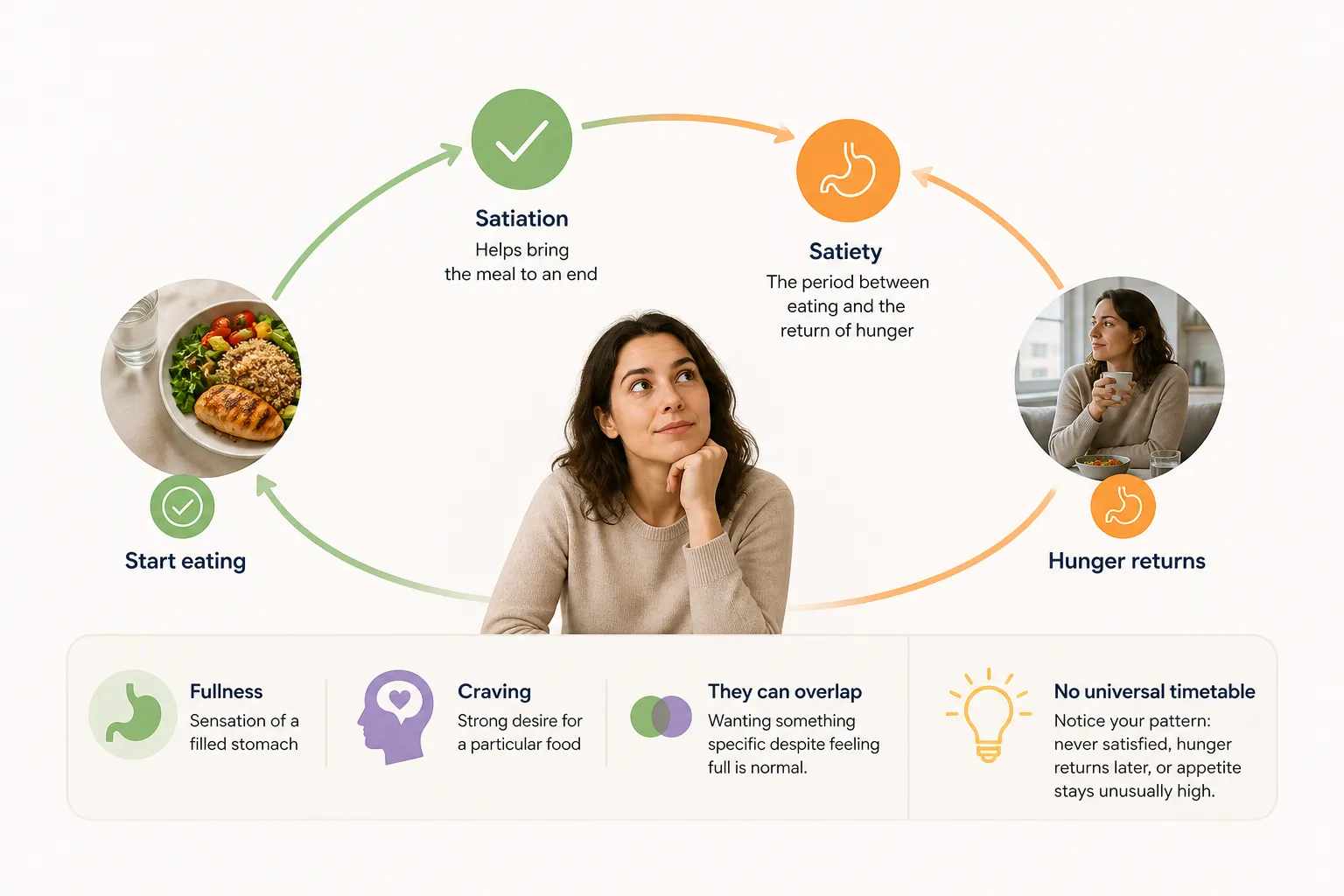
The first two experiences reflect a useful distinction: satiation helps bring a meal to an end; satiety describes the period between eating and the return of hunger.
Hunger is the sense that you need food; appetite is the broader desire to eat. Physical fullness is the sensation of a filled stomach, while a craving is a strong desire for a particular food. These can overlap: wanting something specific despite feeling full doesn’t make your hunger fake or prove you’ve eaten enough.
Your brain combines signals from stomach stretching, nutrient sensing, nerves, and circulating hormones with information about food around you. Energy needs, enjoyment, habits, and food cues can all contribute, rather than one “hunger hormone” switching appetite on or off.
There is no universal post-meal hunger timetable. Notice whether satisfaction never arrives, hunger returns later, or appetite stays unusually high: timing offers clues, not diagnoses.
You may need more food, not more willpower
Before trying to make meals more filling, ask whether you’re getting enough food for your current needs. A vegetable-heavy meal can look substantial without providing enough energy for you, and a calorie app cannot settle that question.
A calorie estimate is a starting point, not proof that you have eaten enough. USDA estimates account for factors including age, body size, activity, and pregnancy or breastfeeding, but individual needs still vary.
“Individual requirements may be higher or lower than DRI recommendations.” — USDA
If you add regular training while keeping meals unchanged, increased hunger may reflect increased needs. Long gaps, skipped meals, or restriction can also leave you hungry, even after you reach a preset calorie target.
Recent weight loss can make hunger harder to manage, too. An analysis in people with type 2 diabetes modeled an increase in appetite following weight loss, suggesting the body can push back by increasing the drive to eat.
That biological response is not a willpower failure. If restriction is part of your pattern, consider whether your eating plan is sustainable, rather than assuming you need more discipline.
Pregnancy, breastfeeding, and growth also change nutritional needs and call for individualized guidance. Meal composition matters, but fullness tactics cannot replace adequate nourishment.
Meal composition matters, but it cannot explain every hungry moment
Enough food and a satisfying mix of components both matter. Protein and fiber can influence how a meal feels, but adjusting them cannot reliably compensate for eating too little. A meal can also look balanced without satisfying your appetite on that particular day.
Protein has modest short-term effects on appetite, on average. A meta-analysis comparing meals with equal calories found that higher-protein conditions reduced hunger and increased fullness ratings in short-term studies, while longer-term findings were inconclusive. That supports protein as one influence on satisfaction, not a guarantee that you will stop feeling hungry.
Fiber is not a guaranteed fullness fix either. In a review of short-term fiber interventions, 39% of treatments reduced reported appetite, while 22% reduced food or energy intake. Effects varied with the food and fiber characteristics, so “more fiber” does not produce the same result for everyone.
As an illustration, adding a protein-containing component to a meal with little protein might make it more satisfying. That is an option to explore, not a tested prescription for your hunger. For detailed troubleshooting, see why healthy meals can still leave you hungry.
The tempting “blood-sugar crash” explanation also needs perspective. In research involving 1,070 participants, glucose dips two to three hours after standardized meals were associated with later hunger, but the correlation was modest at 0.16. Hunger after carbohydrates does not diagnose reactive hypoglycemia, establish that glucose caused the hunger, or mean you should avoid carbohydrates.
These findings also highlight a useful distinction: feeling less hungry, eating less, and losing weight are separate outcomes. An approach that reduces how much people eat does not necessarily reduce how hungry they feel, and neither result alone establishes weight loss.
Eating pace illustrates that difference. A meta-analysis of 22 experimental studies found lower intake with slower eating, but no significant difference in hunger at the end of meals or up to 3.5 hours afterward. Paying attention to a meal may help you notice satisfaction, but slowing down is not a proven hunger cure, and this evidence does not support a universal 20-minute wait before eating more.
Sleep and stress can change the pattern
If similar meals leave you less satisfied during a week of disrupted sleep, the sleep change may be relevant. Short sleep can affect both hunger and how much you eat, but feeling hungrier and eating more are different outcomes and do not always move together.
A review of 41 randomized sleep-restriction trials found greater hunger and food intake on average, without strong overall evidence of changes in the appetite-related hormones ghrelin or leptin. That makes “your hunger hormones are out of balance” too simple an explanation.
Improving sleep has some intervention evidence. In a two-week trial of 80 adults aged 21–40 with overweight who usually slept less than 6.5 hours, sleep extension added about 1.2 hours nightly and reduced estimated intake by about 270 calories daily compared with controls. It did not establish a cure for post-meal hunger or lasting weight loss.
Stress responses vary. Some people eat more, others less, or find their eating pattern changes. A 54-study review found only a small average association between stress and food intake, with substantial variation. Stress-related hunger is not “fake,” and it does not diagnose high cortisol.
Notice whether the change follows poor sleep or stressful periods, without delaying food when you are hungry. Both can coexist with not eating enough; better sleep or relaxation may help, but neither is a guaranteed answer to persistent hunger.
When persistent hunger needs medical attention
Occasional hunger after eating is different from a persistent, unexplained change in your usual appetite. There is no evidence-based day count that makes hunger abnormal: the change from your usual pattern, accompanying symptoms, and impact on daily life matter more.
Persistent unexplained hunger deserves assessment; hunger alone cannot tell you whether the cause is diabetes, a thyroid condition, medication, or something else.
Arrange an assessment. Book an appointment if your appetite remains unusually high without an obvious explanation, even if you cannot identify a cause. MedlinePlus recommends assessment for persistent unexplained increased appetite.
Include a medication review, especially if the change followed a new prescription or dose change. Corticosteroids and some antidepressants can increase appetite, but do not stop or change prescribed medicines without speaking with the prescriber.
Seek prompt help for accompanying symptoms. Contact a healthcare professional promptly if increased hunger comes with unusual thirst, frequent urination, blurred vision, fatigue, or unexplained weight loss. These can be symptoms of diabetes, but they are a reason for assessment, not a home diagnosis.
Increased appetite with weight loss, a racing heart, trembling, or difficulty tolerating heat can also occur with an overactive thyroid. Symptoms overlap across conditions, so assessment and appropriate testing are needed to establish the cause.
Hunger with shakiness, sweating, dizziness, or palpitations is different from uncomplicated post-meal hunger. It may signal low blood sugar, especially if you take insulin or certain other diabetes medicines; follow your prescribed low-blood-sugar plan immediately.
Low blood sugar is rare without diabetes. Recurring shakiness or sweating still deserves assessment rather than being dismissed as a routine “carbohydrate crash.”
Get emergency help for severe symptoms. Call your local emergency number for severe confusion, seizures, or unconsciousness. Vomiting, breathing difficulty, or fruity-smelling breath alongside diabetes-type symptoms can indicate diabetic ketoacidosis and also require emergency assessment; ordinary hunger alone is not this emergency pattern.
Separately, recurrent loss of control around eating, distress, secrecy, or restriction to compensate for eating is a reason to seek professional support, not stricter tracking. Frequent hunger alone does not establish an eating disorder; for binge-eating disorder specifically, NICE recommends regular eating during treatment rather than dieting, because dieting can trigger binge eating.
Use the pattern to choose your next step
If you have no warning symptoms, notice what happens over several ordinary days, rather than monitoring every bite. Use hunger patterns to choose the next question, not to make your own diagnosis.
These patterns can help you choose a starting point:
| What you notice | What to consider | Next step |
|---|
| Never satisfied after meals | Amount and meal balance | Reassess adequate food |
| Hungrier with activity or restriction | Changed energy needs | Review fueling |
| Change follows short sleep or stress | Broader daily context | Support recovery; reassess |
| Persistent change or other symptoms | Needs clinical assessment | Arrange care |
Optional, approximate notes on meal timing, rough components, hunger, activity, sleep, and stress are enough; calorie counting is not required.
Start with enough food, not ways to suppress hunger. USDA energy estimates may be higher or lower than your actual needs, so an app target does not prove you ate enough.
If you remain hungry immediately after eating, consider more food and meal balance rather than forcing a waiting period. These practical meal ideas offer starting points.
Change one plausible factor when practical, but eat when you need to. This is not a diagnostic test: stop tracking if it increases distress, and seek assessment for persistent, unexplained appetite changes rather than extending the experiment or delaying care.
Respond to hunger rather than trying to outsmart it
If you’re hungry after eating, it’s okay to eat more. The goal is appropriate nourishment, not eliminating normal hunger or proving you can ignore it.
Start by meeting that immediate need, then consider what has changed in your eating, routine, health, or medications. Choose one reasonable next step, such as making meals more substantial if you’ve been eating less, rather than chasing a single hormone explanation.
Persistent, unexplained increases in appetite deserve professional assessment, not stricter food rules. You don’t need to solve the pattern alone: if hunger remains confusing, disruptive, or distressing, it’s reasonable to seek help from a clinician or registered dietitian.
- Key sources
- Homeostatic regulation of food intake
- USDA DRI Calculator for Healthcare Professionals
- Kohanmoo et al., 2020: Effect of short- and long-term protein consumption on appetite
- Effects of sleep restriction on metabolism-related parameters in healthy adults, 2019
- MedlinePlus Medical Encyclopedia: Appetite—increased
- NIDDK: Symptoms & Causes of Diabetes
- NIDDK: Low Blood Glucose
- CDC: Diabetic Ketoacidosis
- NICE NG69: Eating disorders—recognition and treatment