


- What you'll learn
- Why fast photo logging is only one part of a useful calorie tracker
- How correction flow and estimate transparency affect real-world accuracy
- Which apps fit different needs, from database depth to coaching
- When barcode scanning and manual search work better than AI photo guesses
- What to check before paying for AI features, trials, or premium tiers
- Why Kibora, MyFitnessPal, Lose It!, Cronometer, Lifesum, Noom, and Cal AI each serve different users
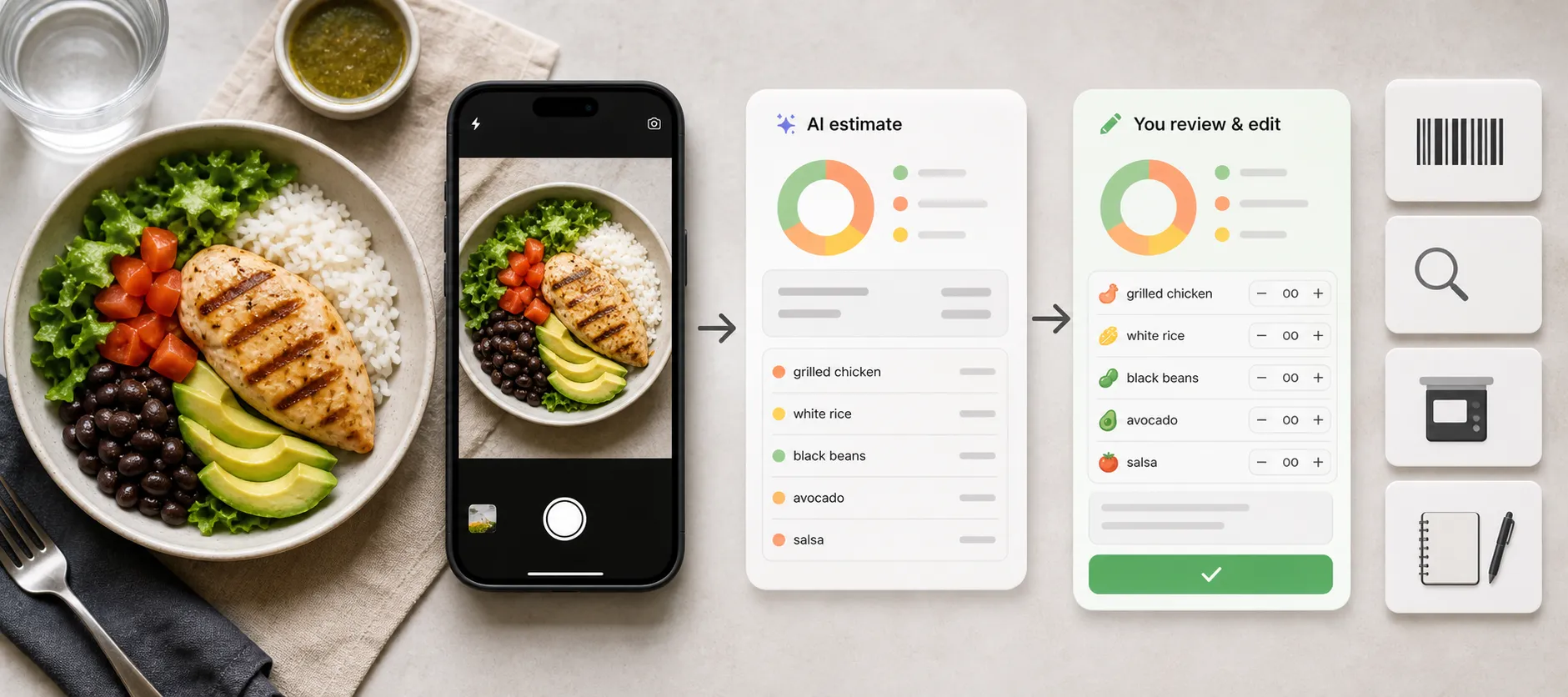
Taking a food photo usually feels easier than weighing ingredients, but calorie estimates can be confidently wrong. A burrito bowl photo might catch rice, beans, chicken, and toppings, yet still miss oil, dressing, extra cheese, or portion size, which is why the best AI calorie tracker is not always the one with the flashiest first guess.
This comparison focuses on real-life usefulness: photo or AI logging, voice or quick input where relevant, barcode and database support, manual correction, pricing, trust complaints, and what kind of guidance you get after the meal is logged. The core question is simple: can you understand the estimate, fix it fast when the AI is wrong, and use it to make a better next decision?
That matters because different apps solve different problems. Some are AI-first and photo-first, some win on database depth, some on nutrient detail, and some on coaching, so the right pick depends on whether you care most about speed, accuracy, cost, or follow-through.
The quick picks: which AI calorie tracker fits which person
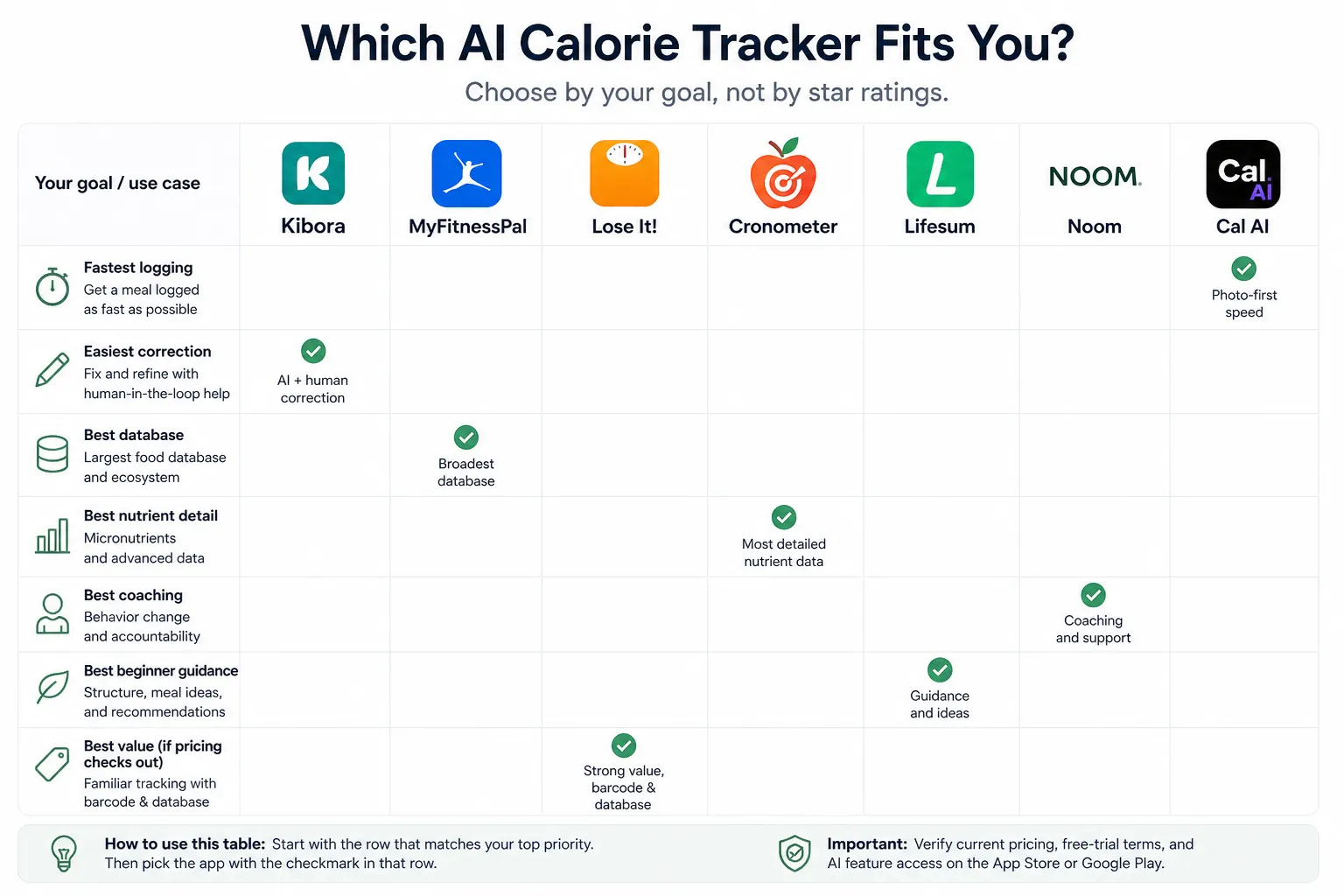
Here is the short version first: there is no single best AI calorie tracker for everyone. The best fit usually depends on whether you mostly log packaged foods, home-cooked meals, restaurant plates, or want coaching after the meal is logged.
These rankings are based on public feature claims, app store disclosures and review patterns, plus the known limits of photo-based calorie estimation, not undisclosed lab testing. Before subscribing, verify current pricing, free-trial terms, and whether AI logging features are included on the app’s latest App Store or Google Play listing.
- Fastest logging: Cal AI or similar photo-first apps for quick meal-photo estimates, if speed matters more than certainty.
- Easiest correction: Kibora for AI-assisted logging with human-in-the-loop edits and interpretation.
- Best database: MyFitnessPal for the broadest mainstream food logging ecosystem.
- Best nutrient detail: Cronometer for users who care about micronutrients, not just calories and macros.
- Best coaching: Noom for behavior-change support beyond meal entry.
- Best beginner guidance: Lifesum for meal ideas, structure, and approachable recommendations.
- Best value if pricing checks out: Lose It! for familiar calorie tracking with barcode and database support.
If you want trust plus correction, choose Kibora. If you want a huge established ecosystem, choose MyFitnessPal. If you want a familiar calorie counter with solid barcode support, Lose It! is usually the easier pick.
Cronometer suits detail-oriented users who may skip flashier AI in exchange for better nutrient depth. Lifesum fits people who want lifestyle guidance, while Noom makes more sense if coaching and accountability matter more than raw logging speed.
Photo-first apps like Cal AI can help reduce friction, but they are the category to scrutinize most closely for estimate transparency, correction flow, and subscription terms. If you want a broader non-AI comparison too, see our calorie tracker app comparison.
- Kibora: choose it for correction and interpretation; skip if you only want the biggest legacy database.
- MyFitnessPal: choose it for database reach; skip if nutrient depth is your top priority.
- Lose It!: choose it for familiar calorie tracking; skip if you want the most advanced coaching.
- Cronometer: choose it for nutrient detail; skip if simplicity matters more than depth.
- Lifesum: choose it for guidance and meal ideas; skip if you mainly want raw data control.
- Noom: choose it for coaching; skip if you want a lighter, lower-friction logging tool.
- Cal AI: choose it for photo speed; skip if you are not willing to double-check estimates and billing details.
What actually makes an AI calorie tracker worth using
This comparison is not about which app makes the loudest AI promise. It is about which one helps you log meals with less friction and fewer hidden errors once real food, real portions, and real habits get involved.
To keep the rankings fair, I’m using five practical dimensions: how well the app logs inputs, how easy it is to correct mistakes, how transparent its estimates are, whether it supports barcode and database logging, and what guidance it gives after the meal is saved. Pricing also matters, because an AI feature is less useful if it sits behind a confusing or expensive paywall.
The AI guess is not the log; the corrected entry is the log.
That correction step is central, not optional. Research on image-based dietary assessment suggests photo logging can help with speed and capture, but food recognition and portion estimation still have clear limits, especially for mixed dishes and preparation details like oil, sauces, or add-ins PMC, PubMed.
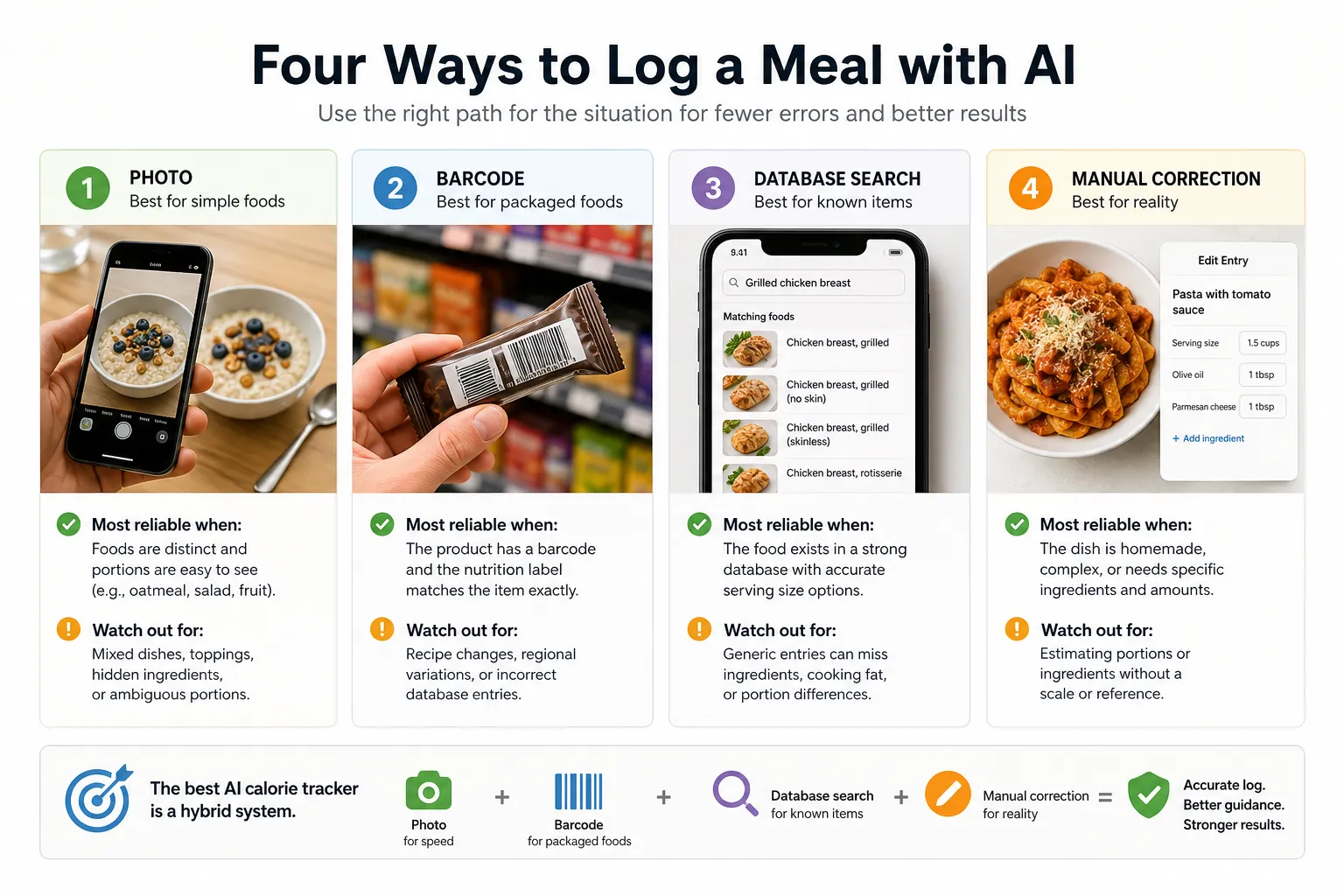
A simple meal example shows why this framework matters. A photo may be good enough for a bowl of oatmeal, a barcode scan is usually better for a packaged protein bar, and homemade pasta often needs manual edits for sauce, oil, and portion size.
The best AI calorie counter is a hybrid system: AI for speed, barcode scanning for packaged foods, database search for known items, and manual correction for reality. The strongest apps do not treat those as competing features. They combine them into one workable logging flow.
That is also why post-log guidance gets a seat in the score. Beginners usually need more than a calorie number. They need context on protein, portions, tradeoffs, and what to change next time.
The best AI calorie tracker apps compared
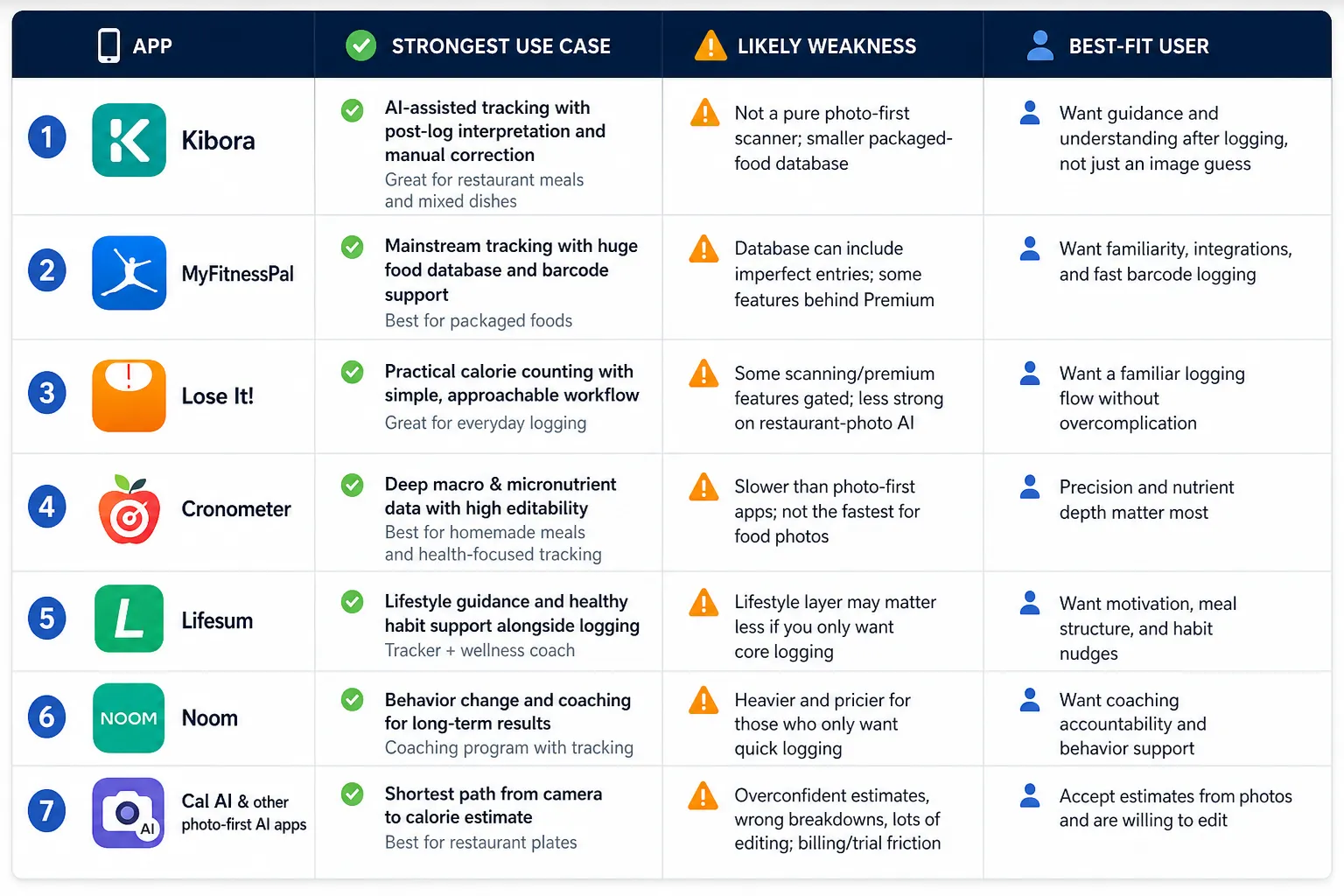
A useful ranking should not reward AI novelty by itself. It should reward the app that gets you from a messy real meal to a usable, editable nutrition record with the least friction. That matters because a packaged yogurt, a restaurant plate, and a homemade mixed dish all stress different parts of a tracker.
1. Kibora
Best for: people who want AI help, but also want to understand and correct the log afterward.
Where it helps: Kibora stands out when the goal is not just recording a meal, but interpreting it in a more useful, science-based way after entry. That makes it a strong fit for restaurant meals and mixed dishes where estimates need cleanup, context, and manual correction rather than blind trust.
Where to be careful: it is better framed as an AI-assisted tracker with interpretation than as a pure photo-first calorie scanner.
Pricing/trial note: check current app listing details before subscribing, since access models can change.
Who should choose it: choose this if you want guidance after logging, not just an image guess. Skip or compare carefully if your top priority is a huge packaged-food database.
2. MyFitnessPal
Best for: mainstream calorie tracking with broad database and barcode support. According to MyFitnessPal, its core value is the large food database and established logging ecosystem.
Where it helps: packaged foods like yogurt are where it usually feels strongest, because barcode and database lookup are often faster than taking a photo. It is more of a calorie database and logging platform than a pure AI photo tracker.
Where to be careful: large databases can include user-generated or imperfect entries, so you may still need to verify serving sizes and macros. Premium access also affects some features, so separate free logging expectations from paid ones.
Pricing/trial note: review current Premium and trial details on the official site and app listing.
Who should choose it: choose this if you want familiarity, integrations, and fast barcode logging. Skip or compare carefully if you mainly want AI photo estimates for restaurant plates. For a deeper contrast, see this comparison of Cal AI and MyFitnessPal.
3. Lose It!
Best for: practical calorie counting with an approachable workflow. Lose It! remains strongest as a weight-loss logging app with solid barcode and database support.
Where it helps: it works well for everyday logging when you want less setup friction than some data-heavy apps. It is generally stronger as a calorie counter than as a cutting-edge AI photo tracker.
Where to be careful: verify which scanning or premium features are gated, since access can vary by plan. If you expect restaurant-photo magic, you may still end up editing a lot.
Pricing/trial note: check current Premium and trial terms before starting.
Who should choose it: choose this if you want a familiar logging flow without overcomplication. Skip or compare carefully if micronutrient depth matters.
4. Cronometer
Best for: people who care about macro and micronutrient detail more than speed. Cronometer is the clearest pick when data quality and nutrient depth matter more than flashy AI.
Where it helps: homemade meals and health-focused tracking are where it shines, because editability and nutrient detail are central. It is stronger as a nutrient tracker than as a photo calorie tracker.
Where to be careful: the tradeoff is speed. If you want one-tap food photos, this may feel slower than photo-first tools.
Pricing/trial note: free and paid tiers differ, so confirm current plan details.
Who should choose it: choose this if precision and nutrients matter most. Skip or compare carefully if you want the fastest meal logging possible.
5. Lifesum
Best for: people who want lifestyle guidance wrapped around logging. Per Lifesum, the app emphasizes meal guidance, plans, and healthy habit support alongside tracking.
Where it helps: it can be a better fit if logging is only one piece of what you want, and you also want nudges about food quality and routines. It sits between tracker and wellness coach more than pure AI scanner.
Where to be careful: if your goal is maximum edit control and transparency on estimates, the lifestyle layer may matter less than the core logging workflow.
Pricing/trial note: subscription access is central, so verify current trial and renewal terms.
Who should choose it: choose this if you want motivation and meal structure. Skip or compare carefully if you mainly want a no-frills food database.
6. Noom
Best for: behavior change and coaching first. Noom belongs in this list because some readers want help after the meal is logged, not just calorie numbers.
Where it helps: if you struggle with consistency, the coaching and psychology framing may be more valuable than any scanner. It is better understood as a coaching program with tracking than as the best AI calorie counter app for fast scans.
Where to be careful: people looking only for quick food capture may find it heavier and pricier than necessary.
Pricing/trial note: review the current program structure and billing details carefully before signing up.
Who should choose it: choose this if you want coaching accountability. Skip or compare carefully if your only goal is fast calorie logging.
7. Cal AI and other photo-first AI apps
Best for: people who want the shortest path from camera to estimate. App store listings are the best place to verify the current claims, subscription disclosures, and review themes for these tools.
Where it helps: restaurant plates are the obvious use case, because a quick photo can reduce friction. But this category often wins on speed more than on transparency.
Where to be careful: common trust complaints include overconfident estimates, wrong ingredient breakdowns, too much correction work, and billing or trial friction. A homemade mixed dish is the real test here, because if the app cannot show editable assumptions clearly, the speed benefit disappears.
Pricing/trial note: check both App Store and Google Play terms closely before starting a trial.
Who should choose it: choose this if you accept that photos give estimates and you are willing to edit. Skip or compare carefully if you want dependable barcode coverage or deep nutrient data.
Why photo calorie estimates still need a reality check
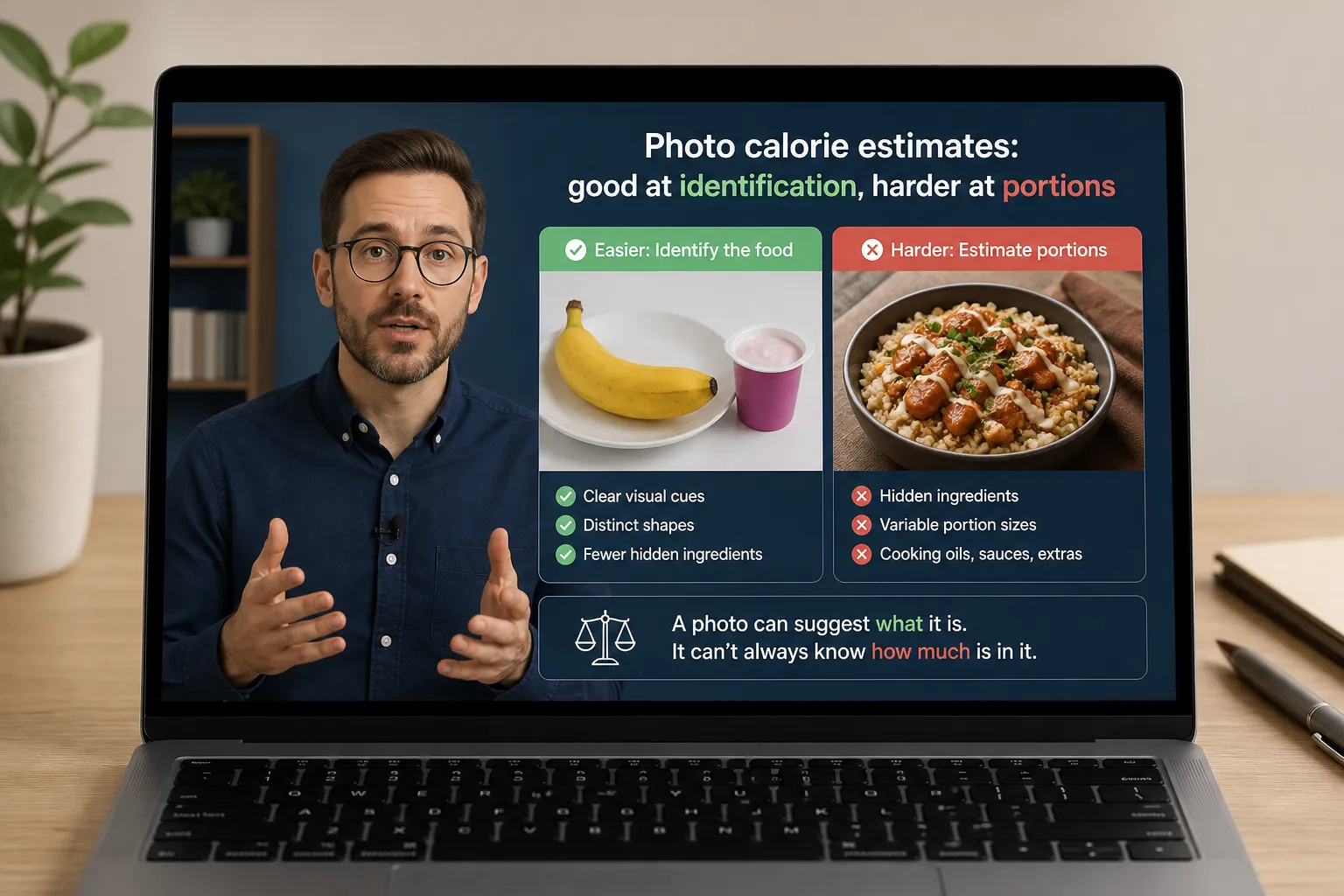
Photo logging can save time, but it helps to frame it correctly. Photo calorie tracking is best understood as a convenience layer, not a measurement instrument. Research on image-based dietary assessment consistently points to the same challenge: recognizing food is one problem, but estimating portion size and hidden ingredients is often harder PMC PubMed.
Some foods are naturally easier than others. A plain banana or a single packaged yogurt gives an app clearer visual cues than a restaurant curry, burrito, or casserole, where the real calorie load may depend on oil, cheese, dressings, butter, or ingredient ratios you cannot see from the top.
Mixed dishes are where confidence can outrun reality. The app may correctly label “burrito bowl” or “chicken curry,” but still miss whether it contains extra rice, creamy sauce, more cooking fat, or a larger serving than the plate makes obvious.
Even the photo itself changes the estimate. Lighting, camera angle, plate size, and foods covering each other can all affect recognition and portion-size estimation, which is why two pictures of the same meal may not produce identical results.
For many people, that is still useful. A fast estimate can be good enough for a trend, especially if it helps you log consistently and catch obvious patterns. But it is often not exact enough for precision dosing, tight macro targets, or medical nutrition use.
If precision matters, manual edits, weighed portions, or verified database entries are still the safer option. That is also why correction flow matters so much in any app, as small logging errors can compound over time and affect results in real life, as discussed in this breakdown of why calorie tracking can go off track.
The hidden deal-breakers: paywalls, trials, reviews, and food-photo privacy
The practical question is not whether an app advertises AI, but what that AI actually includes. Many calorie apps promote photo logging, coaching, or smart analysis on the landing page, then limit those tools to paid tiers. Before downloading, check the current App Store or Google Play listing for subscription details, trial terms, and whether barcode scanning, photo analysis, or deeper insights are free or premium-only App Store and Google Play.
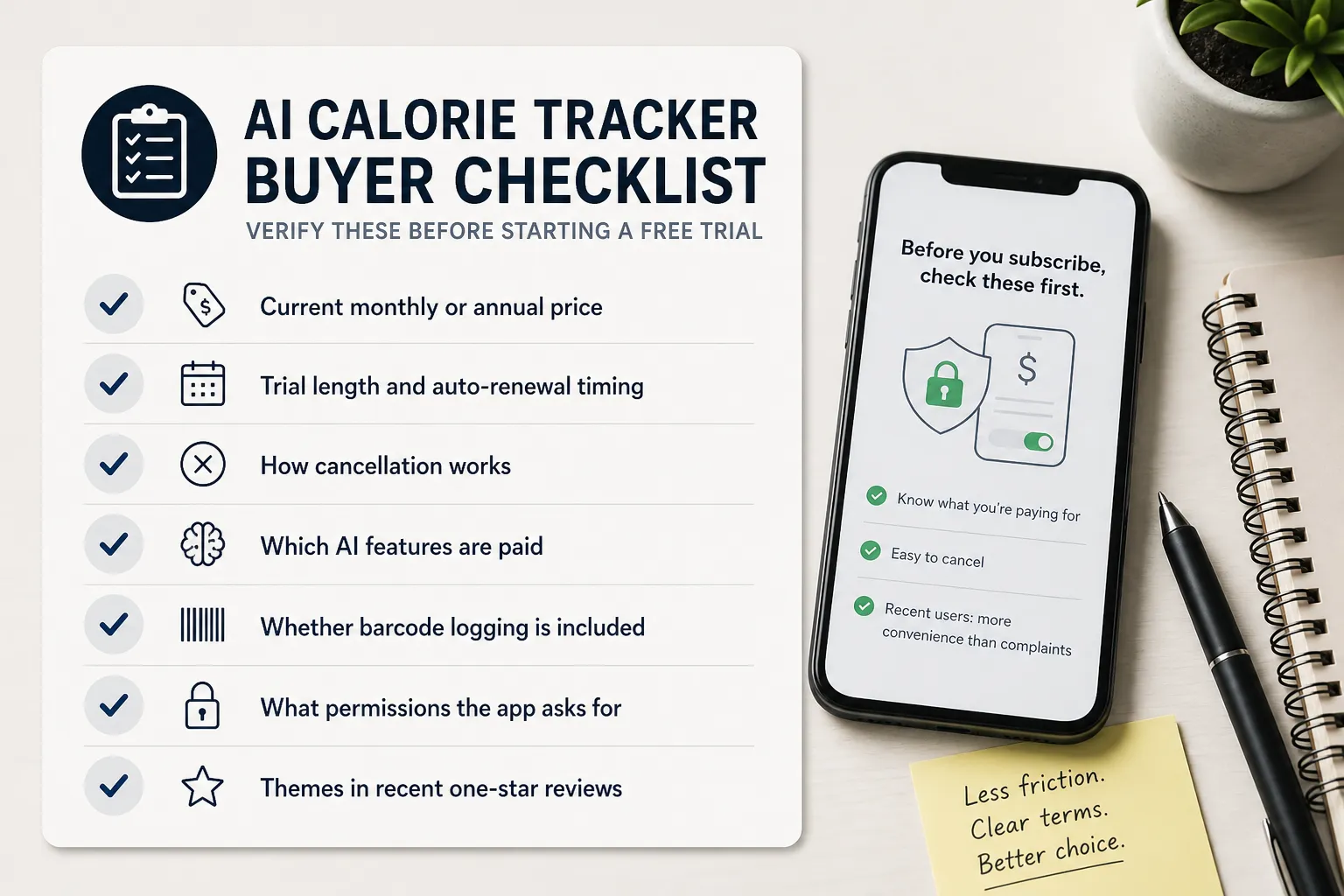
Free trials can still be worth using, but only if the cancellation path is obvious. A simple rule helps here: before paying for an AI calorie tracker, verify three things: what the AI feature actually includes, how easy it is to cancel, and whether recent users complain more about errors than convenience.
A quick pre-download checklist makes that easier:
- Current monthly or annual price
- Trial length and auto-renewal timing
- How cancellation works
- Which AI features are paid
- Whether barcode logging is included
- What permissions the app asks for
- Themes in recent one-star reviews
Recent reviews are more useful than lifetime ratings for spotting current trust issues. Look for patterns such as billing confusion, locked features, buggy updates, wrong food recognition, or too many required corrections. That said, reviews are directional evidence, not proof, because unhappy users are often more motivated to leave detailed complaints.
Privacy is also practical, not abstract. If an app uses meal photos, check whether images are uploaded for processing and decide whether you are comfortable sharing that kind of data. Marketing testimonials can be helpful context, but they are still marketing, and the FTC advises businesses to present endorsements and reviews transparently rather than as standalone validation FTC guidance.
If subscription friction and app clutter matter to you as much as logging speed, this related guide to calorie tracker apps without ads may help narrow the list. In real use, a less flashy app is often the better pick if it is easier to correct, easier to cancel, and clearer about what you are paying for.
Choose the app that makes imperfect logging sustainable
The practical rule is simple: choose based on your main constraint. Pick Kibora if correction plus interpretation matters, MyFitnessPal or Lose It! if food database familiarity matters, Cronometer if nutrient precision matters, Lifesum or Noom if guidance matters, and a photo-first app if speed matters and you accept some correction work.
The most useful AI calorie tracker is the one that turns imperfect food estimates into consistent decisions you can live with. That usually means the winner is not the app with the most futuristic demo, but the one you will keep using honestly when meals are rushed, messy, or repetitive.
Before you commit, try one app with your actual meals for a few days and watch how often you need to fix it. If AI helps you log faster but the corrections feel annoying, the magic wears off quickly.
If you need a starting target before testing, use a calorie target calculator first so you can judge the tracker in context. The best app for a busy lunch logger may not be the best one for someone tracking micronutrients or following a coached weight-loss plan.
- Key sources
- U.S. National Library of Medicine / PubMed Central search results for image-based dietary assessment
- PubMed search for food image recognition and dietary assessment
- MyFitnessPal official site
- Lose It! official site
- Cronometer official site
- Lifesum official site
- Noom official site
- App Store / Google Play listings for each app
- FTC guidance on endorsements and consumer reviews


