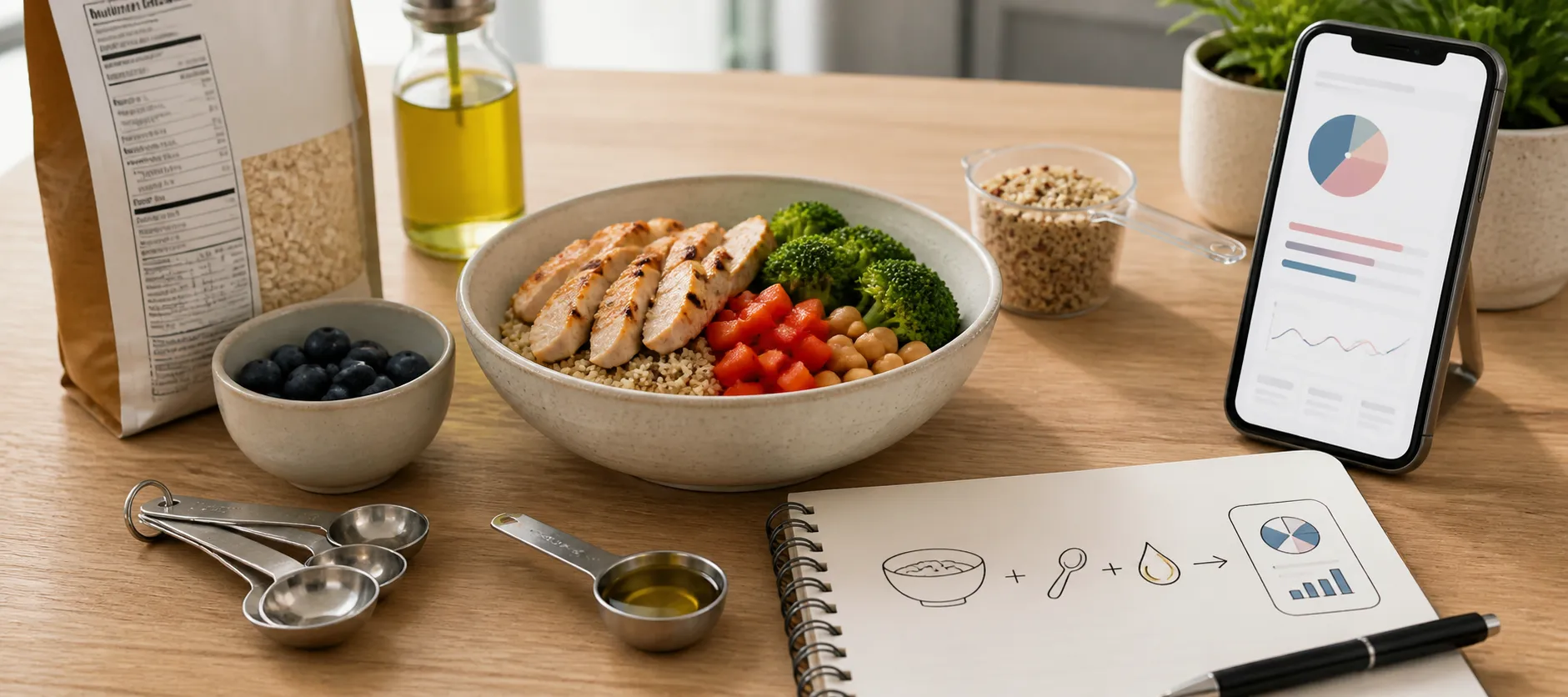
Yes, you can keep an estimated calorie log without weighing every ingredient. Start with labels and countable portions: a yogurt container or two bread slices can give you an entry when you check the labeled serving size and calories. Next, use measuring cups and spoons, then visual estimates when necessary.
This guide keeps the numerical log, rather than replacing it with general portion-control advice. The goal is a usable estimate with clear assumptions, not proof of exact intake. Spend extra effort where portion mistakes matter most, rather than measuring every ingredient equally.
Start with the portion information you already have
Gather package labels or matching nutrition references, cups and spoons if available, a familiar bowl, and a notebook or app. To count calories without a scale, identify the food, estimate the amount eaten, and multiply the matching calories per serving by the servings consumed.
Use this sequence to find a practical starting point, moving down when more specific information is unavailable:
- Actual product and amount: use its label and the fraction or number of servings you ate.
- Known recipe or matching menu item: use the recipe’s portion information or the restaurant’s listed item, accounting for differences you know about.
- Household measure: measure with a cup or spoon, then find nutrition information for that food and preparation.
- Visual estimate: estimate the amount using your bowl, plate, or hand as a reference, then match it to nutrition information.
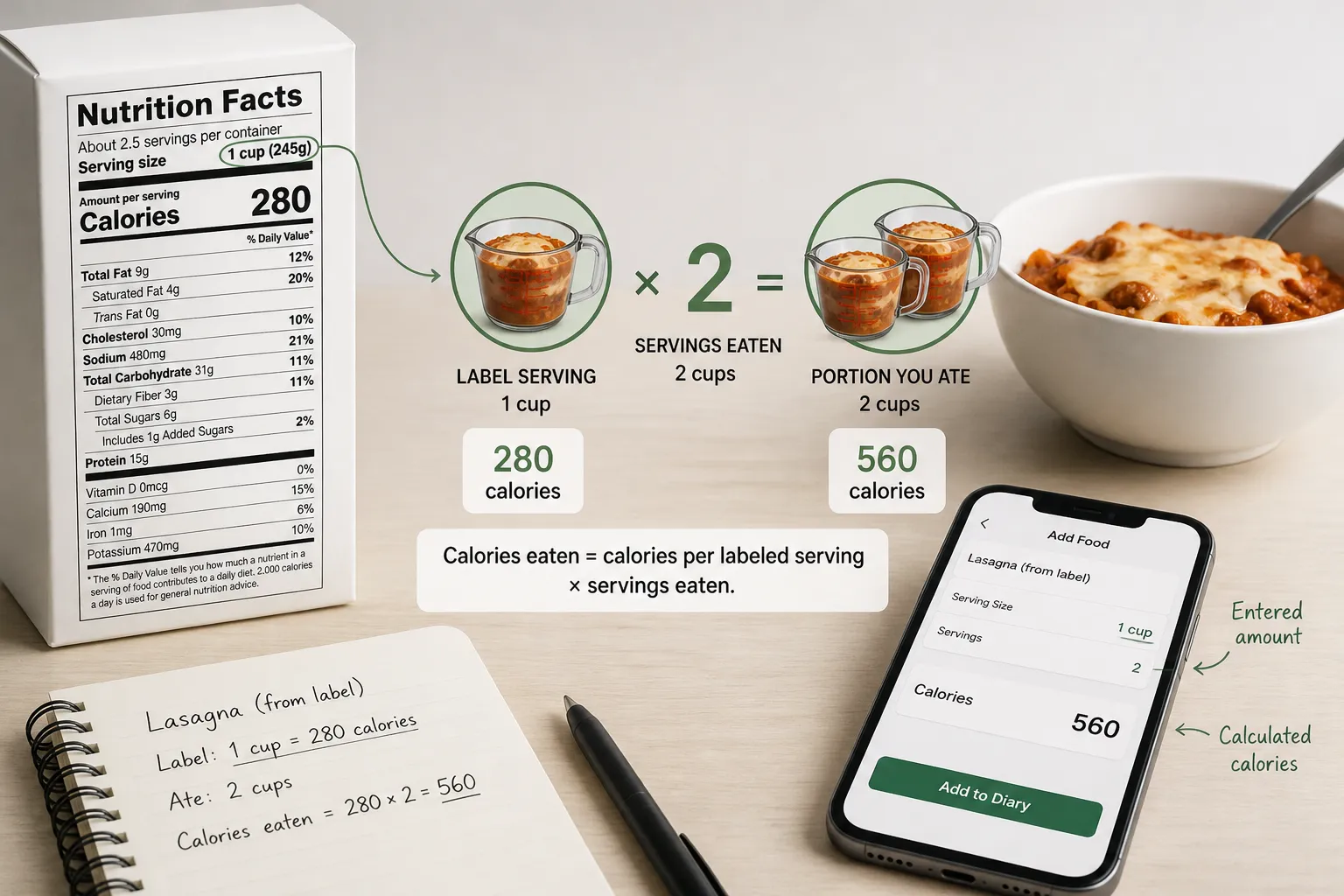
Calories eaten = calories per labeled serving × servings eaten. The FDA’s lasagna example gives 280 calories per cup: eating two cups means entering 560 calories. A labeled serving is not a recommendation or necessarily your eaten portion.
Check servings per container before logging a whole package. If it contains multiple servings, enter the number or fraction consumed, not automatically one serving.
Keep measured and guessed amounts distinct: a measured cup is different from “looks like a cup.” A palm or plate reference alone has no calorie value until you identify the food and match its estimated amount to a suitable reference.
Learn your usual portions—and measure the easy-to-miss extras
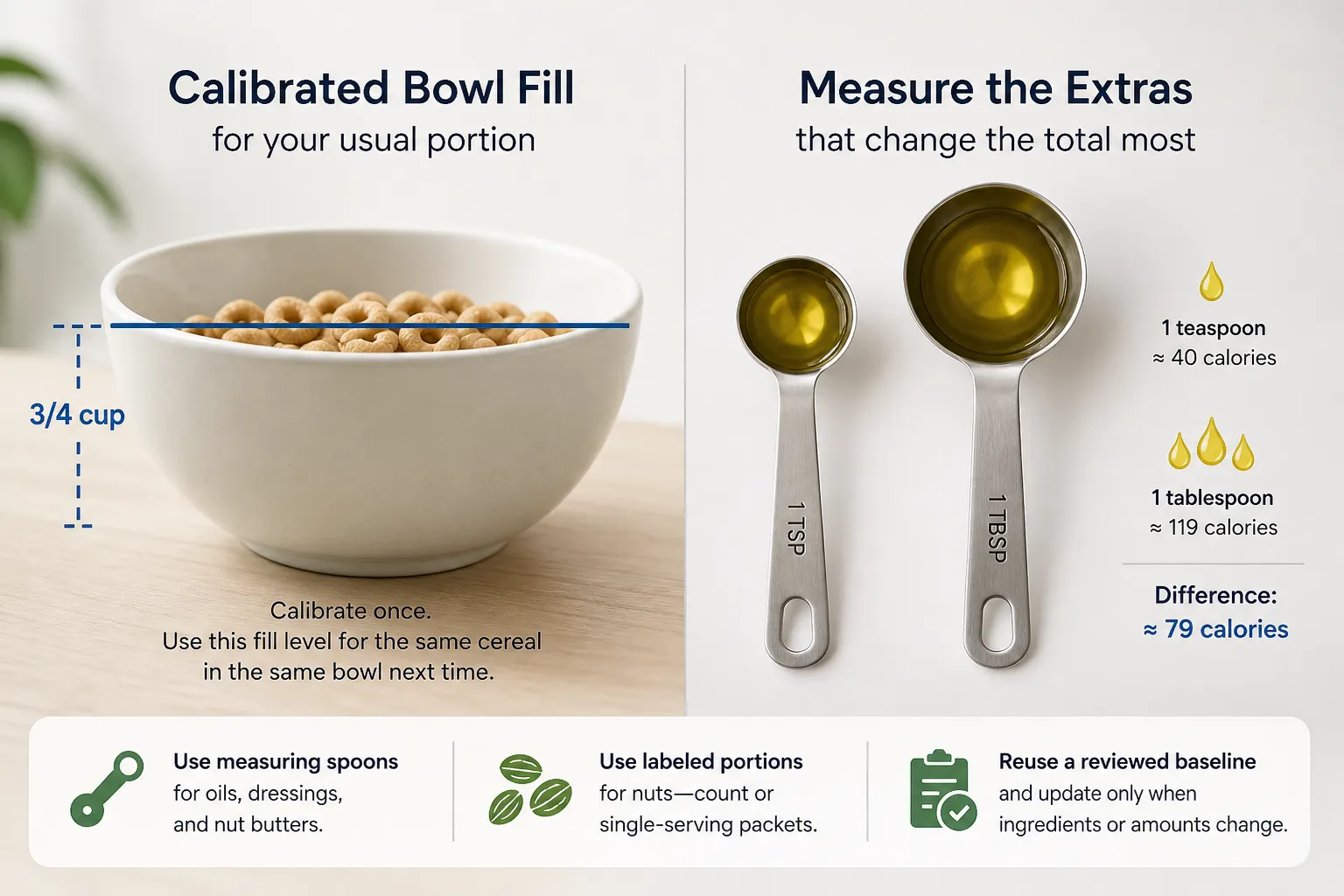
A known bowl fill level gives you a better starting point than “a bowlful.” For an optional one-time calibration, measure 3/4 cup of your usual cereal into your usual bowl and notice where it sits. Log that amount using the cereal’s label, rather than treating every bowl as one serving.
Next time, use that fill level as a visual reference for the same cereal in the same bowl. Record it as an estimated 3/4 cup if you did not measure it again. Different cereal shapes, a different bowl, or a more generous pour can change the amount.
Calibration builds familiarity, not guaranteed accuracy. A systematic review of portion-estimation training found that training can improve performance, but results depend on factors including food complexity and training exposure.
Your hands can provide rough fallback cues when nothing else is available, but they are not conversion charts. In a 67-adult study, fist volumes ranged from about 156 to 397 mL, illustrating how much hand size varies. Food shape adds another variable, so do not assign fixed grams or calories to a palm, fist, or thumb.
Give small additions more portion attention
Measure the additions that can change the total most; use familiar portions for foods you repeat. Oils, dressings, nuts, and nut butter deserve attention because relatively small quantities can materially change a meal’s calorie estimate, not because you need to avoid them.
Olive oil contains approximately 119 calories per tablespoon in OHSU’s nutrition education reference. A teaspoon is one-third of that volume, so confusing the two changes the estimate by about 79 calories. An eyeballed “tablespoon” is not the same input as a measured tablespoon.
Choose an easy portion reference for these extras:
- Oil or dressing: use a measuring spoon or the labeled amount in a single-serving packet.
- Nuts: use the actual label’s count-based serving, if provided, or a labeled packet instead of an undefined handful.
- Nut butter: use the spoon measure specified on your label rather than an undefined scoop.
For repeat meals, reuse a reviewed baseline instead of rebuilding the entry every time. Check what changed: a larger cereal portion, extra dressing, or a new topping needs an update. Reuse saves effort only while the ingredients and amounts remain reasonably similar.
For mixed meals, estimate the recipe before the serving
Homemade batches
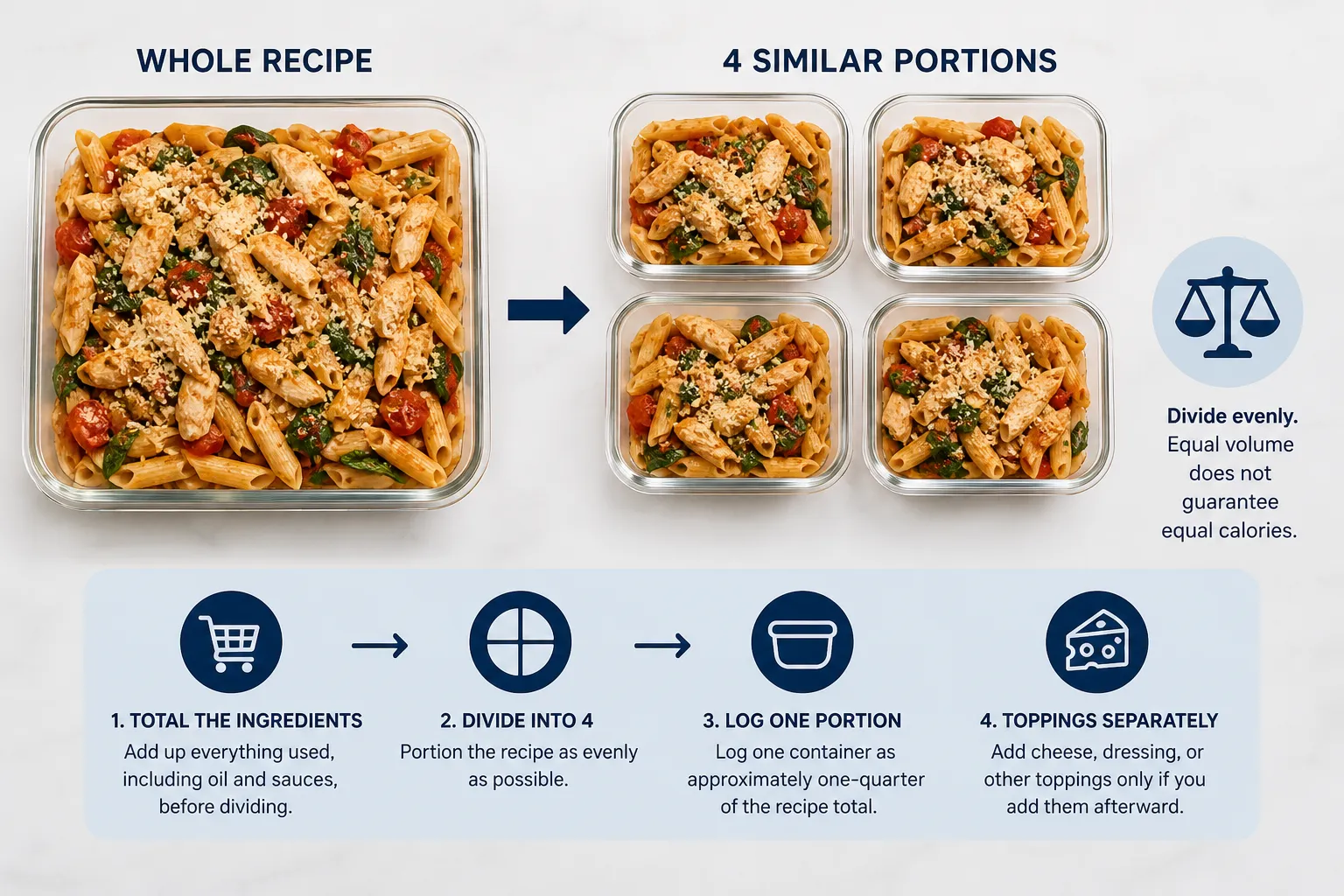
Total the ingredients actually used, including cooking oil and sauces, before estimating your serving. Whole packages, measured cups or spoons, and countable ingredients provide scale-free inputs: use each label’s calories per serving and the number of servings added, following FDA serving-size arithmetic.
For example, mix a pasta batch thoroughly and divide it among four similar containers. Log one container as approximately one-quarter of the recipe total; equal volume does not guarantee equal calories if the meat, pasta, or sauce is unevenly distributed.
Count ingredients already included in the recipe only once. Add cheese, dressing, or other toppings separately if you apply them afterward.
Restaurant meals
Start with the restaurant’s published nutrition when available, rather than a generic dish entry. Match a sandwich’s size and customizations, then account for the selected sides and drink; FDA menu guidance explains that calorie ranges or alternative values may reflect different options.
Without a matching listing, estimate the components separately: bread or starch, protein, vegetables, sauces, and toppings. Use matching food references and the best portion information available, but leave room for unknown recipe details.
Do not add an arbitrary “restaurant surcharge” or assume appearance reveals cooking oil. Hidden fats and recipe differences remain uncertain, even when the visible portion looks familiar.
Let a photo start the entry, not settle the calories
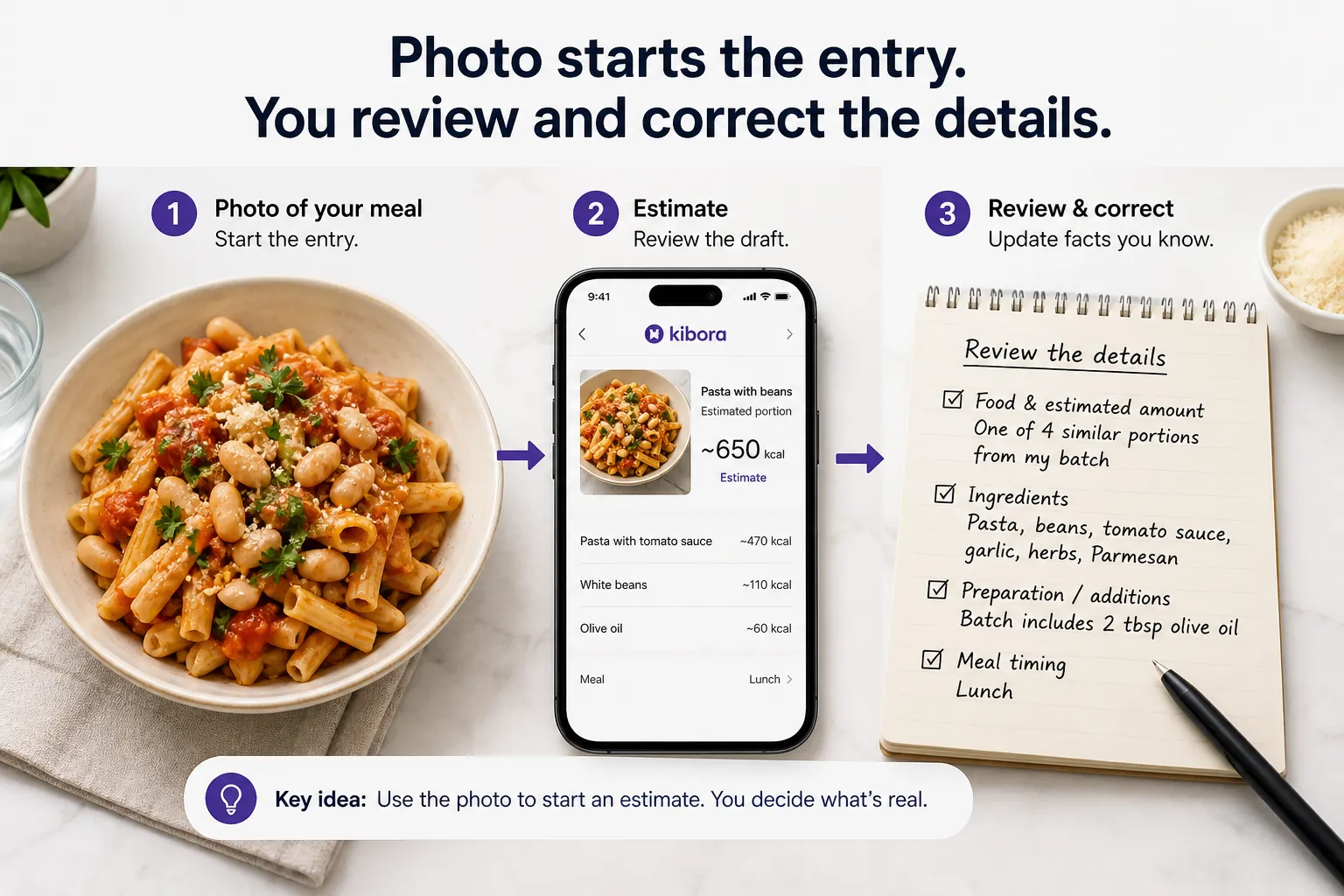
A photo can give you a starting entry to review instead of building a meal log from scratch. Treat a photo estimate as a draft calorie entry: correct the details you know rather than treating the number as a measurement.
Useful context names the food, amount, preparation, and additions, not just “a bowl of pasta.” For example: “One of four similar portions from my pasta-and-bean batch, plus a plain side salad; the batch already includes two tablespoons of oil.” This is context for checking the estimate, not a claim that a photo reveals those details.
Kibora’s documented photo logging workflow lets you estimate a meal, review it, correct it, and save it. Keep the review focused:
- Check the food and estimated amount, ingredients, nutrition details, and meal timing.
- Correct known facts, such as the amount on your actual label or a measured sauce addition.
- For this pasta meal, check that the batch oil is included, but not counted again as a separate addition.
You can also edit an entry after saving. Use a reviewed meal as a reference for repeats, while checking whether the portion or additions changed.
Hidden ingredients remain uncertain. A photo cannot reliably disclose every ingredient or exact recipe quantity. A systematic review of image-based dietary assessment found widely varying methods and lower relative-error ranges for simpler foods; it does not establish Kibora’s accuracy.
A full day of calorie tracking without a scale
This is a fictional arithmetic example, not a meal plan or calorie target. Every food value below is an assumed label or reference entry except the sourced olive-oil value. Substitute your own labels, matching food references, and actual amounts.
For packaged foods, multiply calories per serving by servings eaten, as the FDA’s serving-size guidance explains. Here, cups and tablespoons mean measured quantities; vegetable and salad portions are visual estimates matched to assumed reference entries.
| Meal |
Portion inputs |
Estimated calories |
| Breakfast |
Yogurt, 1 labeled serving: 150; cereal, 3/4 cup: 180; milk, 1/2 cup: 60; berries, 1/2 cup: 40 |
430 |
| Lunch |
Bread, 2 slices: 200; tuna, 1 pouch: 90; mayonnaise, 1 tablespoon: 90; sandwich vegetables: 30; fruit, 1 reference portion: 95 |
505 |
| Snack and drink |
Almonds, 1 packet: 170; measured latte milk, 1 labeled serving: 120 |
290 |
| Dinner |
1/4 pasta-bean batch: approximately 580; plain side salad: 30 |
Approximately 610 |
| Total |
All listed food, drink, and additions |
Approximately 1,835 |
The dinner batch uses these assumed ingredient totals: pasta 1,200 + beans 440 + sauce 280 + vegetables 160, plus two measured tablespoons of olive oil at approximately 238 calories. The OHSU nutrition card set lists olive oil at 119 calories per tablespoon, bringing the batch to 2,318 calories.
Stir the batch and divide it into four roughly equal-volume portions, using the same cup or ladle. The calculation is 2,318 ÷ 4 = 579.5, rounded to approximately 580; the assumed 30-calorie salad brings dinner to approximately 610.
Precise arithmetic does not make the portions exact. Equal-volume servings can contain different amounts of pasta, beans, and sauce if the mixture is uneven. The day’s total is therefore a reviewable estimate, not proof of exact intake.
Now suppose you discover two missed inputs:
- One additional tablespoon of oil eaten that day, beyond the oil already counted in your dinner portion: add approximately 119 calories.
- Half an extra almond packet, using this example’s assumed 170-calorie packet: add 85 calories.
The revised total is approximately 2,039 calories: 1,835 + 119 + 85. That change reflects two specific omissions, not a general error range to apply to every day.
Check whether your estimates are useful enough for your goal
A useful log and an exact intake figure are different things. Start by checking whether your entries are complete, consistent, and manageable, rather than treating a plausible daily total as proof that every estimate was right.
Run this quick audit before changing your approach:
- Completeness: Did I include the latte milk, cooking oil, dressing, and the actual fraction of the recipe I ate?
- Matching entries: Does each entry match the food, label, and preparation I actually used?
- Portion assumptions: Did I record whether the quantity was measured with a cup or spoon, taken from a package, or visually guessed?
- Repeatability: Can I reuse a stable meal entry while updating changed quantities, ingredients, and preparations?
- Effort: Can I keep this level of detail without making eating feel like a bookkeeping exercise?
For broad food awareness, approximate totals can help you notice patterns such as larger portions or recurring additions. Use estimated calories to understand patterns, not to certify an exact deficit; increase measurement precision when your decision requires more precise inputs.
If results and expectations diverge, audit the inputs before restricting further. Leaving out one tablespoon of cooking oil every day creates a consistent omission, not a mistake that cancels out across the week. The National Cancer Institute distinguishes this systematic error from random variation: repeated measurements do not eliminate a bias that keeps pushing estimates in the same direction.
A weekly average does not fix an ingredient you leave out every day.
Look for recurring gaps rather than adding an arbitrary percentage to every uncertain meal. If the same mismatch keeps appearing, this guide to why calorie totals do not add up can help you investigate.
A tightly specified intake goal may justify selectively weighing hard-to-estimate foods, such as oil or nut butter, or following a clinician’s individualized measurement instructions. Weighing improves the portion input, but it does not disclose a restaurant’s hidden recipe or make its nutrition information exact.
Do not use tomorrow morning’s weight to grade yesterday’s log or automatically compensate for an uncertain meal. NHLBI explains that short-term weight fluctuations occur, so one day’s eating and activity do not necessarily determine the next day’s weight.
If tracking becomes distressing, restrictive, or obsessive, step back from calorie logging and consider support from a qualified health professional.
Start with your next meal, not a perfect system
Make your next meal one complete, reviewable entry. Identify the food, enter the amount using the most specific information available, include additions such as sauce or cooking oil, and note which portions you guessed rather than measured.
Then choose one recurring uncertainty to improve, such as how much oil goes into your usual lunch. Check that detail next time instead of chasing perfect precision across every ingredient. Your log is an estimate you can review, not proof of exact intake.
If you would rather keep fewer numerical records, a lighter approach to eating better is a legitimate alternative, not a failure to track correctly.
If logging becomes distressing, obsessive, or restrictive, step back and seek support from a qualified health professional.
- Key sources
- FDA — Serving Size on the Nutrition Facts Label
- Gibson et al. — Accuracy of hands v. household measures as portion size estimation aids
- The Role of Various Forms of Training on Improved Accuracy of Food-Portion Estimation Skills: A Systematic Review of the Literature
- OHSU Moore Institute — Nutrition education card set
- FDA — Calories on the Menu
- AI-based digital image dietary assessment methods compared to humans and ground truth: a systematic review
- National Cancer Institute — Types of Measurement Error
- NHLBI — Aim for a Healthy Weight