


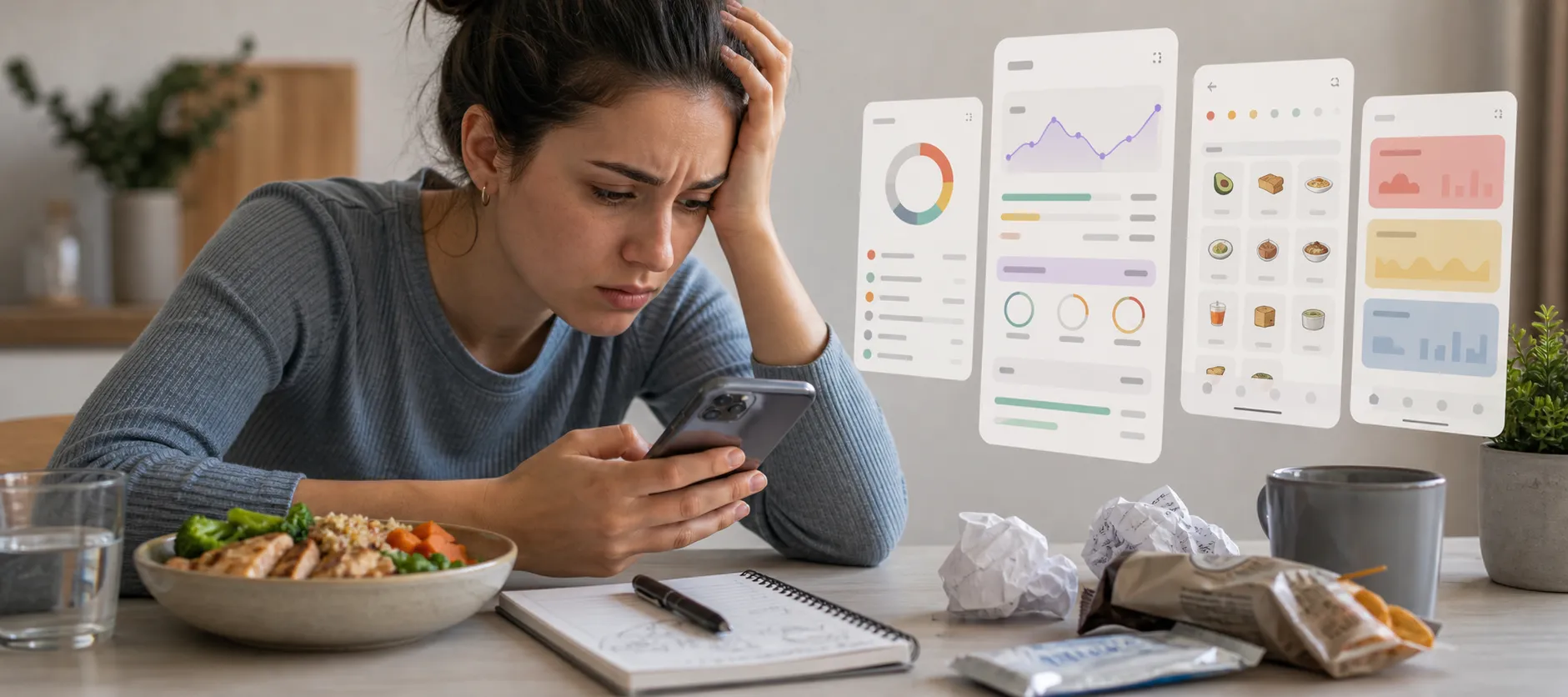
- What you'll learn
- Why food logging becomes too annoying to sustain once meals, travel, and real-life schedules get messy
- How calorie counts can look precise while still being built on rough estimates and questionable database matches
- Why streaks, red numbers, and rigid targets can make normal inconsistency feel like failure
- How ads, paywalls, and feature clutter interrupt the habit diet apps depend on
- Why many apps stop at totals instead of showing patterns that actually help with behavior change
- What a calmer tracking approach looks like when the goal is repeatability, not calorie theater
You start with good intentions. For three days you log everything, scan barcodes, weigh portions, and feel oddly in control. Then real life shows up: a restaurant meal with no clear entry, a wrong barcode, a recipe that takes ten minutes to build, a streak warning, or a feature locked behind a paywall.
That is the core problem. Diet apps do not usually fail because tracking is useless. They fail because they treat logging as the solution, instead of a support system that has to be easy enough to survive normal life. Self-monitoring can help with awareness and weight management when people can actually stick with it, as public health programs like the CDC's diabetes prevention resources suggest.
The contrarian point is simple: the issue is not tracking itself. It is that many apps ask people to do a hard habit inside products that make it harder, noisier, and less trustworthy. As we’ve argued before in this piece on when calorie tracking is actually useful, numbers only help if they lead to insight, not just more data entry.
Logging takes too much work at the exact moment people need ease
The biggest reason diet apps don't work long-term is simpler than most companies admit: food logging is behaviorally expensive. It asks for focus, patience, and tiny admin decisions right when people are hungry, rushed, stressed, eating with family, grabbing takeout between meetings, or trying to get through travel without overthinking every bite.
That is the primary failure mode. Not that tracking is useless, but that most apps treat daily logging like a reasonable chore when, in real life, it is competing with work, kids, restaurant menus, social plans, and plain old fatigue.
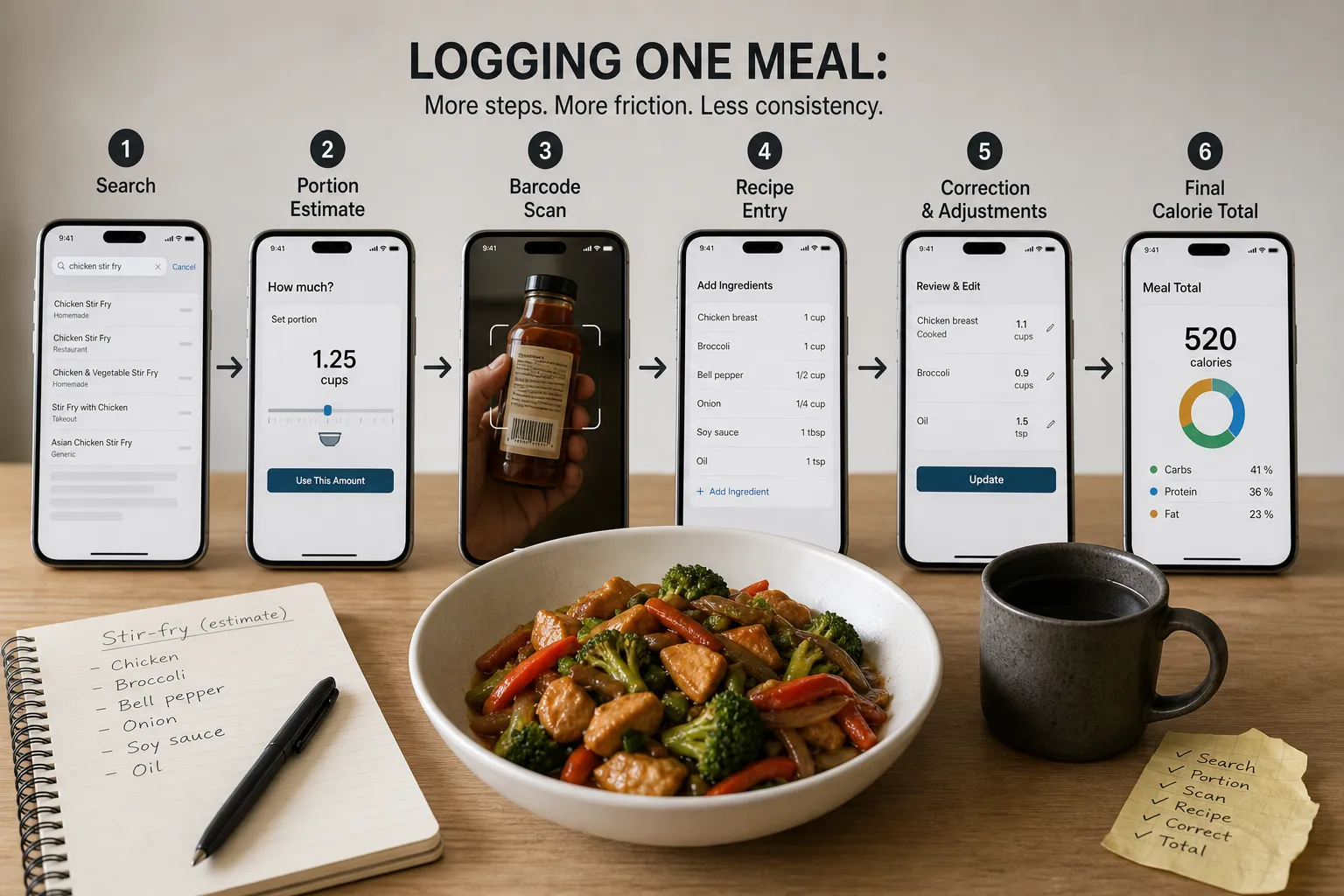
Look at what "just log your meal" usually means in practice. You search a database, choose between five near-duplicate entries, guess which one is least wrong, adjust the serving size, decide whether that was 120 grams or 1.5 cups, maybe scan a barcode, maybe edit the macros, then repeat for each ingredient or side.
A homemade stir-fry can become a mini data project. A restaurant burrito can send you through ten chain listings and user-submitted entries that all look similar but disagree. A shared family meal or leftovers are worse, because now you are estimating a portion of a recipe you did not build in the app in the first place.
This is why so many people start strong and then fade. Barcode scanning, manual search, and recipe builders can feel organized in week one, but by week three they often feel like unpaid clerical work.
The problem is not lack of discipline. Quitting is often a rational response to a tool that keeps asking for precision in situations that are naturally messy.
Research on dietary self-monitoring consistently finds that the benefit depends heavily on frequency and adherence, not just the existence of a tracking feature set. If a method is too annoying to use regularly, its theoretical completeness does not matter much in practice according to systematic review evidence on dietary self-monitoring and weight loss.
That is the part many apps underestimate. They optimize for database depth, feature count, and nutritional detail, while ignoring the reality that every extra tap, confirmation, and correction raises the odds that the habit breaks tonight, not someday.
Adherence matters more than perfection. A perfect logging system people abandon is worse than a good-enough system they can actually maintain when life gets noisy.
This is also why the best app is rarely the one with the most features. It is the one that makes the right action easy enough to repeat even when the user is tired, late, distracted, or eating something that does not fit neatly into a database.
AI-first apps are trying to solve this by speeding up input, and that can help. If a user can describe a meal conversationally instead of building it ingredient by ingredient, the burden drops immediately.
But speed alone does not fix everything. If the result is hard to trust, hard to correct, or too vague to be useful, faster logging just creates a different kind of friction.
That is the more honest standard. Tools like MyFitnessPal, Lose It!, Cronometer, and Noom are recognizable because they made tracking mainstream, but mainstream is not the same as sustainable. Modern alternatives, including Kibora's more calm and correctable approach, are directionally closer to what people actually need: less admin, less interruption, and a system built around repeatability rather than data-entry heroics.
When calorie counting fails, it often fails here first. Not in the science of self-monitoring, but in the everyday mechanics of asking people to do too much work for every meal.
The calorie number looks exact, but it often isn’t
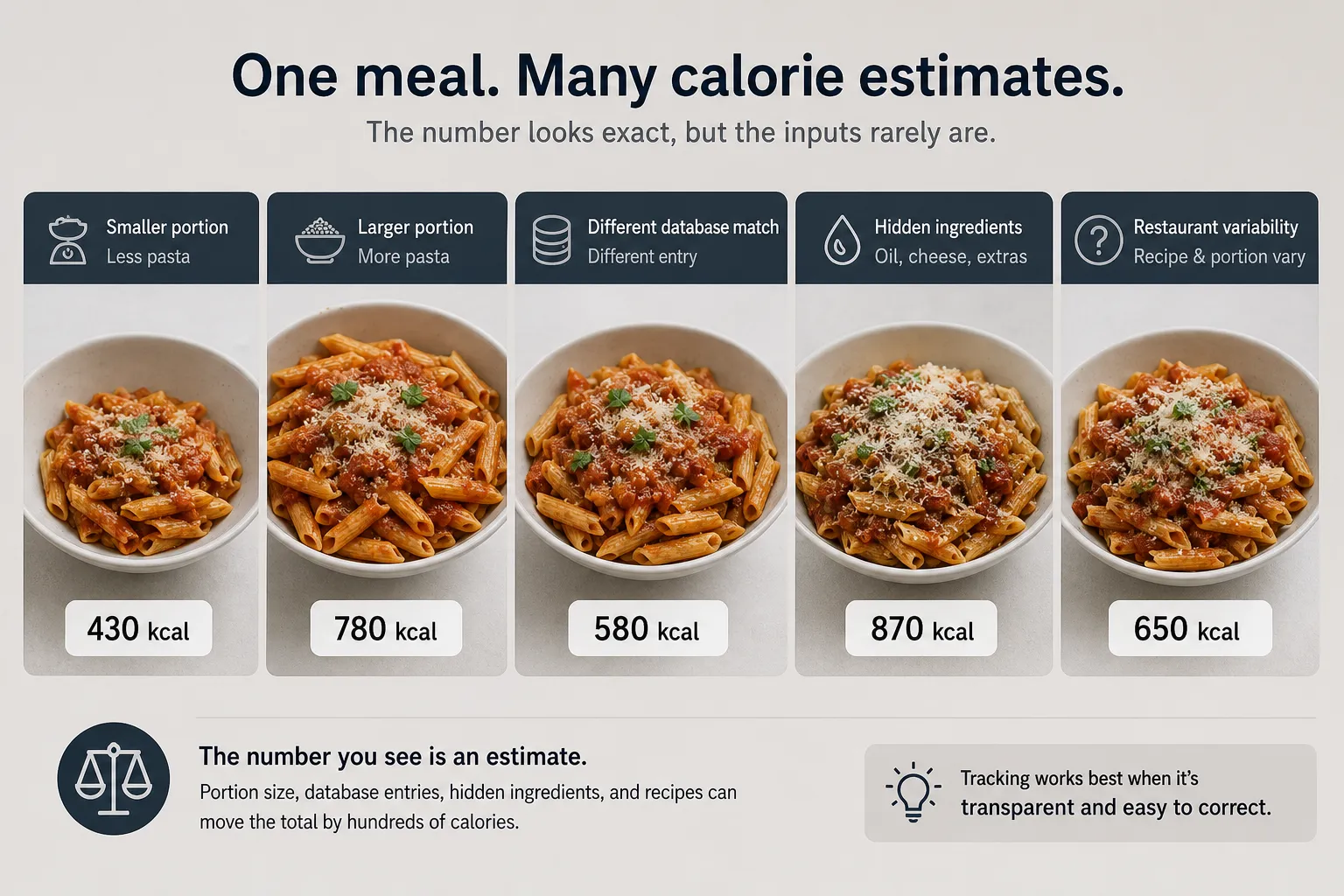
Diet apps love to show a clean number like 642 calories, as if food tracking were a precise measurement. But a lot of that number is built from rough inputs, guesses, and mismatched records, so what looks exact is often just an estimate with confidence it did not earn.
That is not always the user’s fault, and it is not always the app’s fault either. Food data is inherently messy, especially once real meals replace barcodes and packaged servings.
Portion size is the first place trust starts to wobble. Research on dietary reporting error and portion-size estimation has long shown that people struggle to estimate how much they ate, particularly without weighing food.
A tablespoon of peanut butter can be level or heaped. A bowl of pasta can mean a modest serving or something twice as large. A restaurant salad can look light while hiding extra oil, cheese, dressing, and add-ons that never make it into the log.
Then there is the database problem. Most tracking apps rely on large food databases, often built from standardized sources like USDA FoodData Central, plus brand data and user-generated entries. That sounds comprehensive, but in practice it often means duplicate foods, incomplete listings, and multiple entries for what appears to be the same item.
That is how two entries for “chicken burrito” or “oatmeal, cooked” can show meaningfully different calorie totals. The user is left picking the one that seems closest, which turns tracking into a guessing game while the app still presents the final result as a fact.
Mixed dishes and restaurant meals are where the illusion really breaks. Home recipes vary, restaurant portions vary, and ingredients like oil, butter, sauces, and dressings can swing the total more than people expect.
AI and photo logging can reduce typing, but they do not remove uncertainty. A camera may correctly recognize pasta or curry while still missing portion size, hidden ingredients, cooking fat, or whether that “small drizzle” was actually two tablespoons of oil.
This is why correctability matters almost as much as accuracy. If an app makes it hard to swap the wrong database match, edit a portion quickly, or fix an obvious mistake, trust breaks fast because the user knows the number is off and cannot easily do anything about it.
And once trust breaks, adherence usually follows. People can live with estimates if the app is transparent about uncertainty and easy to correct, but they stop caring when a supposedly precise tool keeps producing shaky numbers they cannot confidently act on.
If you want a deeper look at what makes calorie tracking feel believable enough to use, this breakdown of calorie tracking accuracy and correctability gets into the details. The practical standard is not perfection. It is whether the app is honest enough, flexible enough, and calm enough that users can keep going without feeling misled.
Streaks and diet pressure can make food feel like a moral test
Not every reminder, goal, or coaching prompt is bad. For some people, structure is exactly what makes a habit stick. The problem is that many diet apps blur support with pressure, and that shift changes how logging feels.
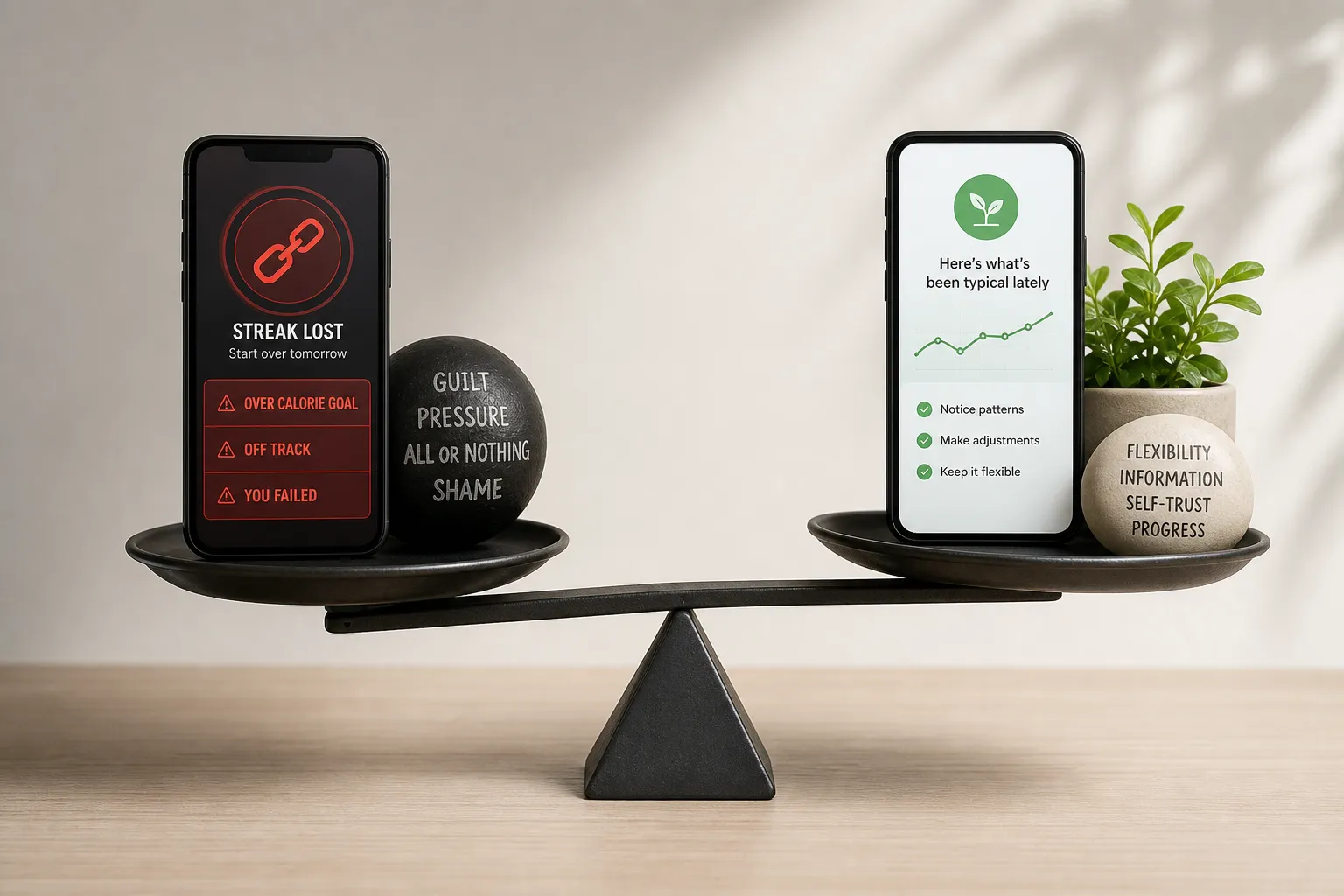
A streak can look harmless until real life interrupts it. Miss one day, see the streak reset, and a tool that was supposed to help now tells you that normal inconsistency counts as failure.
The same thing happens with red numbers, warning language, and rigid daily targets. If you go over a calorie goal at dinner and the app instantly frames the day as off-track, plenty of users stop logging right there, not because they do not care, but because the app has already made the day feel ruined.
That matters because food is emotionally loaded in a way step counts or screen-time limits usually are not. Judgmental design can make people less honest with the app, less consistent with logging, and more likely to avoid the tool altogether.
Controlling design versus autonomy-supportive design
Controlling design says: hit the target, keep the streak, get back on plan. Autonomy-supportive design is calmer. It treats intake as information, allows flexible goals, and helps users notice patterns across days or weeks instead of turning every meal into a pass-fail test.
A missed day should not trigger restart messaging that feels like a confession booth. Better feedback sounds more like, "Here is what has been typical lately," and less like, "You broke the chain."
This is also where some structured programs do outperform bare logging. Reviews of digital weight-loss interventions suggest that approaches with coaching, accountability, or behavior-change support can improve outcomes compared with simple self-monitoring alone when that support reduces ambiguity and helps people stay engaged.
But more structure is not automatically better. Program-based apps in the Noom category can be useful for users who want a curriculum, coaching, and regular accountability, yet the same features can feel exhausting when the experience lands as rules, notifications, lessons, and subscription pressure.
That is the real issue with guilt-based motivation. It can create short-term compliance, but it often creates program fatigue too. People do not quit because they are lazy. They often quit because being managed by an app all day is draining.
The better model is not no goals, no reminders, and no accountability. It is support that feels like support, not surveillance. A calmer tracking philosophy, including the kind Kibora points toward, makes room for flexible targets, easy course correction, and pattern awareness without treating every imperfect day like a personal failure.
Ads, upsells, and clutter break momentum
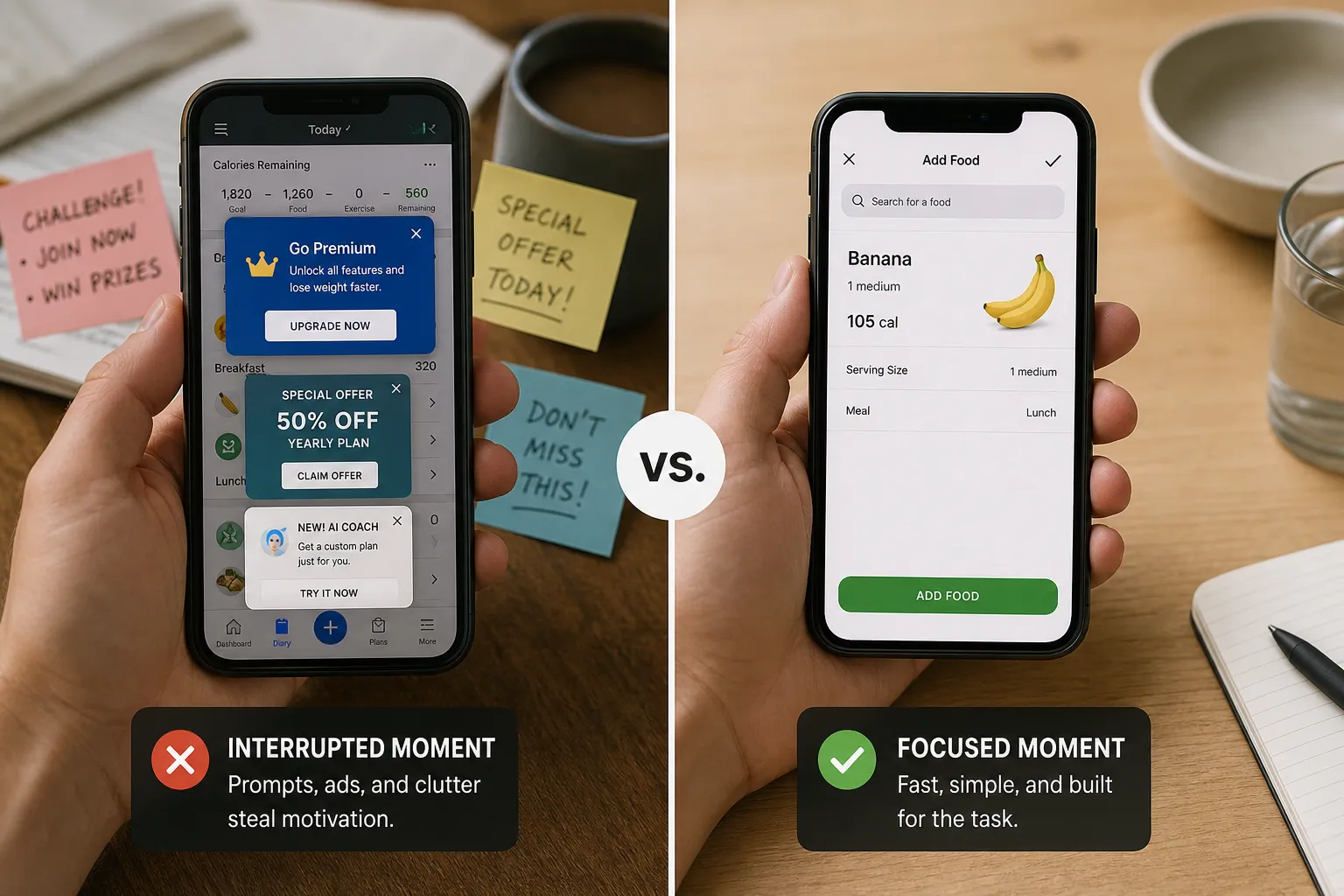
A diet app’s core job is to protect the logging moment. If someone opens the app hungry, rushed, or halfway through making dinner, every pop-up, premium prompt, and crowded panel spends a little of the motivation that got them there in the first place.
That is why interruptions are not neutral. A tracker that slows down food entry with ads or upgrade screens is not just annoying, it is damaging the exact consistency the app depends on to be useful long-term.
This is where a lot of products get their business model backwards. They need frequent logging to create value, but then they interrupt logging with the monetization and feature clutter wrapped around it.
Public app reviews show the pattern clearly, even if they do not prove anything about clinical outcomes. On the Apple App Store and Google Play, recurring complaints around apps like MyFitnessPal often mention pricing changes, premium prompts, ads, bugs, syncing problems, and frustration about where features have moved or what now requires payment.
Those complaints matter because they point to a recurring product failure: the app asks for trust while interrupting the habit. A user who only wants to log lunch should not have to navigate a monetization maze before entering food.
Paywalls are not the problem by themselves. People will pay for a tool that clearly saves time, reduces friction, or gives genuinely useful insight.
The resentment starts when the paywall shows up inside an essential workflow moment. If barcode scanning, meal entry, saved foods, or other high-frequency actions feel unstable, hidden, or constantly nudged toward upgrade, the app starts to feel less like a coach and more like a toll booth.
Feature clutter creates a similar problem from a different angle. MyFitnessPal, Lose It!, Cronometer, and Noom all sit in different parts of the market, but they illustrate the same risk: the more the dashboard tries to do at once, the easier it becomes to bury the one thing the user came to do.
For many people, the failure is not a lack of capability. It is that the path from opening the app to logging breakfast gets crowded by program banners, community tabs, coaching hooks, progress widgets, and subscription prompts.
Subscription fatigue is really a trust problem. Users are usually willing to pay when the value is obvious and the product respects their momentum. They become less willing when the app feels like it is withholding speed, simplicity, or formerly normal functionality just to create upgrade pressure.
This is one reason calmer products feel different even before they feel smarter. Kibora’s philosophy is useful here: tracking should be fast, correctable, and focused on the action the user is trying to complete, not on exhausting them with choices before the food is even logged.
If ads, paywalls, or interface clutter are the main reason you keep falling off, it helps to compare tools built around a cleaner workflow. This roundup of calorie tracker apps without ads is a practical place to start.
Long-term adherence is fragile. When an app keeps interrupting the habit it needs in order to help, quitting is not a discipline failure. It is often a rational response to a tool that keeps getting in its own way.
Most apps collect numbers, then leave you alone with them
The biggest missed opportunity in food tracking is simple: logging is not the outcome. Entering breakfast, scanning a barcode, or confirming a calorie estimate only matters if the app helps you notice something useful and make a better decision next time.
Too many diet apps stop at the ledger. They give you a daily total, maybe a red or green target, and then quietly hand the problem back to you: what exactly should you do differently tomorrow?
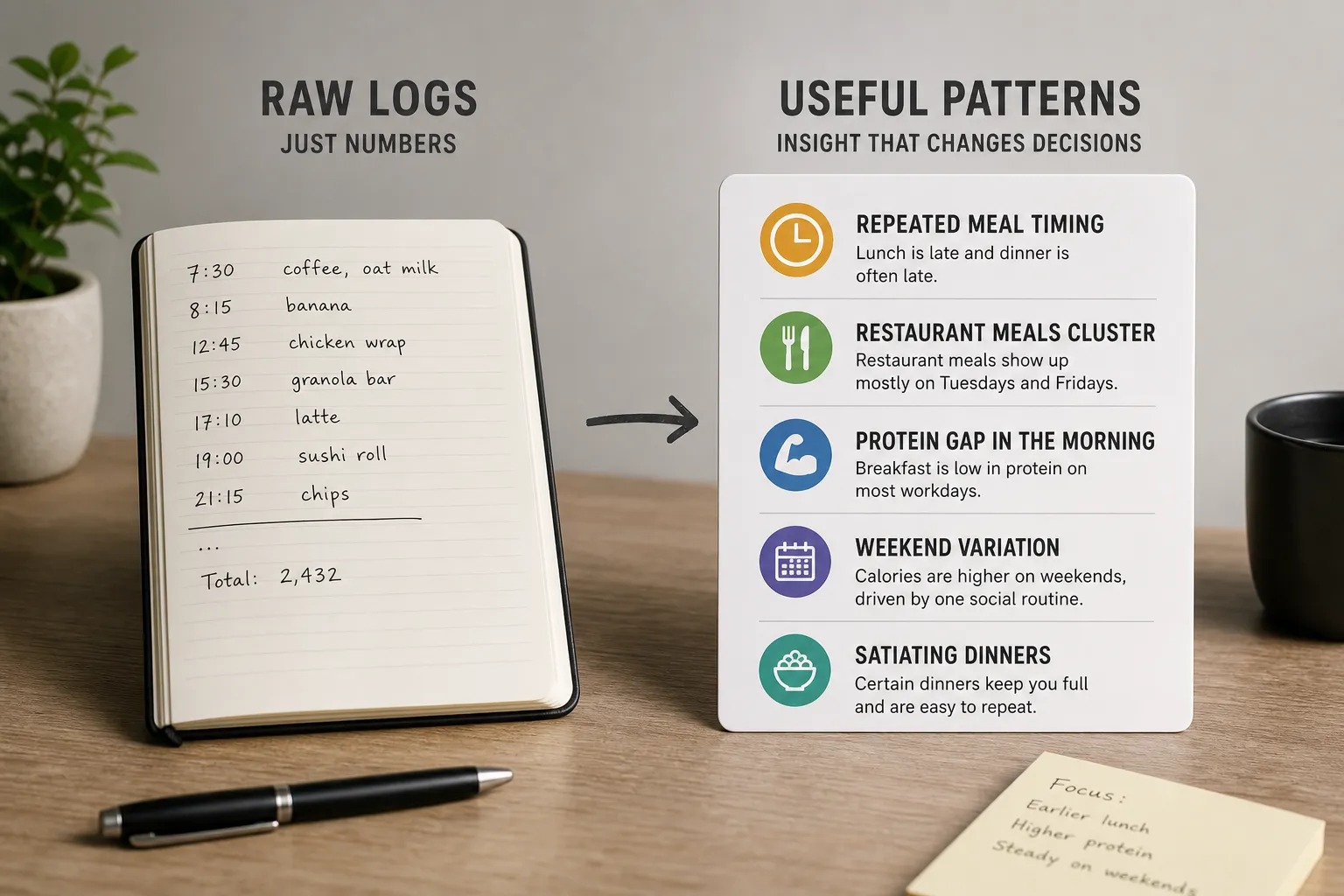
That is where a lot of calorie counting fails. A number can tell you that you went 300 calories over, but it cannot tell you whether the real pattern is restaurant lunches on Tuesdays, low-protein breakfasts that leave you raiding snacks at 4 p.m., or weekends that look nothing like weekdays.
Useful feedback is usually about patterns, tradeoffs, and repeatability, not one isolated day. The broader behavior-change context around weight management has always been bigger than a single calorie total, which is why public health guidance focuses on sustained habits and calorie balance over time, not perfection at every meal according to the NHLBI.
Shallow feedback sounds like this: you were over, you were under, you hit your goal, your streak is alive. Useful insight sounds more like this:
- Your highest-calorie snacks tend to happen after low-satiety lunches.
- Your breakfast is consistently low in protein on workdays.
- Restaurant meals are not random. They cluster around your busiest days.
- You eat more on weekends, but mostly from one recurring social routine.
- Certain dinners keep you full and are easier to repeat without feeling restricted.
That kind of interpretation reduces ambiguity. It turns a fuzzy sense of failure into something specific and adjustable.
This is also why standalone logging apps often underperform once the novelty wears off. MyFitnessPal, Lose It!, Cronometer, and Noom all solve different parts of the category, but many users still end up with a pile of entries and very little clarity about which choices actually matter most for them.
The better question is not “Did I log enough?” It is “What is this data showing me about my routine, hunger, satiety, convenience, and defaults?” If the app cannot help answer that, then more logging just creates more data noise.
Kibora’s philosophy makes sense in that light. Fast, calm, correctable tracking should lead to understanding, not just compliance. The point is not to build a more detailed archive of meals you regret. The point is to notice what repeats, what satisfies you, and what is easiest to change.
If you want the data to become more actionable, it helps to think in terms of decisions rather than totals. This is where using food data for better decisions matters more than chasing a perfect daily number.
When an app only reports totals, it leaves all the interpretation work to the user. When it helps surface patterns, it finally starts doing the job people assumed tracking would do in the first place.
Use an app only if it gives more than it takes
A diet app is worth keeping only if it lowers effort, earns trust, avoids shame, respects your attention, and turns logs into decisions. If it asks for constant work and gives back vague totals, streak anxiety, or noisy dashboards, quitting is not a failure. It is a rational response to a bad trade.
The standard is simpler than most app store pages make it sound. A useful app should work on an ordinary Tuesday, not just during a highly motivated first week, and it should support the kind of sustainable habits that public health guidance keeps pointing people toward over time, not short bursts of perfect compliance according to NIDDK.
A quick mental checklist helps. Ask yourself:
- Is logging fast enough that I will still do it when I am busy?
- Can I spot and correct mistakes without a fight?
- Does the app treat missed logs and imperfect meals as normal, not as moral failure?
- Does it stay out of the way, with minimal ads, clutter, and interruptions?
- After I log, do I actually learn something useful about my patterns or next choice?
That last question matters most: Did logging this meal help me understand anything, or did it just consume attention? A calm tracker that produces imperfect but usable patterns is usually more valuable than a feature-heavy tracker people abandon after two weeks.
This is also the right lens for judging alternatives. Kibora is aligned with that philosophy, not as a magic fix, but as an example of what better tracking should feel like: fast, calm, correctable, and focused on patterns rather than calorie theater. If you want to see that kind of approach, you can explore Kibora.
The goal is not to become perfect at logging. The goal is to learn enough to make better choices, consistently, without turning food into a second job.
- Key sources
- CDC - National Diabetes Prevention Program / self-monitoring resources
- Systematic review on dietary self-monitoring and weight loss
- USDA FoodData Central
- Research on dietary reporting error and portion size estimation
- Systematic review on digital interventions for weight loss
- Apple App Store - MyFitnessPal listings and reviews
- Google Play - MyFitnessPal listing
- National Heart, Lung, and Blood Institute (NHLBI) - Aim for a Healthy Weight
- NIH/NIDDK - Weight management and healthy living resources


