- What you'll learn
- Where the 30-plants-a-week idea came from and what the original research actually found
- Why plant variety may matter for the gut beyond just hitting a fiber target
- What counts as a plant food in a weekly tally, including grains, beans, herbs, and spices
- How to count mixed meals and avoid inflating the number with tiny trace ingredients
- Why 30 is a useful tracking goal, but not a clinical threshold or guarantee of better health
- How to adapt plant diversity goals if you have IBS or FODMAP sensitivity
“30 plants a week” sounds like another viral nutrition rule, but this one has a real research origin. The catch is the part social posts often skip: it is a diversity benchmark, not a gut-health prescription.
That makes it worth tracking, without treating it like a magic number or a guaranteed fix. Someone eating spinach, banana, oats, and broccoli every day may be eating well, but not very widely.
This article will cover where the number came from, what counts as a plant, why variety may matter for the gut, and how to use the target flexibly.
Where the 30-plants-a-week idea came from
The most-cited origin of the 30 plants a week idea is an analysis from the American Gut Project, a large citizen-science effort that collected microbiome samples and lifestyle data from volunteers. In the widely referenced Cell paper, one of the standout diet patterns was plant-food diversity.
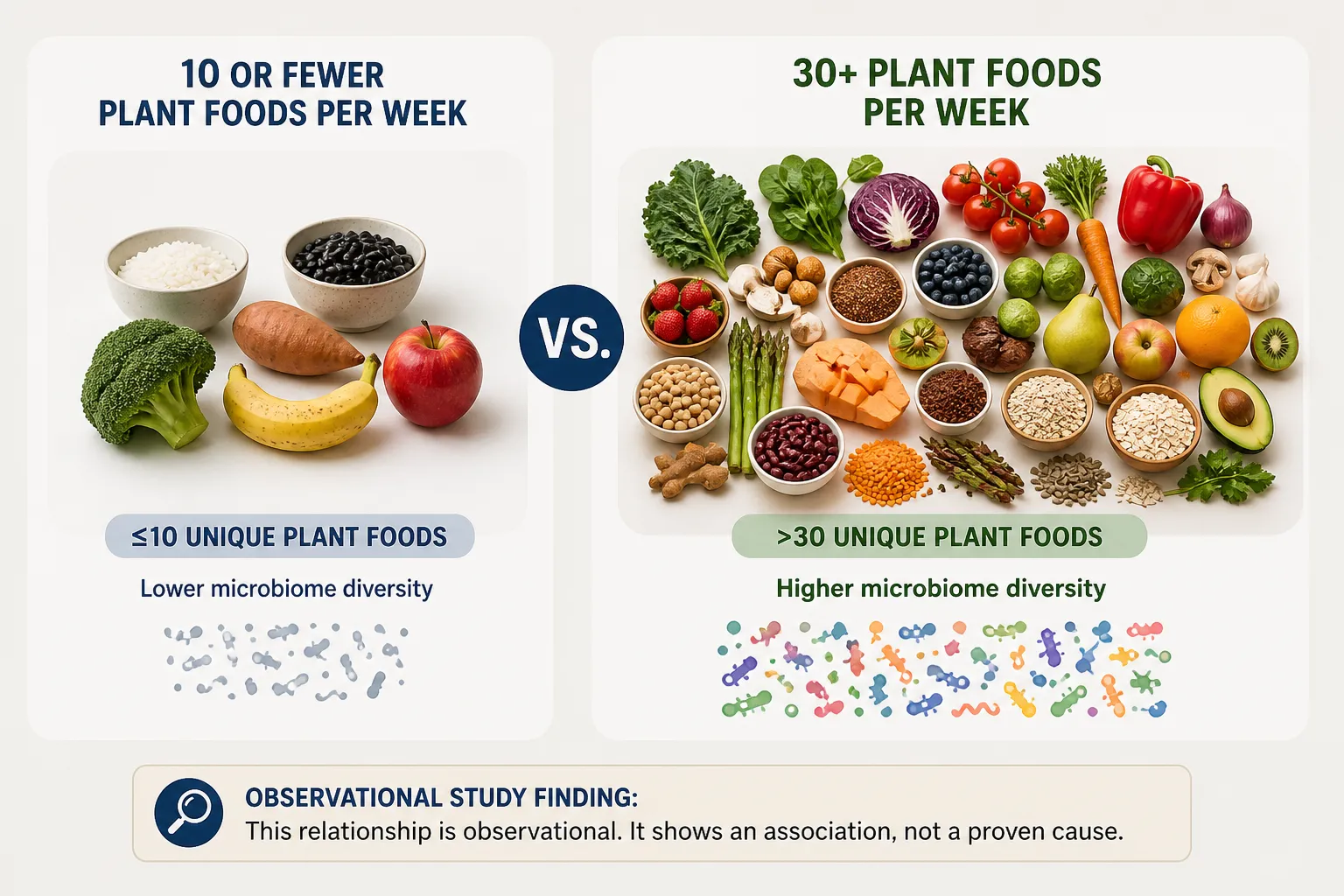
In plain language, people who said they ate more than 30 unique plant foods per week tended to have more diverse gut microbiomes than people who ate 10 or fewer. The project itself was unusually large and exploratory, which is part of why the finding spread so widely beyond research circles. You can see the broader project background at the American Gut Project.
“>30 unique plant foods per week was associated with significantly higher microbiome diversity than ≤10 plant foods per week.”
That is the actual finding. The popular rule came later. The number 30 was not introduced as a clinical guideline or a proven treatment target. It came from a comparison inside an observational dataset.
This limitation matters. The science behind 30 plants is real, but the strongest claim is association: higher plant variety was linked with higher microbiome diversity, not proven to cause it. People who eat a wider range of plants may also have other health-supportive habits, which means confounding is possible.
A simple way to picture it is to compare a week built around the same few staples with a week that rotates beans, grains, vegetables, fruits, nuts, seeds, herbs, and spices. That does not prove 30 is the magic cutoff. It does show where the idea came from and why diversity became the part worth paying attention to.
Why variety may matter more than one perfect gut food
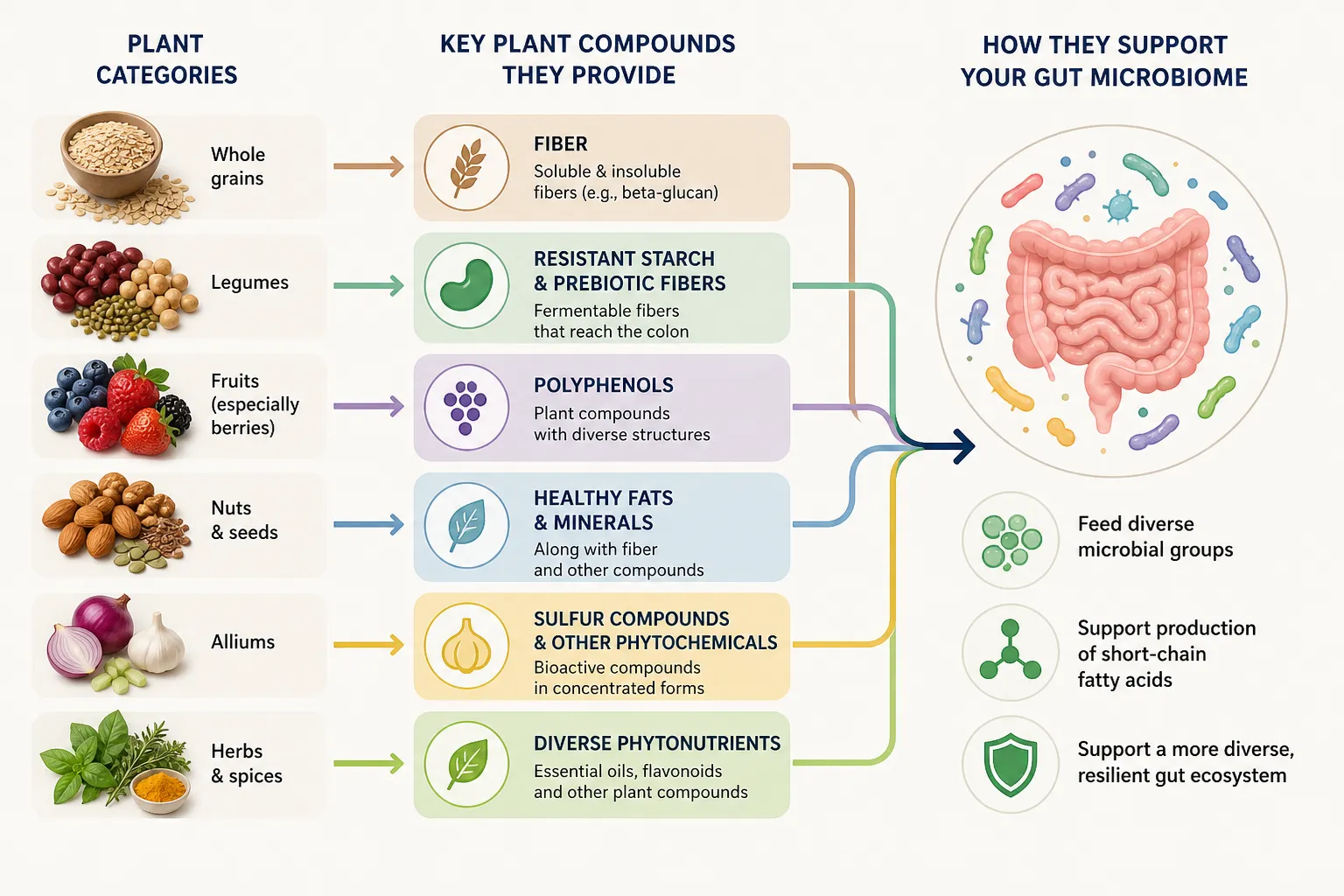
The study result becomes more believable once you look at the biology. Plant diversity matters because the gut is not fed by fiber alone. Different plants deliver different fibers, starches, polyphenols, and micronutrients, and those compounds can be used by different microbial groups.
That is why “eat more fiber” is helpful but incomplete advice. A more precise idea is to eat more kinds of fibers and plant compounds, because fiber is not one single substance with one single effect. Harvard’s overview of dietary fiber explains that soluble and insoluble fibers behave differently in the digestive tract, and whole plant foods often contain a mix.
In practice, different plants bring different inputs. Oats are known for beta-glucan, beans provide fermentable fibers and resistant starch, berries contribute polyphenols, and nuts and seeds add fiber along with fats and minerals. Even herbs and spices can matter here because they pack concentrated plant compounds into small amounts.
Some of these compounds act as substrates for microbes, meaning they can be fermented or otherwise metabolized in the gut. Resistant starch and certain prebiotic fibers are especially relevant because they can help feed microbes that produce short-chain fatty acids, while polyphenols also appear to interact with the gut microbiota in ways researchers are still working to map out clearly.
This helps explain why repeatedly eating one so-called superfood is probably less useful than rotating across many plant foods over the week. One person could eat the same salad every day and still miss the broader range of compounds found in legumes, whole grains, nuts, seeds, berries, alliums, herbs, and other plant groups.
Variety also matters beyond the microbiome. Different plant families contribute different vitamins, minerals, and bioactive compounds, so a wider spread of foods can make nutritional coverage more robust, not just more fibrous. If you want a deeper look at the basics, our guide to fiber and digestion covers why fiber works through more than one pathway.
That said, microbiome diversity should be handled carefully. It is often discussed as a feature of a more resilient gut ecosystem, but it is not a simple health score, and higher diversity is not automatically better in every context. The Human Microbiome Project is a useful reminder that the microbiome is highly complex, varies across people, and does not translate neatly into one universal target.
So the logic behind 30 plants a week is plausible without being absolute. A diverse intake gives your gut access to a wider menu of compounds, which may support a wider range of microbial niches, but that is still different from saying there is one perfect number or one guaranteed outcome.
What counts as a plant in the weekly tally
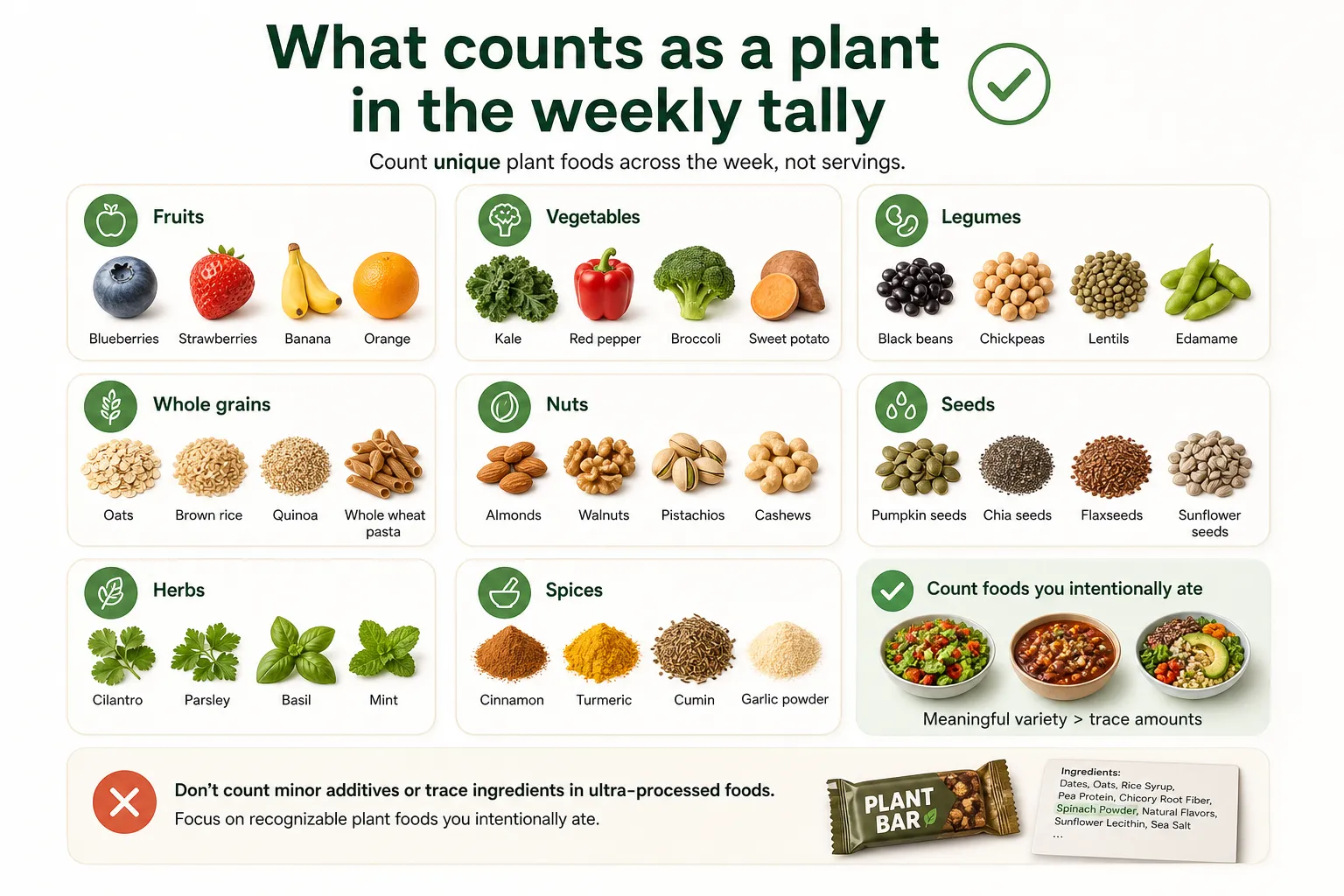
The simplest way to track 30 plants a week is to count unique plant foods across the whole week, not servings. For tracking, a plant is less about botany and more about dietary variety: count distinct fruits, vegetables, legumes, whole grains, nuts, seeds, herbs, and spices consistently across the week.
That means black beans and chickpeas count as two. Oats and brown rice count as two. Blueberries and strawberries count as two. Consistency matters more than perfection, so pick a practical rule and keep using it the same way each week.
Different varieties can count separately if they are meaningfully different foods. Red cabbage and green cabbage are close enough that many people would count them as one, while sweet potato and white potato are clearly different and can count separately.
Mixed dishes often make plant variety easier than people expect. A bowl with brown rice, black beans, corn, peppers, avocado, salsa, cilantro, pumpkin seeds, and lime could add several unique plants in one meal. Chili, stir-fries, grain bowls, salads, soups, and curries work the same way.
Herbs and spices can count too, including things like cilantro, parsley, cinnamon, or garlic powder. But do not use tiny trace amounts to game the number. The point is meaningful variety, not squeezing credit from a dusting of plant ingredients.
The same caution applies to ultra-processed foods. If a snack bar contains a long ingredient list with trace spinach powder, apple fiber, or chicory root, that should not count the same way as eating recognizable plant foods. A clear rule of thumb is to count foods you intentionally ate as plants, not minor additives buried in packaged products.
The best reason to track 30 plants is behavior change
The biggest benefit of a weekly plant count is not that 30 unlocks a special effect. It is that the number makes variety visible. Once you start counting, you notice whether your meals repeat the same fruit, the same salad greens, and the same two vegetables every week.
That shift in attention matters. A plant count nudges you toward more color, texture, legumes, grains, nuts, seeds, and herbs instead of focusing only on calories or macros. Someone can easily hit a fiber goal while still eating from a narrow plant list, which means tracking variety adds a different kind of useful feedback.
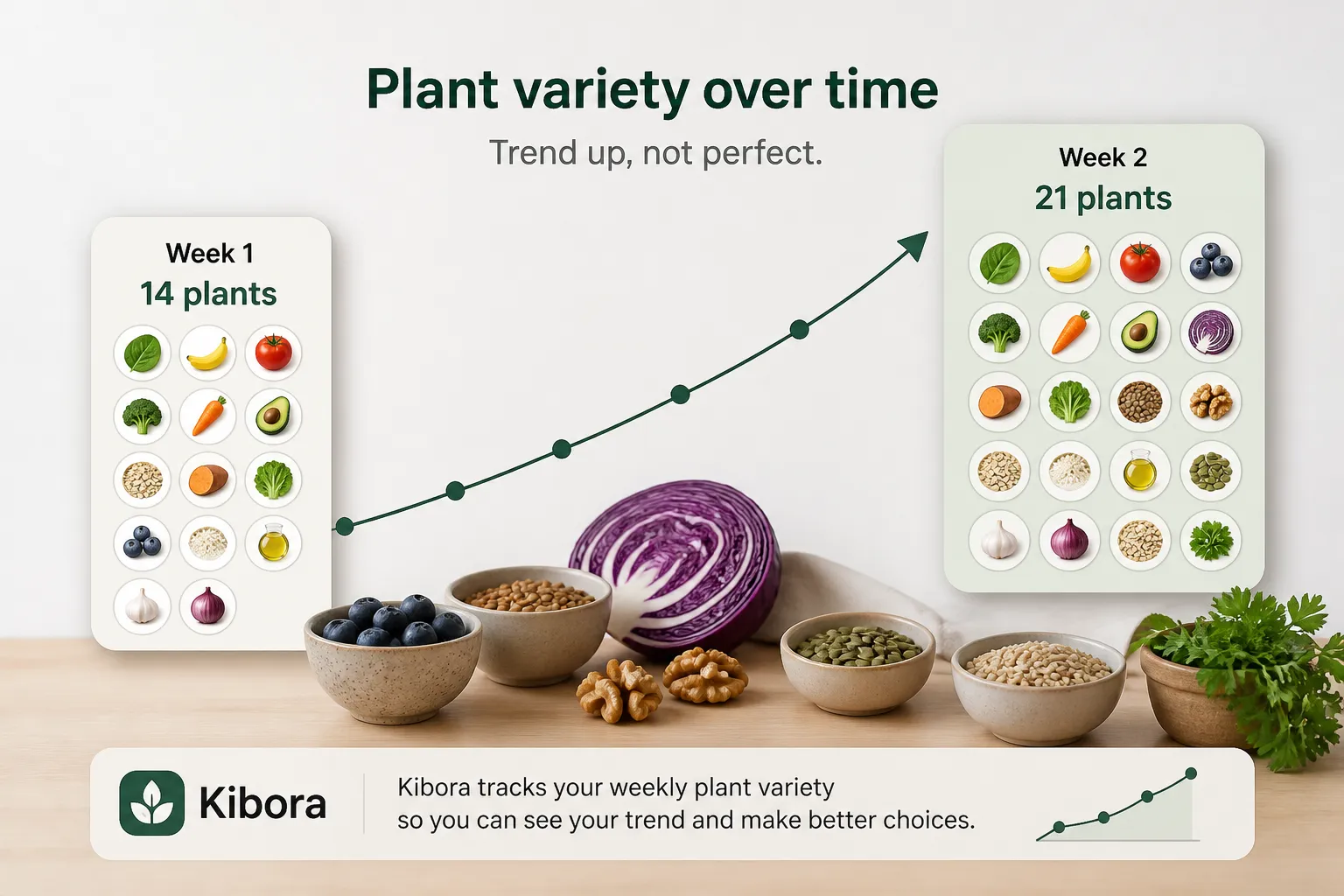
The most practical question is not “Did I hit 30 perfectly?” but “Is my weekly range wider than last week?” The plant count is most useful as a trend line: if your weekly variety is rising, your diet is probably becoming more microbiome-friendly even before you reach 30.
For example, week one might total 14 plants. In week two, adding lentils, berries, cabbage, walnuts, pumpkin seeds, barley, and a few fresh herbs brings that total to 21. That is not a pass or fail score. It is a sign that the diet is becoming more varied in a practical, repeatable way.
This is where tracking can help without turning food into a rigid optimization project. If an app like Kibora shows your weekly plant variety, it can give you a quick way to spot patterns and see whether your meals are broadening over time. Used well, that kind of data works best as a feedback loop for better decisions, not as a reason for guilt.
Curiosity beats perfection. If the number helps you rotate foods more often, it is doing its job.
When more plants are not automatically better
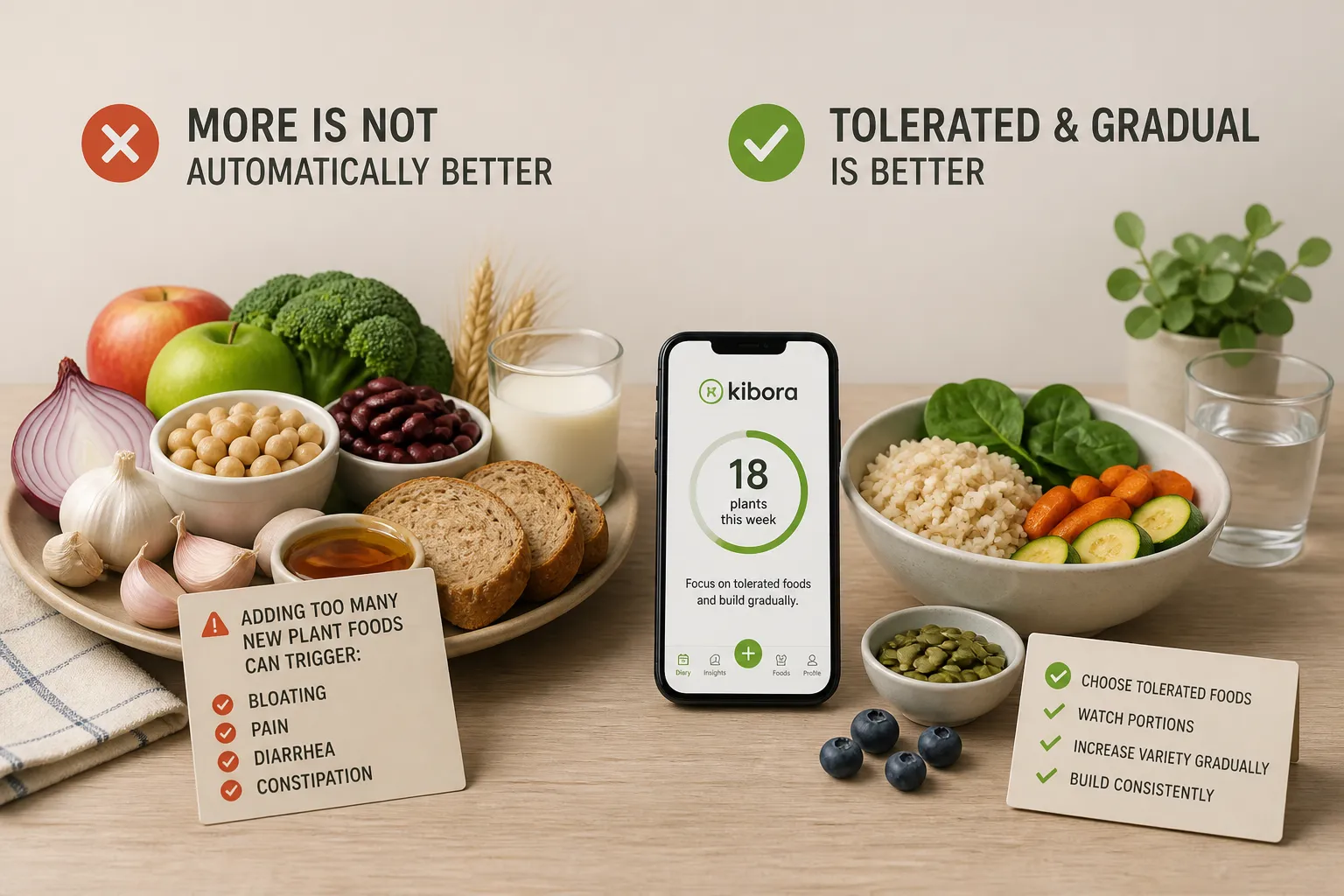
Plant variety can support a healthier eating pattern, but more is not always better if your gut is already struggling. For people with IBS, FODMAP sensitivity, inflammatory bowel conditions, or active bloating, pain, diarrhea, or constipation, adding lots of new plant foods at once can increase fermentable carbs and make symptoms worse.
That is why the 30-plants idea needs a symptom-aware approach. Foods that are nutritious for many people, including onions, garlic, some legumes, certain fruits, wheat-based foods, and some sweeteners, can still be common triggers for sensitive readers, as reflected in Monash University FODMAP resources.
The best plant-diversity target is the highest variety you can tolerate consistently, not the highest number you can force in a week. If 30 leaves you bloated and uncomfortable, a lower count built from tolerated foods is the better target for now.
IBS or FODMAP sensitivity does not mean avoiding plant diversity forever. It usually means choosing tolerated options, watching portions, and increasing variety gradually instead of adding several new beans, cruciferous vegetables, and wheat-based grains in the same week.
Going slowly often helps with high-fiber changes too. If you want a practical next step, this guide to foods that cause bloating can help you spot patterns before you push variety higher.
If digestive symptoms are persistent, severe, or changing, get medical advice rather than trying to push through discomfort. The NHS IBS guidance also recommends clinical support when symptoms do not settle or need proper assessment.
A simple way to build toward 30 without overthinking it
Start by counting a normal week exactly as it is. Do not change your meals yet. Just notice your baseline, whether that is 8 plants, 14, or 22, so you know what “more variety” actually means for you.
Then add 3 to 5 new plants the next week instead of trying to jump straight to 30. This is usually easier on your routine, your budget, and your digestion. Harvard also notes that increasing fiber from a range of plant foods is a practical way to build a healthier pattern over time, especially when done gradually according to its fiber guidance.
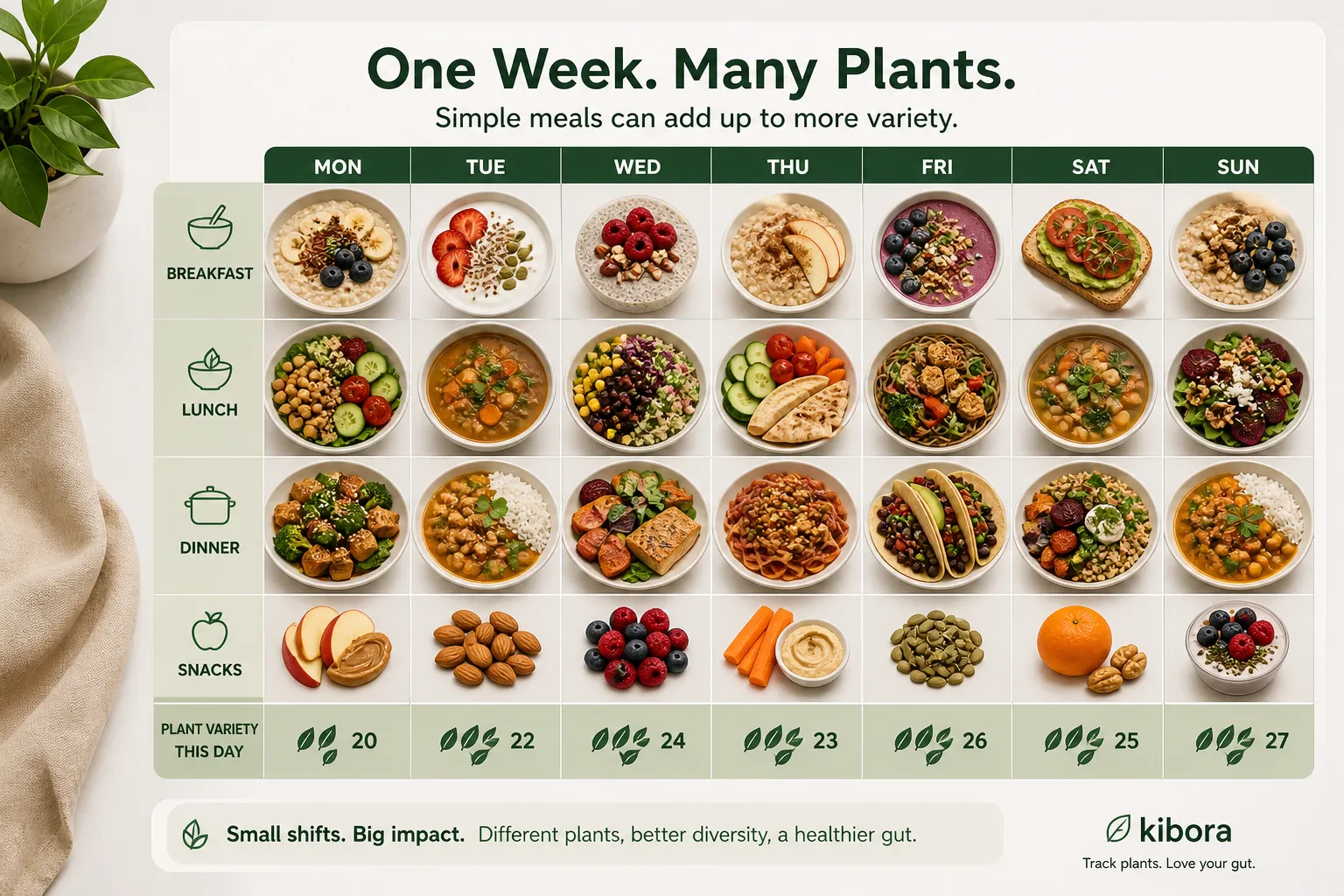
You do not need 30 new recipes to reach 30 plants; you need small rotations inside meals you already eat. If breakfast is usually oats and banana, keep the same structure and add berries, ground flax, walnuts, or cinnamon across the week.
Mixed dishes make variety almost automatic. Soups, salads, curries, stir-fries, tacos, grain bowls, and even oatmeal toppings let you layer in lentils, beans, cabbage, herbs, seeds, and fruit without making meals feel complicated.
- Swap rice for barley or quinoa.
- Rotate spinach with arugula or cabbage.
- Use almonds one week, walnuts or pumpkin seeds the next.
- Keep frozen vegetables and berries on hand.
- Use canned beans and dried lentils for easy add-ins.
Repeat plants still count as healthy choices, even if they only raise your variety total once that week. The goal is not to abandon your staples. It is to build a wider mix around them, one simple change at a time.
Track the pattern, not the perfect number
The strongest case for 30 plants a week is not that 30 is magical. It is that the target gives you a simple way to notice whether your diet is moving toward more variety, more fiber, more polyphenols, and better overall quality.
That is why this works best as a directional tool, not a rigid rule. Thirty plants a week is not the finish line for gut health; it is a simple way to notice whether your diet is becoming more diverse.
If you currently eat 12 different plant foods in a typical week, getting to 16 or 20 is real progress. A better week is often just a week with a few more plants than the one before, especially if you are building slowly and paying attention to symptoms.
Keep the benchmark flexible, adapt it if you have IBS or FODMAP sensitivity, and do not force foods that leave you feeling worse. The value of this target is precisely that it helps you track a helpful pattern without turning eating well into another perfection project.
Start this week by counting what you already eat, then add one or two new plant foods you know you can handle.
- Key sources
- Levin et al. / American Gut Project, Cell (2018)
- American Gut Project
- NIH Human Microbiome Project / overview resources
- Harvard T.H. Chan School of Public Health - The Nutrition Source: Fiber
- Review on dietary polyphenols and gut microbiota (general review literature)
- Monash University FODMAP Diet resources
- NHS IBS advice