TL;DR
Cal AI suits calorie and macro tracking on iPhone or Android. Alma emphasizes voice logging, nutrient detail and coaching on iPhone. Compare their features, subscriptions and reviews.
- What you'll learn
- Which app fits calorie tracking, nutrition coaching, or Android use.
- How their food logging methods and correction options differ.
- What their subscriptions include and how to interpret the advertised prices.
- What App Store ratings and individual reviews can tell you.
- Which differences matter when choosing between Cal AI and Alma.
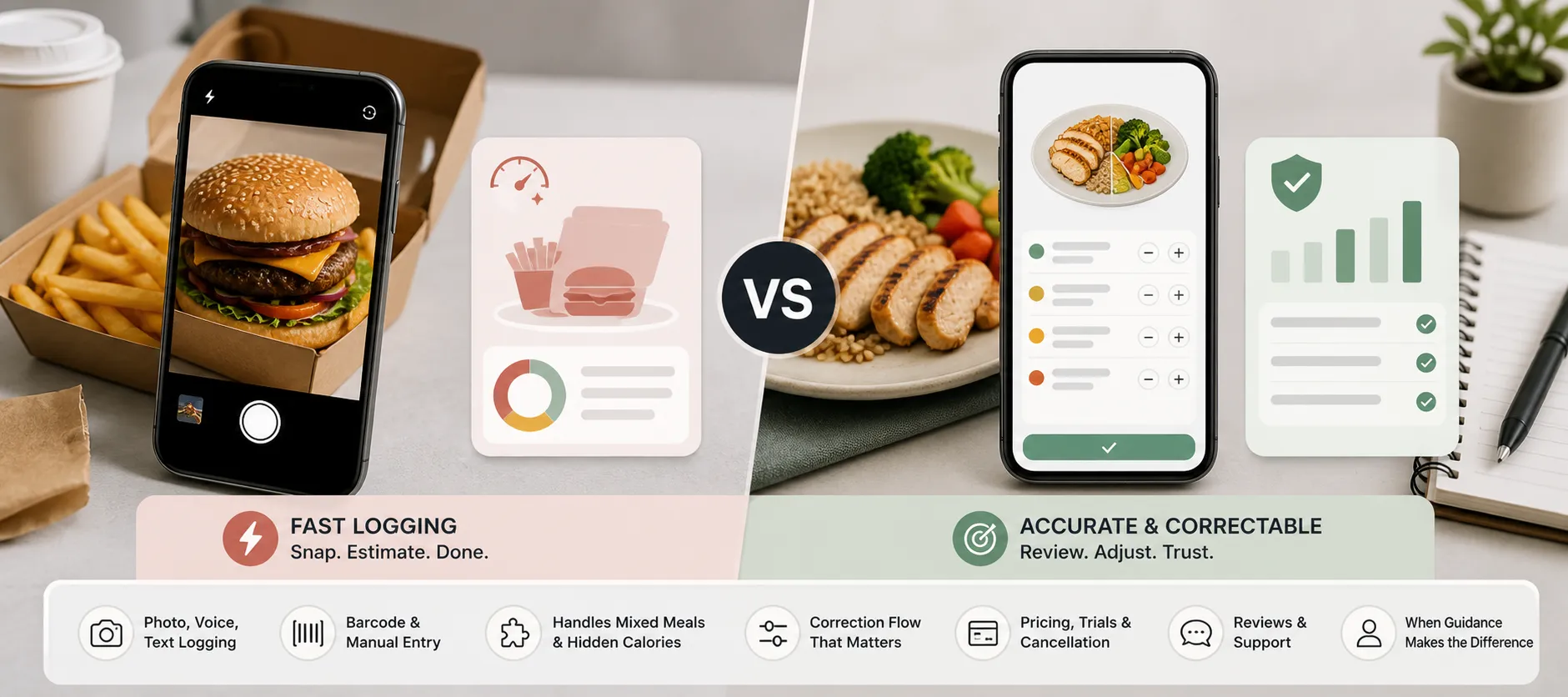
Cal AI is a good fit if your priority is a calorie and macro diary with photo logging, particularly on Android. Alma is the stronger candidate if you use an iPhone and want voice logging, detailed nutrient tracking, and coaching built around your food history. Both do more than recognize a plate of food, so the choice comes down to what you want after the meal is logged.
Cal AI vs Alma at a glance
| What matters | Cal AI | Alma |
|---|
| Phone platform | iPhone and Android | iPhone; currently no Android app |
| Food entry | Photo, barcode, meal description, database search, manual entry | Photo, barcode, voice, text, saved foods |
| Main emphasis | Calorie and macro targets, progress tracking, AI suggestions | Calories and macros, 25+ nutrients, Alma Score, conversational coaching |
| Health connections | Apple Health and Google Fit | Apple Health; TrainingPeaks is also documented |
| Reports | PDF export | PDF and CSV export |
| Access | Subscription required for food-scan results; advertised three-day trial | Paid membership after onboarding; all features included |
The biggest immediate filter is your phone. Cal AI supports Android, while Alma currently describes its app as iOS only. On iPhone, the more useful distinction is whether you want to track intake or also spend time exploring nutrition patterns and asking follow-up questions.
Food logging: photos, packaged foods, and repeat meals
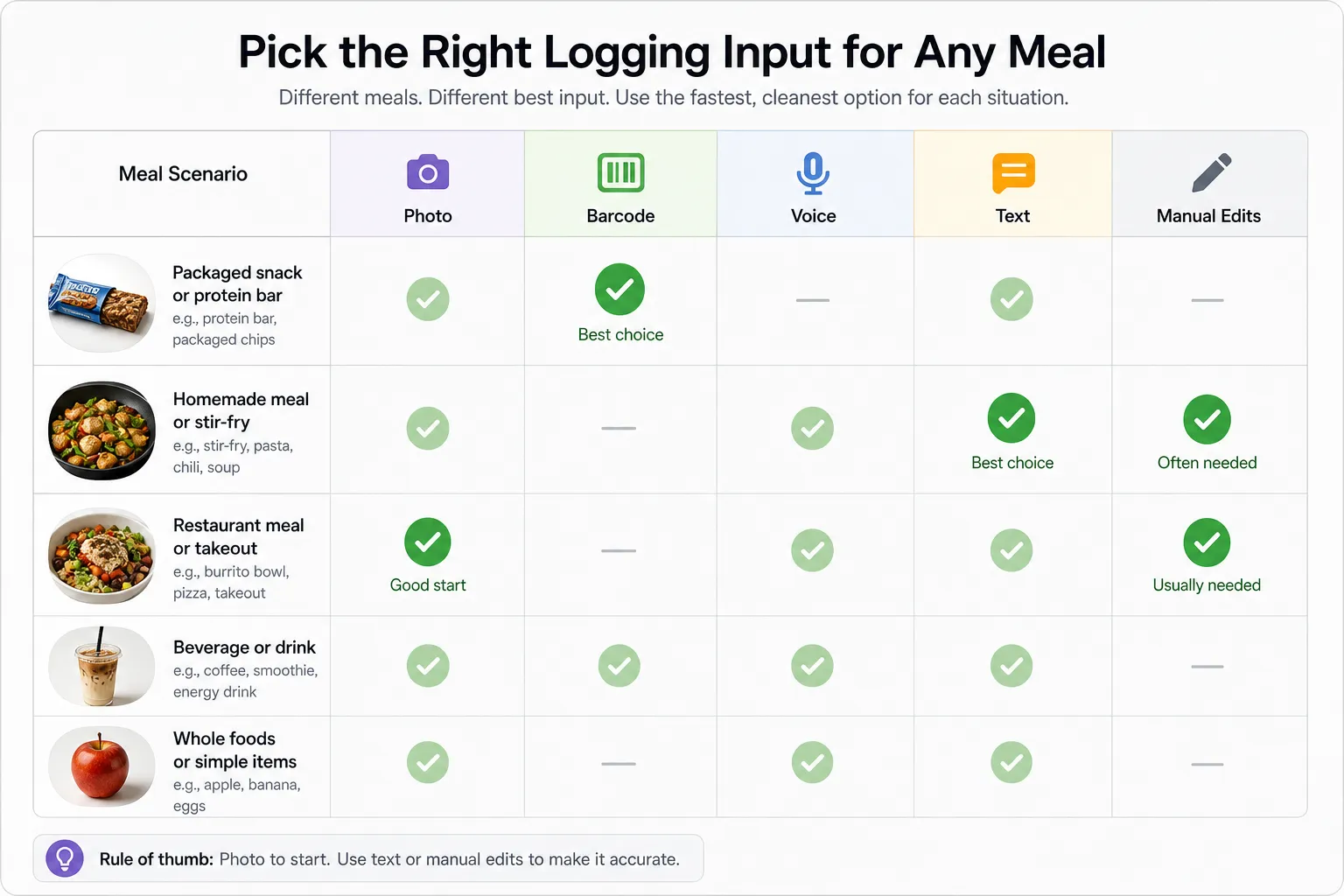
Cal AI's main workflow centers on photographing a meal and getting calories, protein, carbohydrate, and fat estimates. It also supports barcodes and meal descriptions, so photography is an option rather than a requirement for every entry.
For familiar breakfasts or a packaged snack, the alternatives matter. Cal AI's Android accessibility documentation describes food search, recent items, and manual entry. You can also create your own foods and recipes. That gives it a practical route for meals that are easier to describe or reuse than photograph.
Alma gives voice entry a more prominent role alongside photos, text, and barcodes. Saying what you ate can suit a meal you have already finished, or a mixed dish whose ingredients are difficult to identify from a picture. Its release notes also document portion and ingredient corrections, saved meals, and recurring meals.
The useful distinction is the entry method you will actually use: Cal AI offers several routes into a calorie diary; Alma makes spoken logging an explicit part of its food journal. Neither product's feature list establishes that it is faster for your meals.
Accuracy: neither has earned a head-to-head win
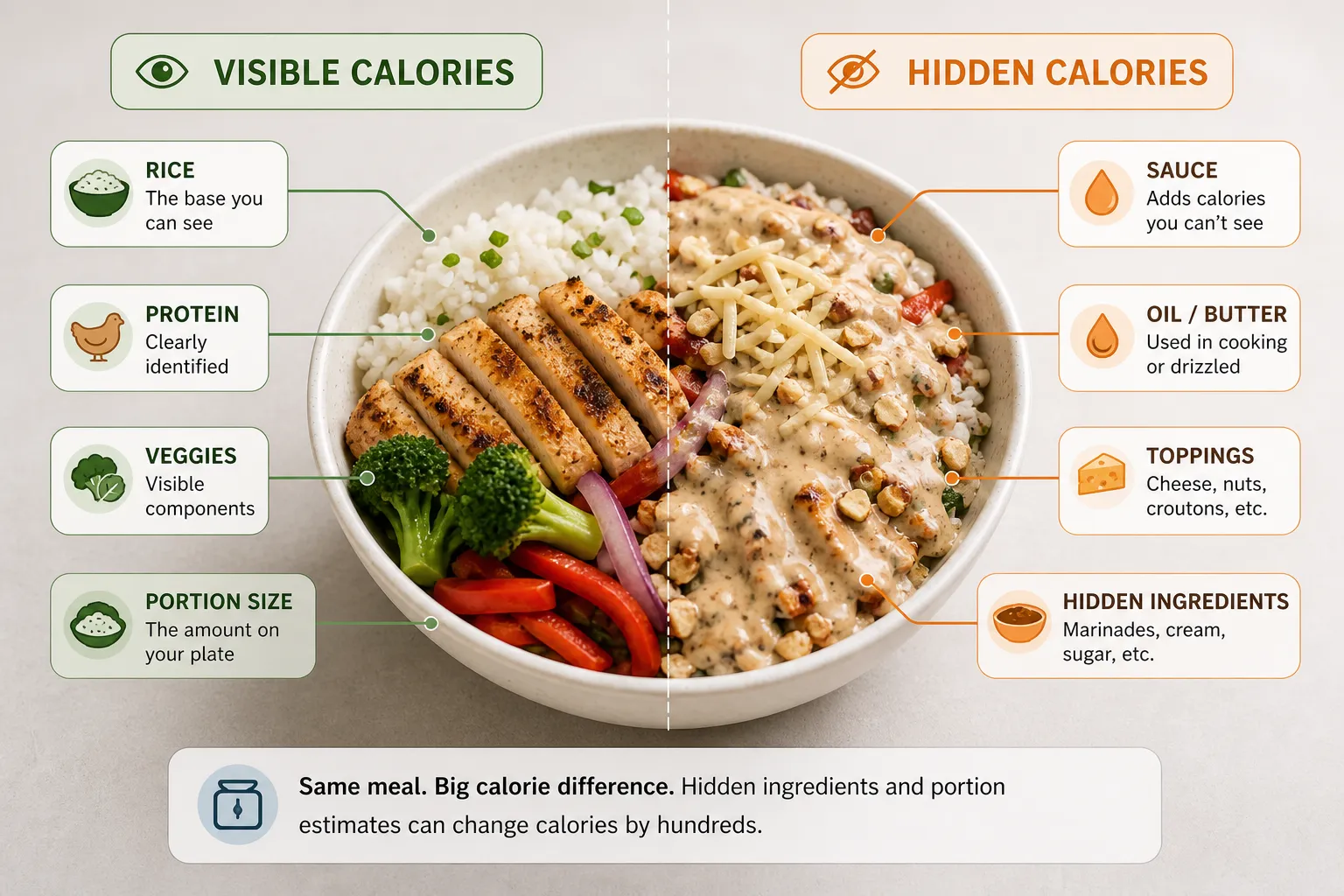
A photo can identify a food without establishing its exact portion or preparation. Oil mixed into a dish and sauce beneath other ingredients are especially difficult to judge visually. That limitation applies to the task itself, regardless of which app supplies the estimate.
Cal AI acknowledges incorrect scans in its support FAQ. Alma documents controls for correcting an entry. Neither establishes a controlled comparison showing which app produces more accurate calorie estimates across the same meals. A star rating or an advertised accuracy percentage cannot settle that question.
For everyday use, the more actionable difference is how you supply missing information: a description, a known serving size, a barcode, or an edited entry. Our guide to why calorie tracking is hard covers those measurement limits in more detail.
Nutrition features: targets or deeper coaching?
Cal AI combines calorie and macro totals with progress tracking and personalized AI suggestions. It should not be dismissed as a camera with a calorie number attached. Its focus makes sense when your main task is recording meals against nutrition goals and following your progress.
Alma's offering puts more emphasis on nutrient detail and interpretation: fiber, added sugar, micronutrients, and a daily Alma Score alongside calories and macros. The score summarizes diet quality; it is a different kind of feedback from simply reaching a calorie target.
The coaching layer lets you ask about your food history and explore patterns such as repeatedly low fiber or meals that contribute little protein. Alma describes this as guidance tied to the food log, including suggestions for what to change next. That is a reason to shortlist it if interpreting your meals matters as much as recording them.
More feedback is useful only if you want to act on it. If a calorie and macro diary already answers your main question, extra nutrition detail may not be a reason to switch. If you routinely finish logging and wonder what to do differently tomorrow, Alma's coaching focus is a more relevant advantage.
Pricing and trials: compare the renewal cost
Alma's US App Store lists $19.99 per month or $99.99 per year in September 2026. The annual plan works out to about $8.33 per month, billed annually. Membership is required after onboarding and includes every feature; there is no ongoing free tier.
Cal AI's US listing requires a subscription for food-scan results and shows several purchase amounts without consistently identifying their billing periods. Those amounts cannot reliably establish a monthly or annual price winner. Its website advertises a three-day trial; the offer shown at signup determines your renewal charge.
There is also a switching cost worth knowing: Cal AI says subscriptions do not transfer between iPhone and Android. If you change platforms, it requires a new subscription. Deleting the app does not cancel a store subscription, so a trial you do not want to keep needs to be cancelled through the relevant store.
Reviews: Cal AI has a much larger rating history
In the US App Store listings viewed in September 2026, Cal AI showed 4.8/5 from approximately 366,000 ratings; Alma showed 4.7/5 from 464. That is a substantial difference in review volume, while the scores themselves are close.
A featured Cal AI reviewer praised barcode logging and customization but wanted better workout controls. An Alma reviewer highlighted the value of interpreting food data. These are individual experiences, not measurements of reliability or accuracy.
The review volume gives Cal AI a broader body of user feedback to examine. Alma's smaller sample makes its aggregate score less informative by comparison. Neither score establishes which app will handle your usual foods better, and older feature complaints may no longer describe the current release.
Which one should you choose?
- Choose Cal AI for Android, or shortlist it for calorie and macro tracking. Its range of entry methods and larger review history make it a reasonable candidate when a practical food diary is the priority.
- Choose Alma if you want voice entry and nutrition coaching on iPhone. Its nutrient detail and food-history questions give you a clearer reason to choose it beyond the shared photo-logging feature.
- If price is the deciding factor, compare the actual offers. Alma publishes identifiable monthly and annual plans; Cal AI's public purchase list does not provide an equivalent comparison.
If you are still exploring this category, our guide to the best AI calorie trackers covers a wider shortlist.
Where Kibora fits in your shortlist
Kibora is another option if you want convenient logging alongside explanations of your food and nutrition patterns. Its logging and guidance features include food insights, weekly patterns, and links to the science behind an insight.
- Key sources
- Apple App Store: Cal AI’s subscription disclosure, ratings and reviews and Alma’s US pricing, ratings, reviews and release notes.
- Cal AI: features and advertised trial, subscriptions, scanning, syncing and exports, and Android logging options.
- Alma: nutrition features, logging methods and iOS availability, and coaching based on food history.
- Kibora: logging features and nutrition insights.