


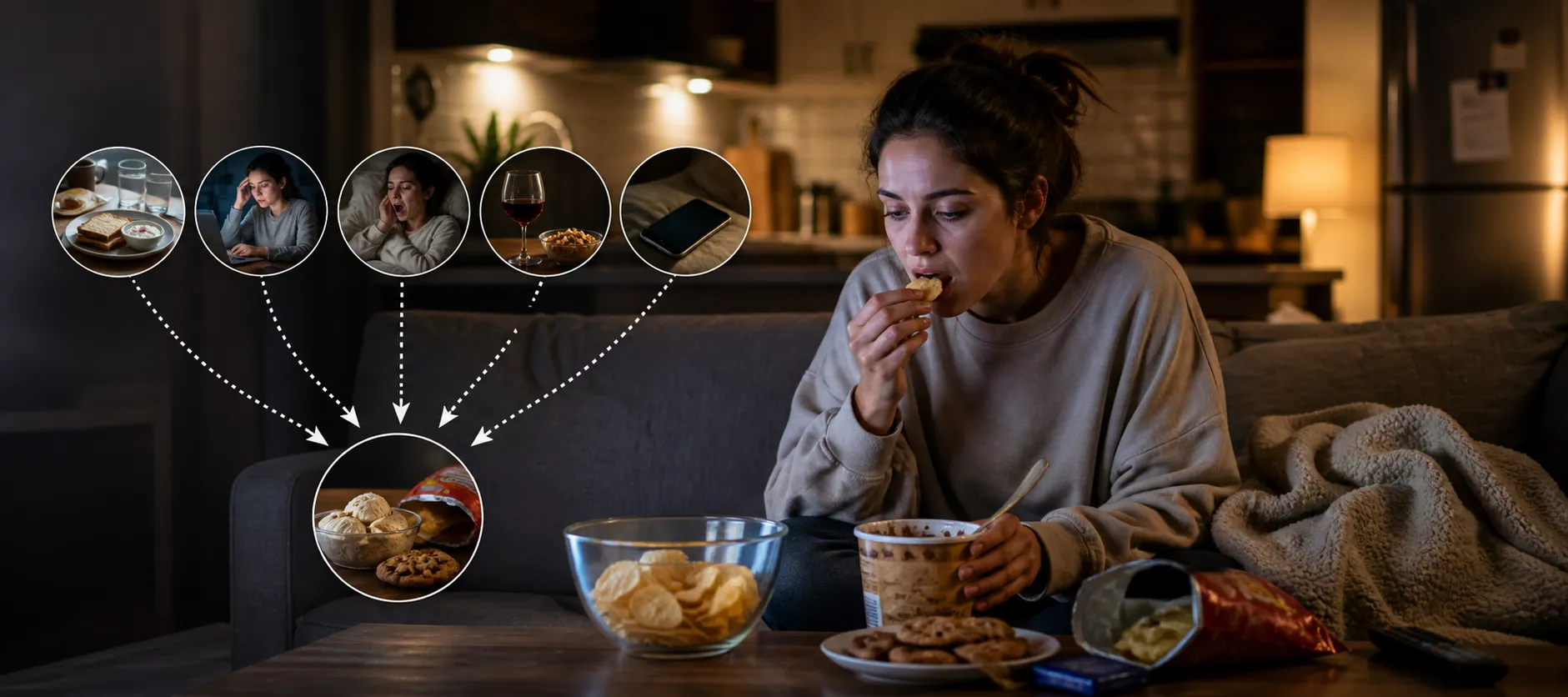
- What you'll learn
- Why daytime under-eating can turn into rebound eating at night
- How protein, fiber, and meal volume affect fullness after dinner
- Why short sleep can make cravings and late-night snacking stronger
- How stress, alcohol, and screen time can push eating into autopilot
- Simple ways to reduce food cues and make the kitchen less tempting
- When a planned evening snack makes more sense than trying to white-knuckle hunger
You eat pretty reasonably all day, then 9 p.m. hits and suddenly the pantry feels magnetic. Maybe you skipped breakfast, had a light lunch, pushed through stress, and now the snack cravings feel far bigger than your intentions.
That pattern is usually not a personal failure. Night overeating often has more than one cause: under-fueling earlier, meals low in protein and fiber, stress, sleep debt, alcohol, habit cues, and the simple fact that self-control tends to feel thinner late in the day.
Late eating is not automatically a problem. The issue is when it feels out of control, regularly pushes you past comfort, or keeps disrupting your goals or sleep.
The best way to stop overeating at night is often to make the evening less biologically and emotionally difficult before it begins. In the sections ahead, we’ll walk through seven common reasons this happens and practical fixes for each one.
You arrive at night under-fueled
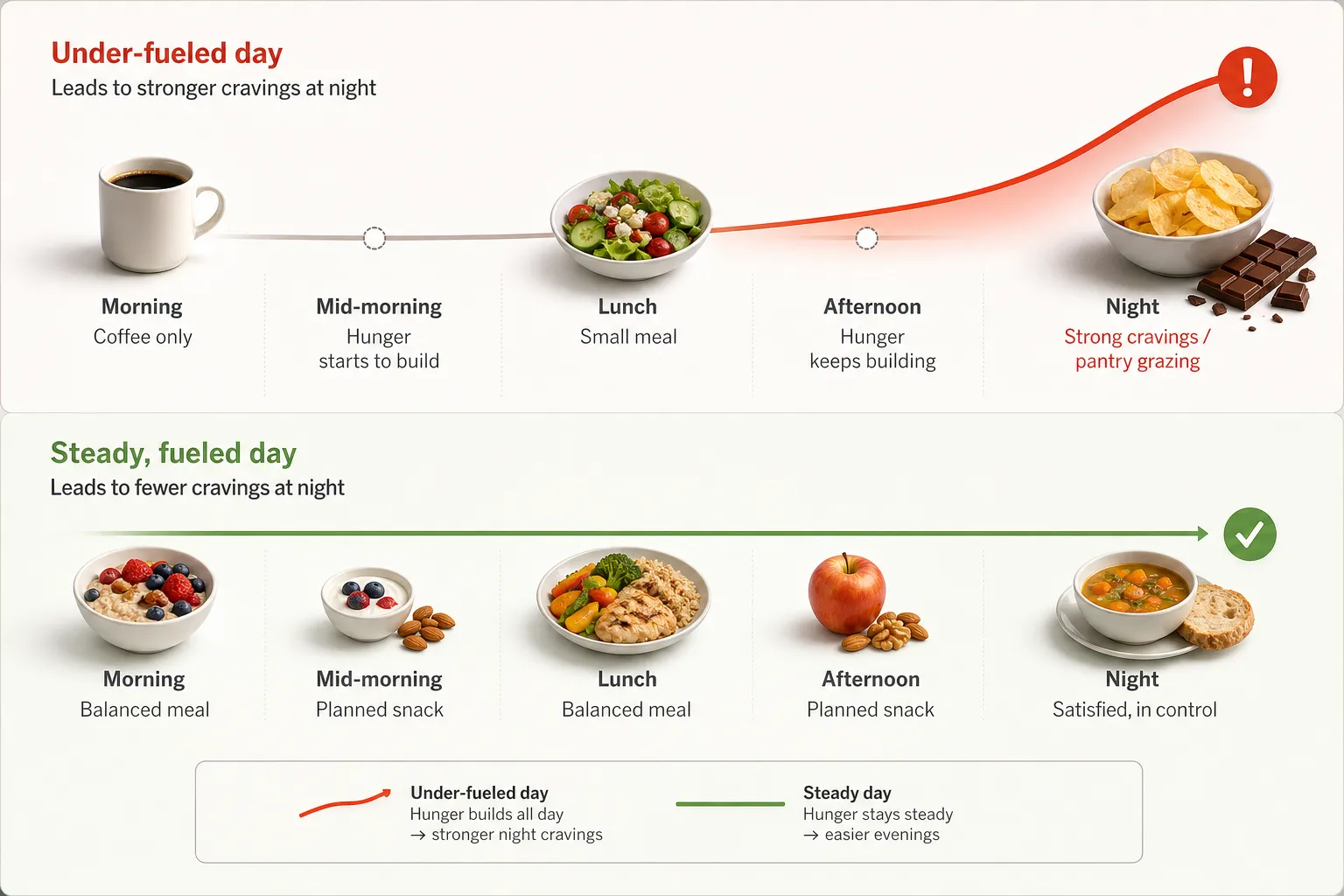
One of the most common answers to “why do I overeat at night?” is simple: you did not eat enough earlier. If breakfast was coffee, lunch was delayed, or daytime meals were very small, hunger can keep building in the background until evening feels less like a choice and more like a catch-up session.
This is not always intentional. Sometimes it happens because you are dieting, but it can also happen because meetings ran long, your appetite was low, or the day got chaotic. Either way, the effect is similar: by night, the body often pushes harder for quick energy, and easy, highly palatable foods become much harder to ignore.
A coffee-only morning plus a small salad lunch can easily turn into pantry grazing after dinner. Night overeating often starts as daytime under-eating: by the time the kitchen is quiet, hunger has had all day to build momentum.
The fix is usually not trying to “be good” at night. It is often eating enough earlier, with meals that are more filling. Practical guidance from Harvard’s Nutrition Source supports building meals around satisfying basics like protein, fiber-rich carbohydrates, and healthy fats, which can help meals last longer.
If this pattern sounds familiar, a few realistic changes can lower the odds of rebound eating later:
- Eat a real lunch instead of piecing together snacks.
- Add a planned afternoon snack so hunger does not go from mild to urgent.
- Avoid saving most of your calories for nighttime.
- Keep daytime meals predictable, even on busy days.
If you tend to under-eat early and then rebound later, it may help to use a realistic intake target rather than guessing. Kibora’s calorie calculator can be a useful starting point for that.
Your meals do not keep you full long enough
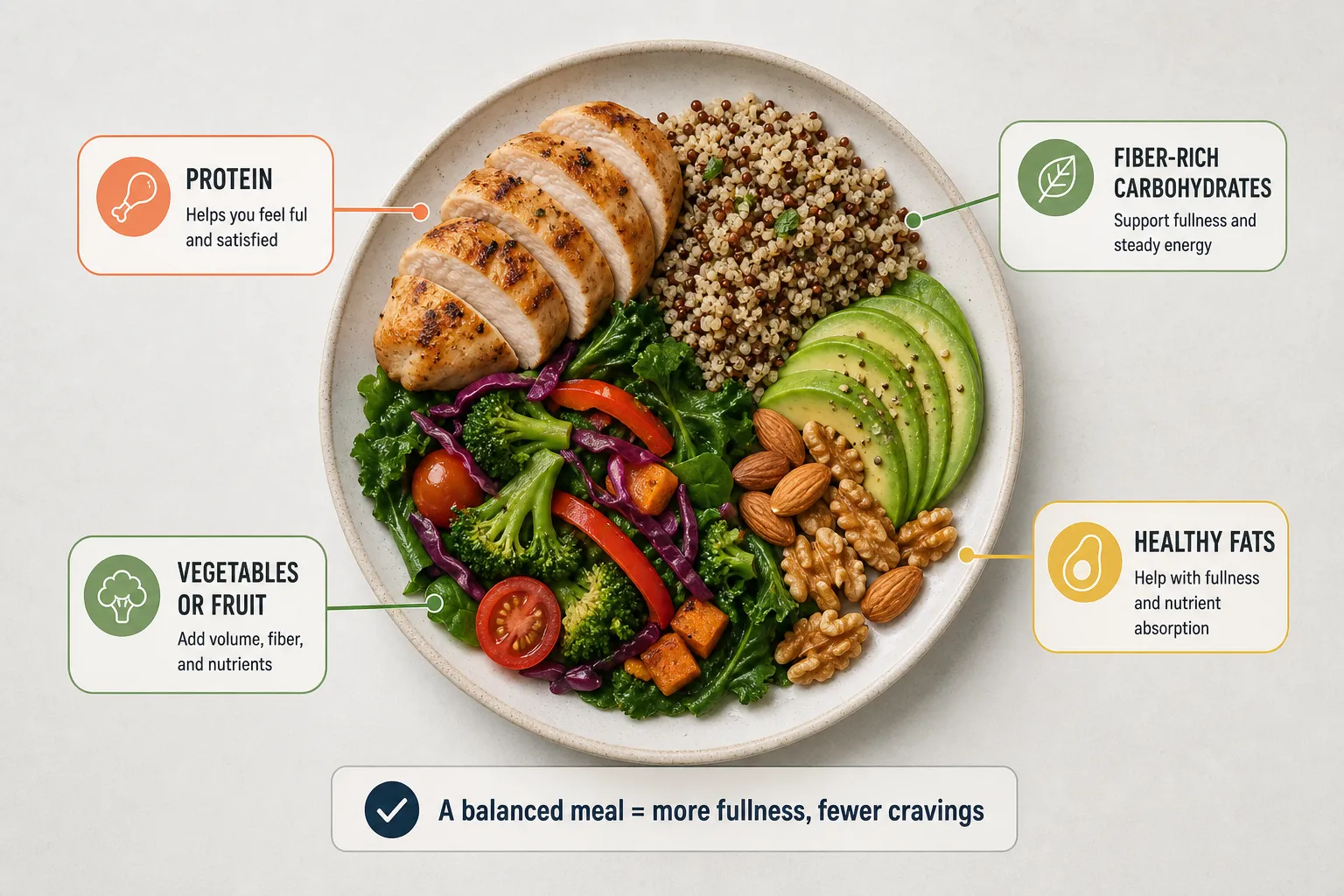
Sometimes the problem is not that you ate too little. It is that your meals were not built to hold you over. A meal can have enough calories on paper and still leave you asking, “why am I so hungry at night?” if it is low in protein, low in fiber, or just not very substantial.
Protein can help with fullness, and fiber helps regulate hunger and blood sugar. Volume matters too. Meals with vegetables, fruit, beans, soup, potatoes, yogurt, or other water-rich foods simply take up more room and often feel more satisfying than small, easy-to-overeat foods.
A filling meal is not just about calories. It is usually a mix of enough food, enough protein, enough fiber, and enough volume to carry you to the next eating window. If one or more of those pieces is missing, late-night snacking becomes much more likely, even if you technically had breakfast, lunch, and dinner.
This is why toast alone may disappear fast but not last long. Add eggs, Greek yogurt, tofu, cottage cheese, or another protein source and it becomes a different meal. Pasta alone can do the same thing, but pasta with beans, vegetables, chicken, tofu, or a side salad is more likely to keep you settled through the evening.
If you are genuinely hungry at night, try upgrading the snack instead of treating hunger like a failure. Chips as the main event often turn into grazing, while something with protein and fiber tends to land better.
- Apple with peanut butter
- Greek yogurt with berries
- Crackers with tuna or cottage cheese
If you want more ideas, this list of foods that keep you full longer can help you make small swaps without following a rigid diet.
Sleep debt makes cravings louder
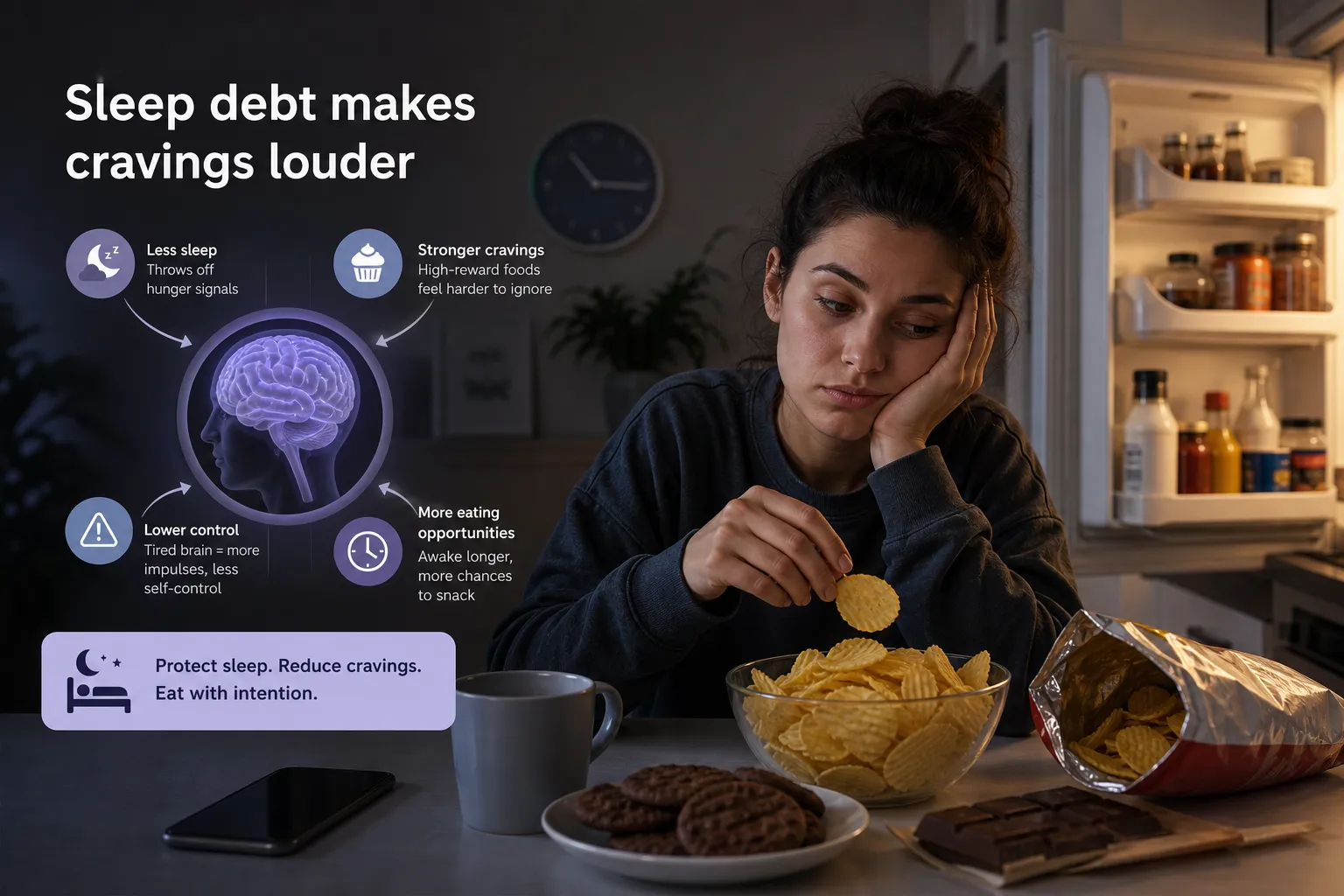
If you regularly sleep five or six hours, the next evening may feel harder than it should. Sleep deprivation can increase appetite, but that is only part of the story.
Sleep deprivation can increase your appetite.
Poor sleep does not just make you tired. It can make high-reward foods feel harder to ignore the next evening, which helps explain why chips, sweets, and takeout can suddenly sound much more appealing than the dinner you planned.
This is why sleep should be treated as both a biological and behavioral driver of night overeating. Appetite signals can shift with short sleep, but so can attention, impulse control, and your tolerance for effort, which makes convenient snack foods more likely to win.
There is also a simple practical reason late nights lead to more eating: you are awake longer. After dinner, staying up with screens and easy-to-grab snacks can create a second eating window, even if you were reasonably full an hour earlier.
Circadian timing adds another layer. Reviews on meal timing and circadian eating suggest that eating very late may happen at a time when decision-making and glucose handling are less favorable, though that does not mean all late eating is automatically harmful.
What matters most is the pattern. If being tired pushes you toward more cravings, more grazing, and more late-night convenience foods, sleep debt may be one of the reasons you overeat at night.
What helps
The fix is usually not “use more willpower at 10 p.m.” It works better to reduce the setup that makes late-night snacking likely in the first place.
- Protect a realistic bedtime so you are not creating extra eating hours every night.
- Cut late caffeine and keep alcohol modest, since both can make sleep and appetite regulation worse.
- Build a short wind-down routine so tiredness does not automatically become a cue to snack.
- Plan a filling dinner, or an intentional evening snack with protein and fiber if dinner is early.
- Set a kitchen cutoff routine, such as tea, brushing your teeth, or turning off the main lights.
If you want a deeper look at how meal timing, sleep, and hunger patterns interact, that can help you spot whether your late-night eating starts with your schedule, not just your cravings.
Stress turns the evening into a release valve
Stress eating at night is often less about a lack of willpower and more about timing. After a day of work, commuting, caregiving, or constant decisions, evening can be the first moment your body and mind register how worn down you feel.
Food can become a fast, available way to change that feeling. Research has linked stress with emotional eating and stronger pull toward highly palatable foods for some people, which helps explain why someone may feel fine at 3 p.m. but suddenly want cookies after finally sitting down at 9 p.m. PubMed reviews on stress and eating support that connection.
The key point is that the craving may be for relief, comfort, or a mental shift as much as for calories. If the craving is mostly for relief, the solution needs to include relief, not just a rule about food.
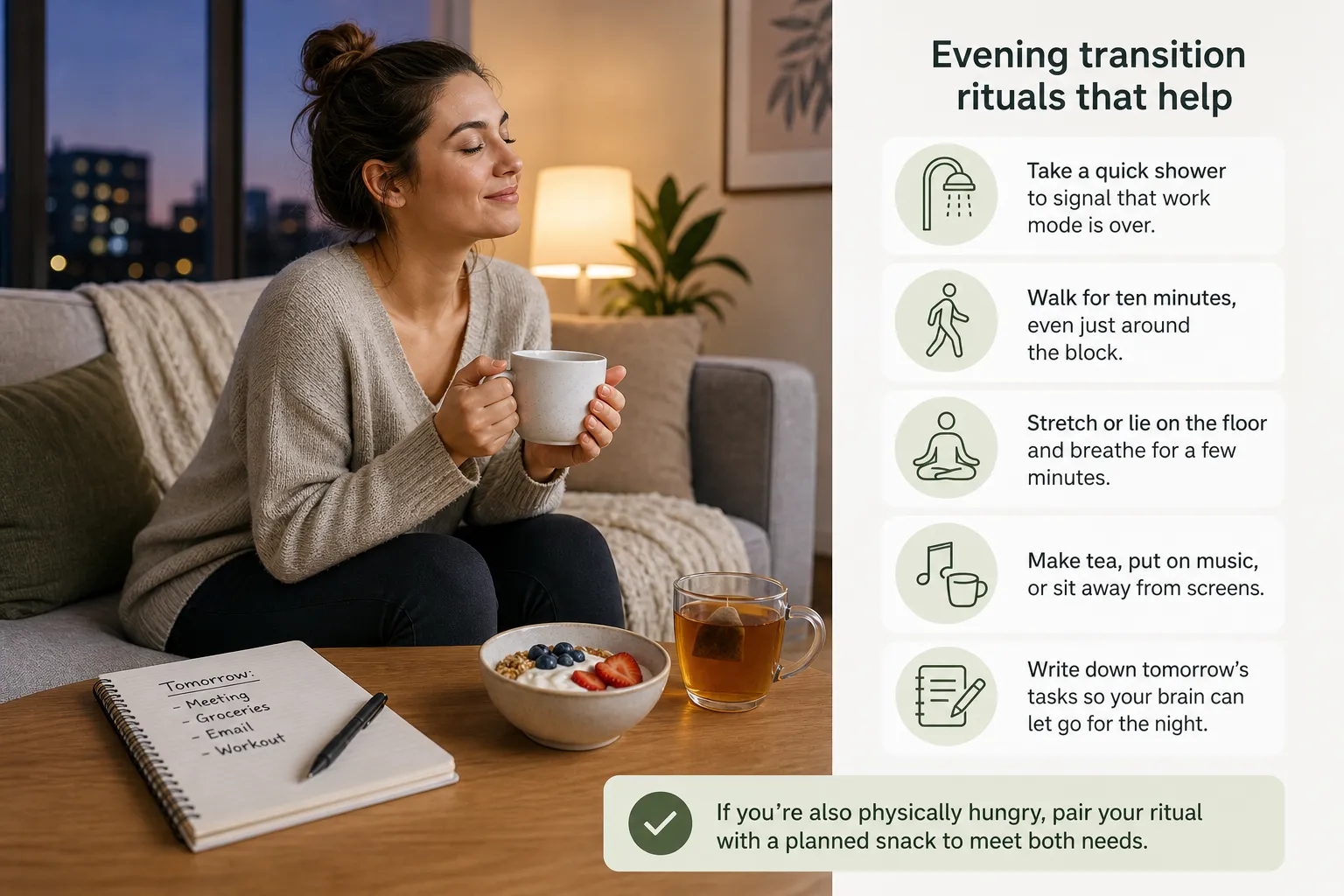
That is why a transition ritual helps. The goal is to interrupt the sprint-then-snack pattern before the kitchen becomes your only off switch.
- Take a quick shower to signal that work mode is over.
- Walk for ten minutes, even just around the block.
- Stretch or lie on the floor and breathe for a few minutes.
- Make tea, put on music, or sit away from screens.
- Write down tomorrow's tasks so your brain can let go for the night.
If you are also physically hungry, do not try to white-knuckle it. Pair the decompression routine with a planned snack, such as yogurt and fruit or toast with peanut butter, so you are meeting both needs instead of swinging between restriction and late night snacking.
Alcohol makes later choices less deliberate
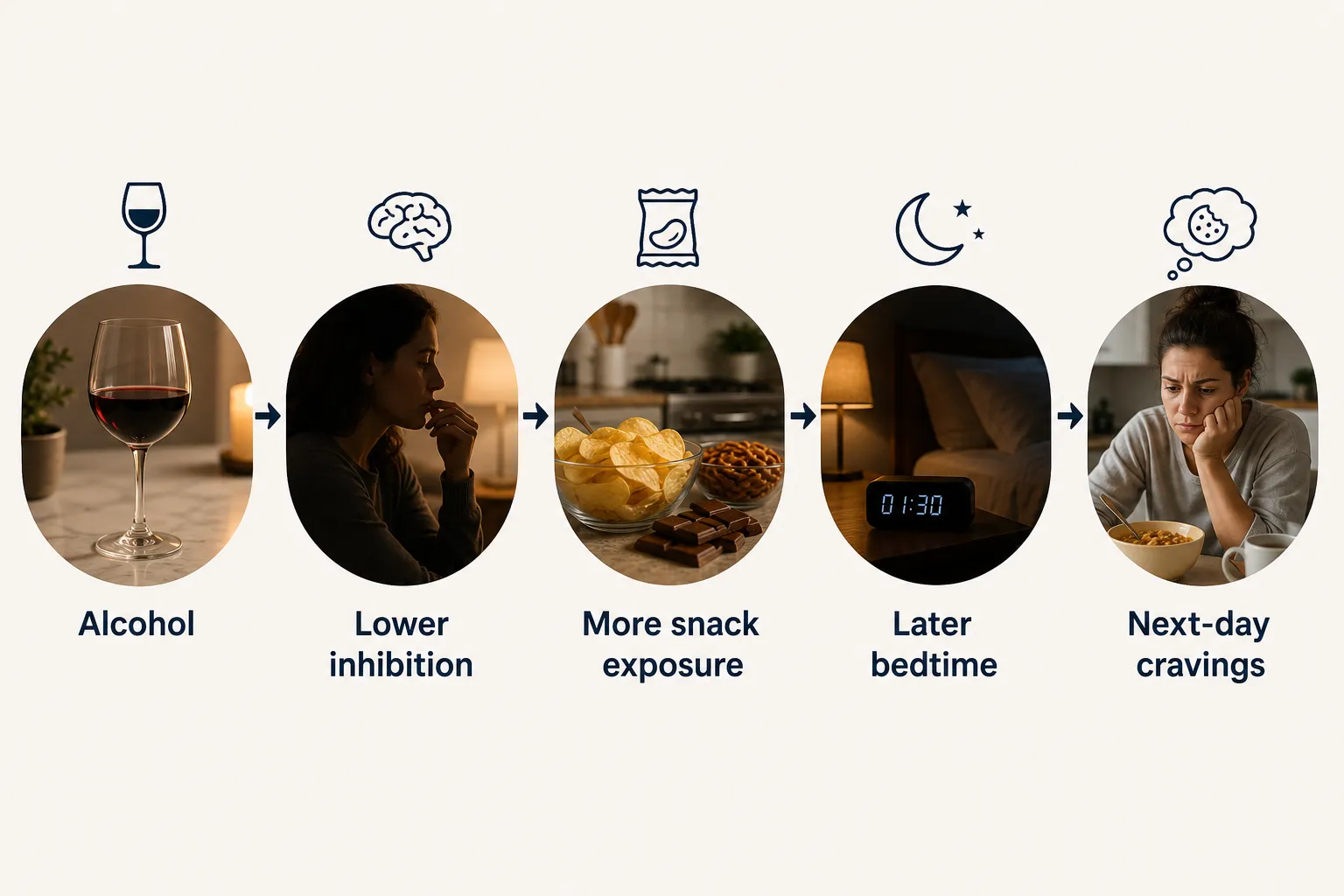
Alcohol is a common but under-discussed reason night overeating happens. It does not have to lead to overeating, but it often removes the pause between craving and action, which makes spontaneous snacking, takeout, or larger portions more likely.
A typical pattern is simple: a drink before dinner turns into grazing while cooking, then a bigger dinner, then something salty or sweet later. Alcohol can lower inhibition and increase reward-seeking, so the foods that sound good in the moment often win over the plan you had earlier.
It also tends to travel with other risk factors for late night snacking. People may stay up later, eat socially, order convenience food, or snack on chips and desserts that are easy to keep reaching for.
Another part of the picture is sleep. Even if alcohol makes you feel sleepy, it can worsen sleep-disrupting evening food and drink patterns, which can leave you hungrier and more craving-prone the next day.
The practical goal is to decide a few things before drinking, not after. That can look like:
- Eat a balanced meal before or with alcohol
- Decide on one snack in advance if you want one later
- Alternate drinks with water
- Set an alcohol cutoff so the night does not keep stretching
- If you want a snack after drinking, portion it onto a plate or bowl instead of eating from the bag
If alcohol is part of your evening, structure helps more than willpower. A small plan made earlier can protect you from the part of the night when choices feel easiest to loosen.
Your screen-and-snack routine trains your brain to expect food
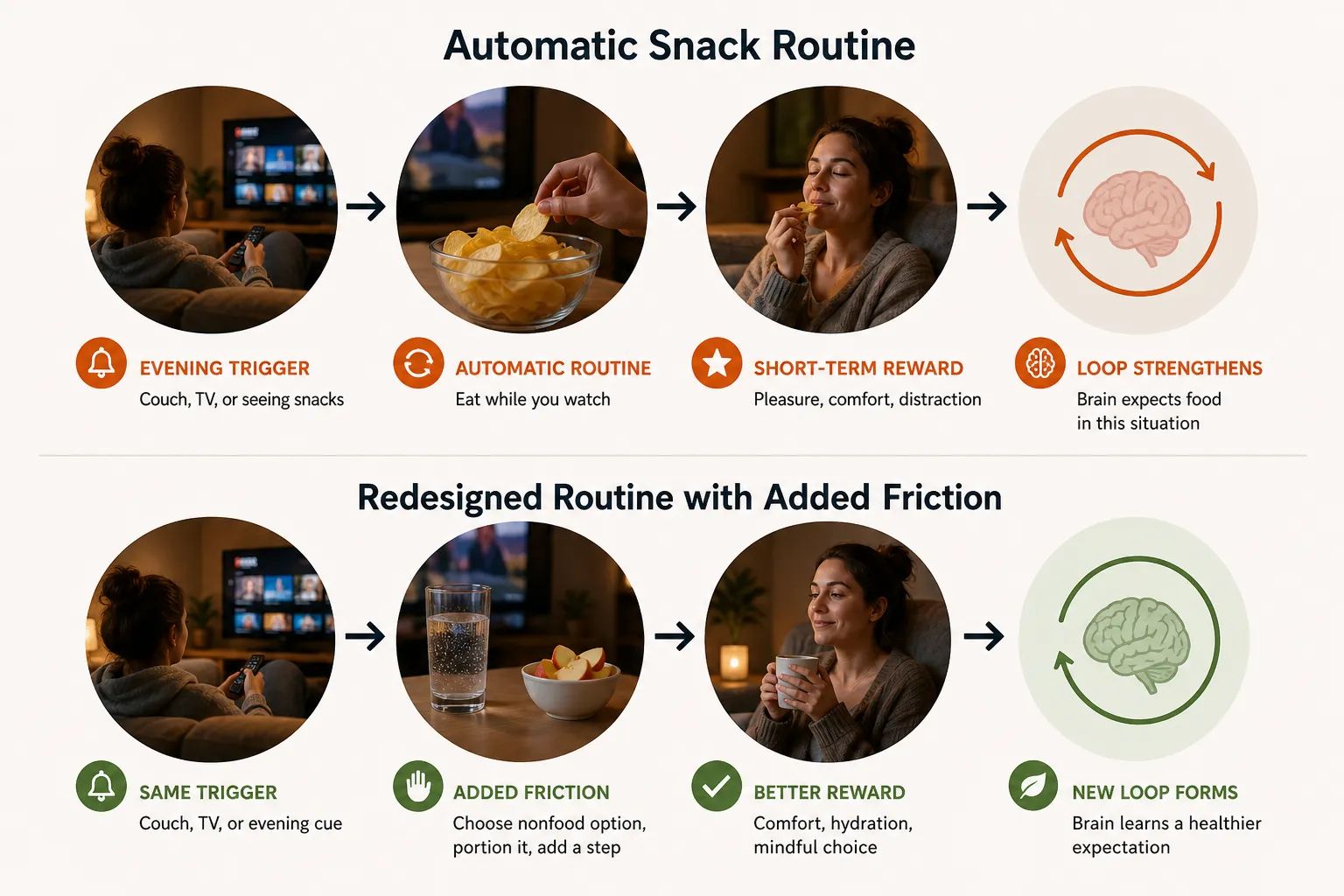
Night overeating is often a habit loop, not a sudden loss of discipline. The cue might be the couch, the TV remote, or seeing a bag of chips on the counter. The routine is eating while you watch. The reward is easy pleasure, comfort, or simple stimulation at the end of the day.
That matters because a craving is not always a command from your body. Sometimes it is a cue from your environment repeated often enough to feel automatic. If your usual pattern is couch plus streaming plus snacks, your brain can start asking for food before physical hunger is very strong.
Screens make this easier to miss. When your attention is on a show, eating can become more automatic, and stopping points are less clear. You are not checking in with hunger as often because the routine is already running.
Easy access also changes the odds. Visible, highly palatable foods tend to pull harder at night, especially when your energy is lower and you want the most convenient reward. If chips, cookies, or ice cream are the first thing you see, they require almost no effort to eat.
The practical fix is to change the cue and add friction to the routine. You do not need more willpower. You need an evening setup that makes the default choice easier.
- Portion snacks into a bowl instead of eating from the package.
- Keep trigger foods out of sight or store them higher up.
- Buy single portions instead of large bags.
- Keep more filling options visible and easy to grab.
- Close the kitchen after dinner, brush your teeth, or move to a different room.
- Pair TV with tea, sparkling water, or another nonfood routine.
Small changes like these break the cue, interrupt the routine, and make the reward less automatic, which is often enough to reduce late night snacking.
By night, your easiest decisions usually win
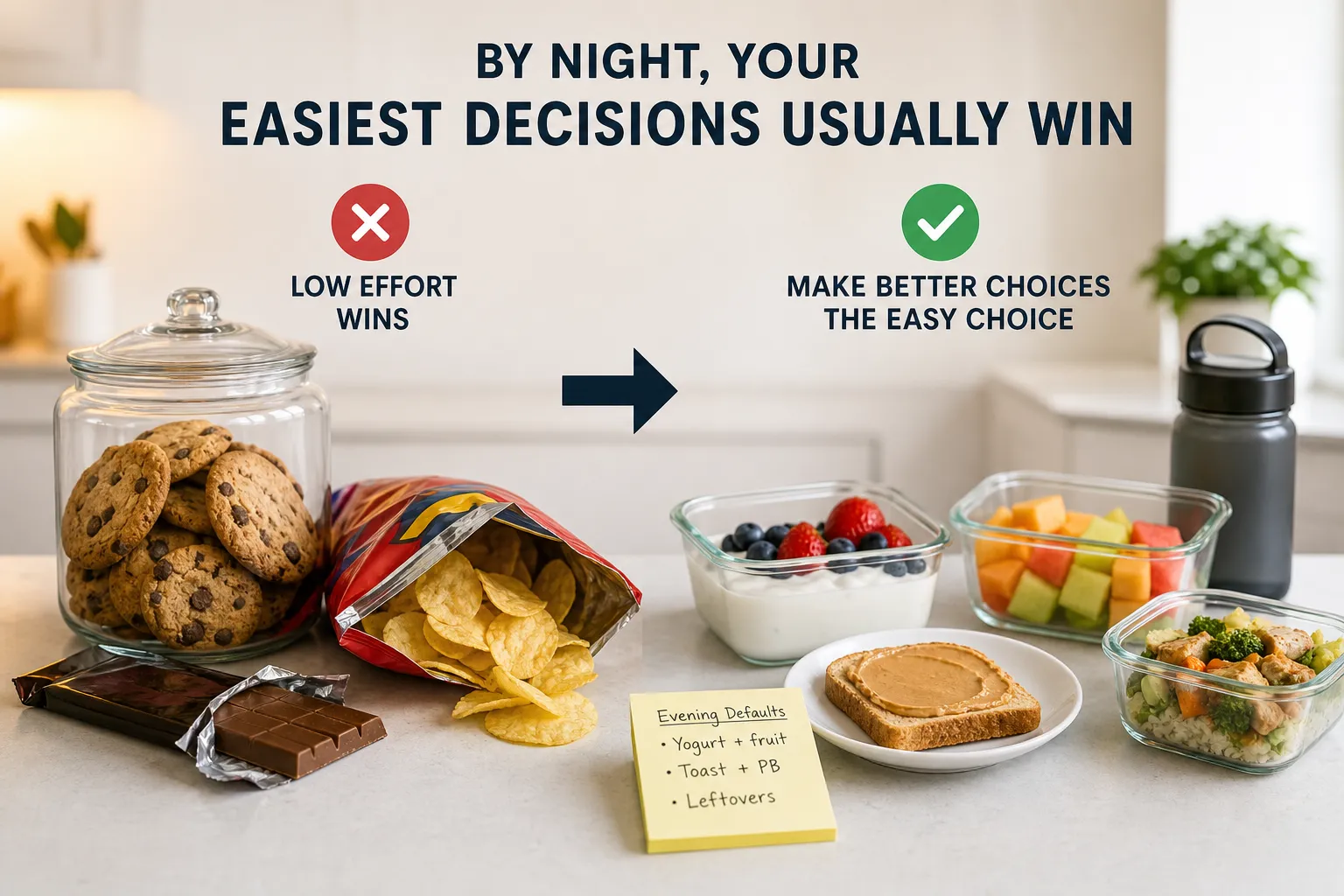
After a full day of work, errands, stress, and food rules, many people do not overeat at night because they suddenly stop caring. They overeat because the easiest option wins. If cookies are open on the counter and fruit needs washing and cutting, the low-effort choice often beats the better intention.
This is where ideas like decision fatigue and restraint fatigue can be helpful. The evidence is mixed, so it is better to treat them as practical lenses, not settled laws. Still, many people notice that by evening they have less patience for planning, resisting cravings, or making every food choice from scratch.
Rigid dieting can make this worse. If your daytime plan is built on banning favorite foods, ignoring hunger, or trying to be “good” all day, those foods can feel more urgent at night, which raises the risk of rebound eating. Night overeating often looks less like a lack of discipline and more like the backlash from too much restriction.
A useful rule of thumb is this: the weaker your evening bandwidth, the more your food environment becomes your meal plan. That means the fix is not trying to be more virtuous at 9 p.m. It is making better choices easier before you are tired.
Practical ways to do that include:
- Plan dinner before the afternoon gets busy.
- Pre-portion one evening snack instead of grazing from a large package.
- Keep a short list of filling defaults like yogurt and fruit, toast with peanut butter, or leftovers.
- Prep easy dinner components ahead so takeout or random snacking is not the only convenient option.
- Include satisfying foods earlier in the day so the evening does not feel like compensation.
The goal is not perfect control. It is to reduce how many nighttime food decisions depend on willpower alone.
Make the evening easier before it starts
The most effective fix for night overeating is usually not more willpower at 9 p.m. It is lowering the number and intensity of triggers before the evening begins.
A simple way to test that is a one-week experiment: change one daytime factor and one evening factor. For example, add more protein and fiber to lunch, plan an afternoon snack, set a short wind-down routine, and portion any evening snack before you sit down.
If you are truly hungry at night, eating something intentional is often better than trying to white-knuckle through it and ending up overeating later. A planned nighttime snack is not the same as night overeating; the difference is intention, portion, hunger, and how you feel afterward.
That gives you a practical sequence to follow:
- Fuel earlier in the day.
- Build meals that are filling, especially with protein and fiber.
- Protect sleep as much as you can.
- Reduce stress before the late evening crash.
- Limit alcohol if it tends to trigger extra eating.
- Redesign cues like screens, snack visibility, and autopilot routines.
- Pre-decide your evening options, including a portioned snack if needed.
If real hunger shows up, keep the response simple and structured. Choose a snack with protein, fiber, or both, and if you want ideas, this guide to better late-night snacks can help.
If the pattern feels repetitive, secretive, or out of control, it is worth taking seriously. Regular distress, shame, waking up to eat, or concern about binge eating or night eating syndrome are good reasons to talk with a clinician, registered dietitian, or mental health professional, and the NIDDK notes that eating-related symptoms are treatable and appropriate to discuss with a professional.
- Key sources
- Harvard T.H. Chan School of Public Health - The Nutrition Source
- Harvard T.H. Chan School of Public Health - Fiber
- Harvard T.H. Chan School of Public Health - High-Protein Diet Review
- NIH National Heart, Lung, and Blood Institute - Sleep Deprivation and Deficiency
- PubMed search for circadian eating and time-restricted eating reviews
- PubMed search for systematic reviews on stress and eating
- NIH / NIDDK - Eating Disorders


