


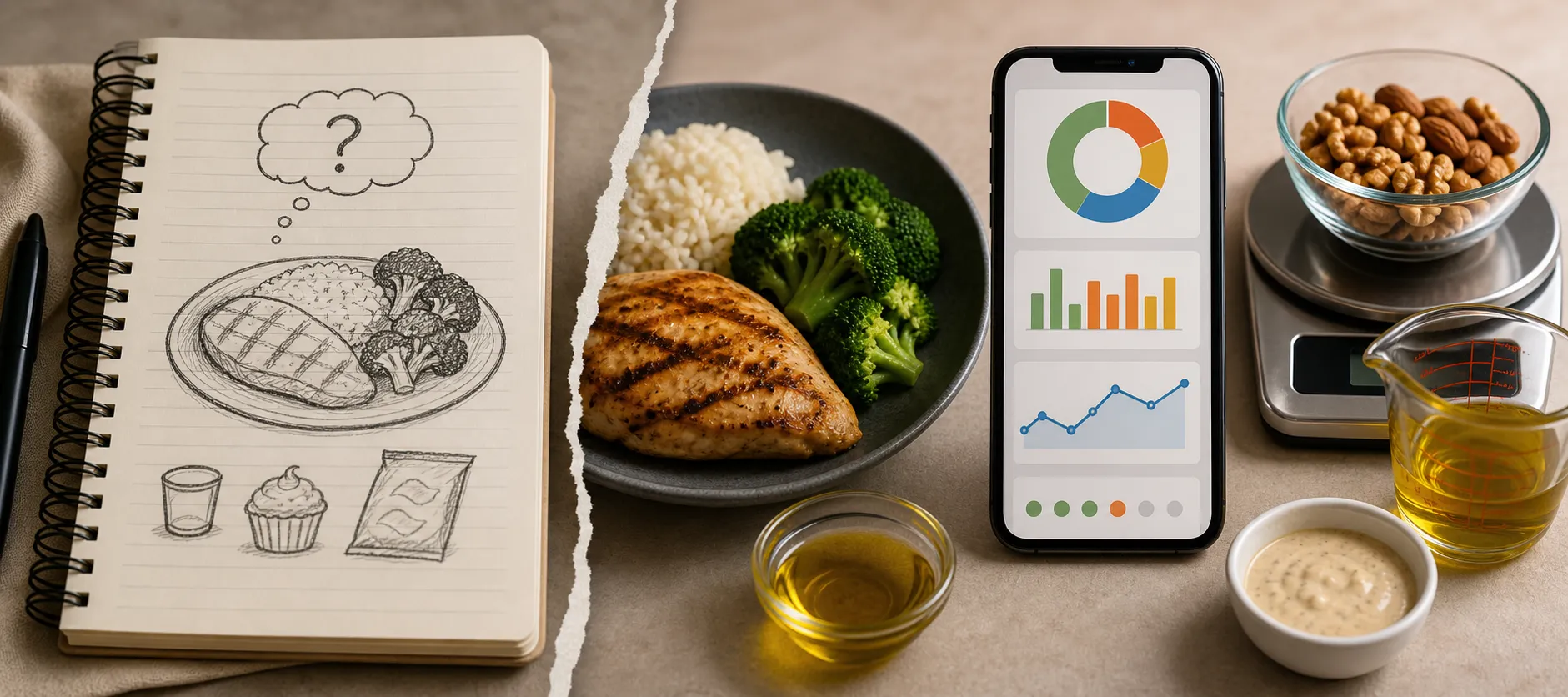
- What you'll learn
- Why false confidence in calorie logs leads to the wrong eating and weight-loss decisions
- Which calorie tracking errors happen most often, especially with oils, snacks, drinks, and restaurant meals
- Why nutrition label rounding and app database limits make entries useful, but never perfect
- How portion size bias and hidden calories can quietly distort weekly totals
- Which foods are worth weighing or measuring first to improve consistent calorie tracking
- How to use weekly weight trends and log reviews to adjust your intake instead of reacting to one day
Inaccurate tracking is not harmless. It turns guesswork into decisions, which is how people end up cutting calories too hard, blaming their metabolism, or deciding tracking “doesn’t work” when the real problem is the input.
But accuracy is not the same as perfection. You do not need the exact calories in every bite. You need a log that is consistent enough to reveal patterns and honest enough to correct when those patterns stop matching reality.
That is the tension most people miss. A salad logged as “healthy” can still be a bad data point if the oil, dressing, and bites from cooking never make it into the app. And if the same mistake shows up every day, that repeated error can explain a stalled week better than memory ever will. That is the standard this article uses for accurate calorie tracking: not fake precision, but useful signal.
The real danger is false confidence
The biggest problem with calorie tracking is not imperfect math. It is false confidence. Once a number is written down, people treat it like a fact, and that number quickly becomes the basis for decisions about eating less, eating more, changing macros, blaming exercise, or deciding a plan has failed.
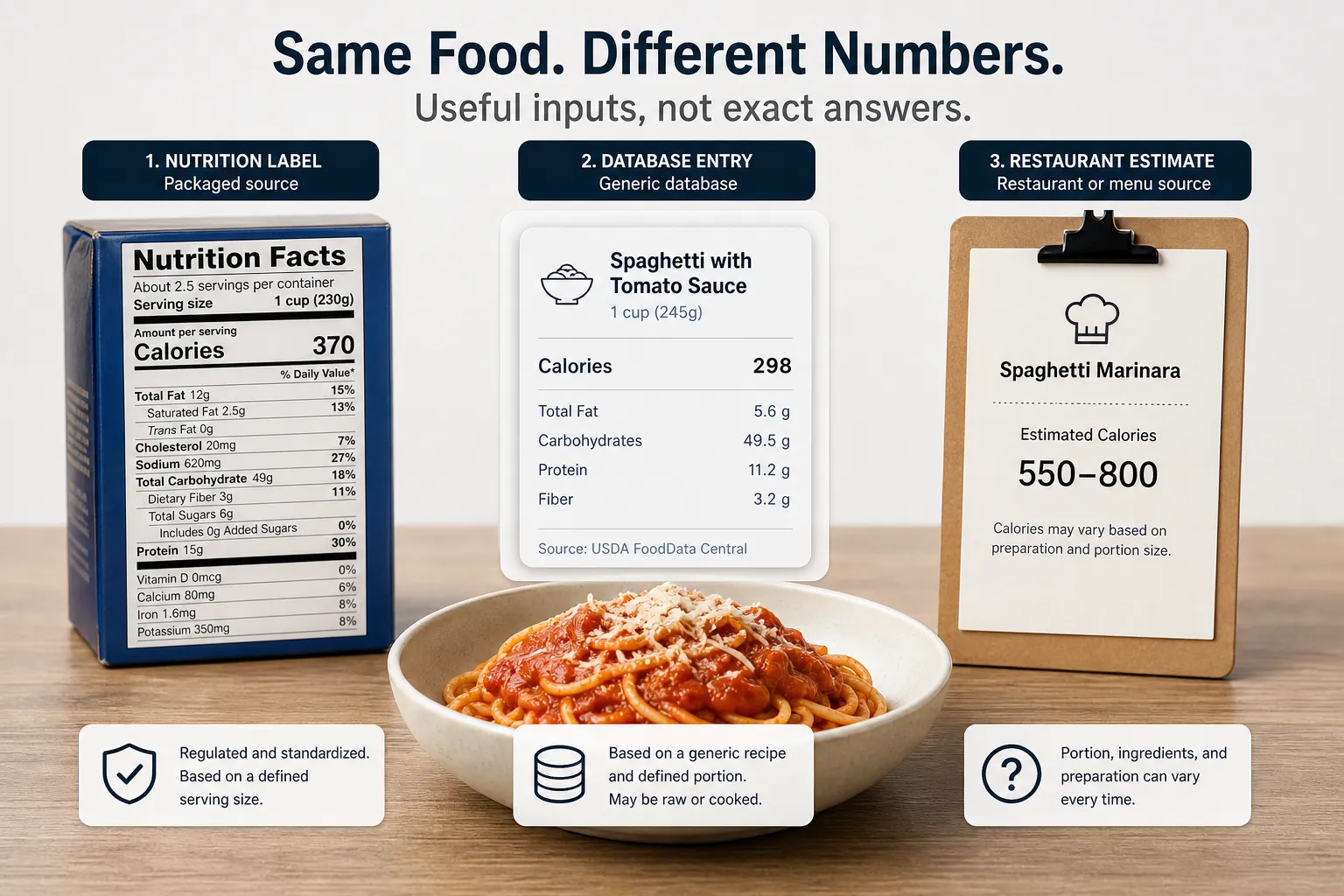
That is why tracking accuracy matters in the first place. A nutrition log is not a diary. It is a feedback tool, and feedback only works if the input is reliable enough to compare intake with outcomes and make a correction.
If you log 1,800 calories but routinely miss 300 to 500 calories from oils, drinks, snacks, or serving-size errors, you are not responding to reality. You are responding to a fictional deficit. The adjustment you make next, like cutting food further or assuming your metabolism is broken, can be wrong because the starting data was wrong.
This is also why the useful standard is not perfect precision. It is whether your log is consistent enough to be corrected. If the numbers are realistic and logged the same way over time, weekly trends can tell you whether intake and body-weight changes line up or whether something needs adjusting.
That feedback loop matters because dietary self-monitoring is often associated with better weight-management outcomes, especially when it is done consistently and reviewed rather than ignored after logging. Reviews of the research support self-monitoring as a useful behavior, not because every entry is exact, but because repeated tracking can make patterns visible over time according to the literature indexed in PubMed.
Public health guidance takes a similar view. The CDC emphasizes behavior patterns around nutrition, physical activity, and healthy weight rather than one perfect daily calorie number, which fits the idea that tracking is most useful when it helps people notice habits and adjust them through consistent self-monitoring and review.
You can think about your log the same way tools like the NIDDK Body Weight Planner frame calorie estimates: as inputs that should be compared against real-world body-weight trends and adjusted when the results do not match the estimate over time. That is a much better standard than pretending yesterday's total was exact to the calorie.
Imperfect data is normal. Misleading data is the real threat. If your log is close enough to reveal the relationship between what you eat and what happens next, it can guide better decisions. If it quietly understates intake every day, it can make smart people chase the wrong fix for weeks.
If you have a history of eating disorders or obsessive tracking, use caution here. More tracking is not always better, and support from a qualified clinician or dietitian can be a better path than trying to force tighter control.
Most calorie errors happen before the app gets involved
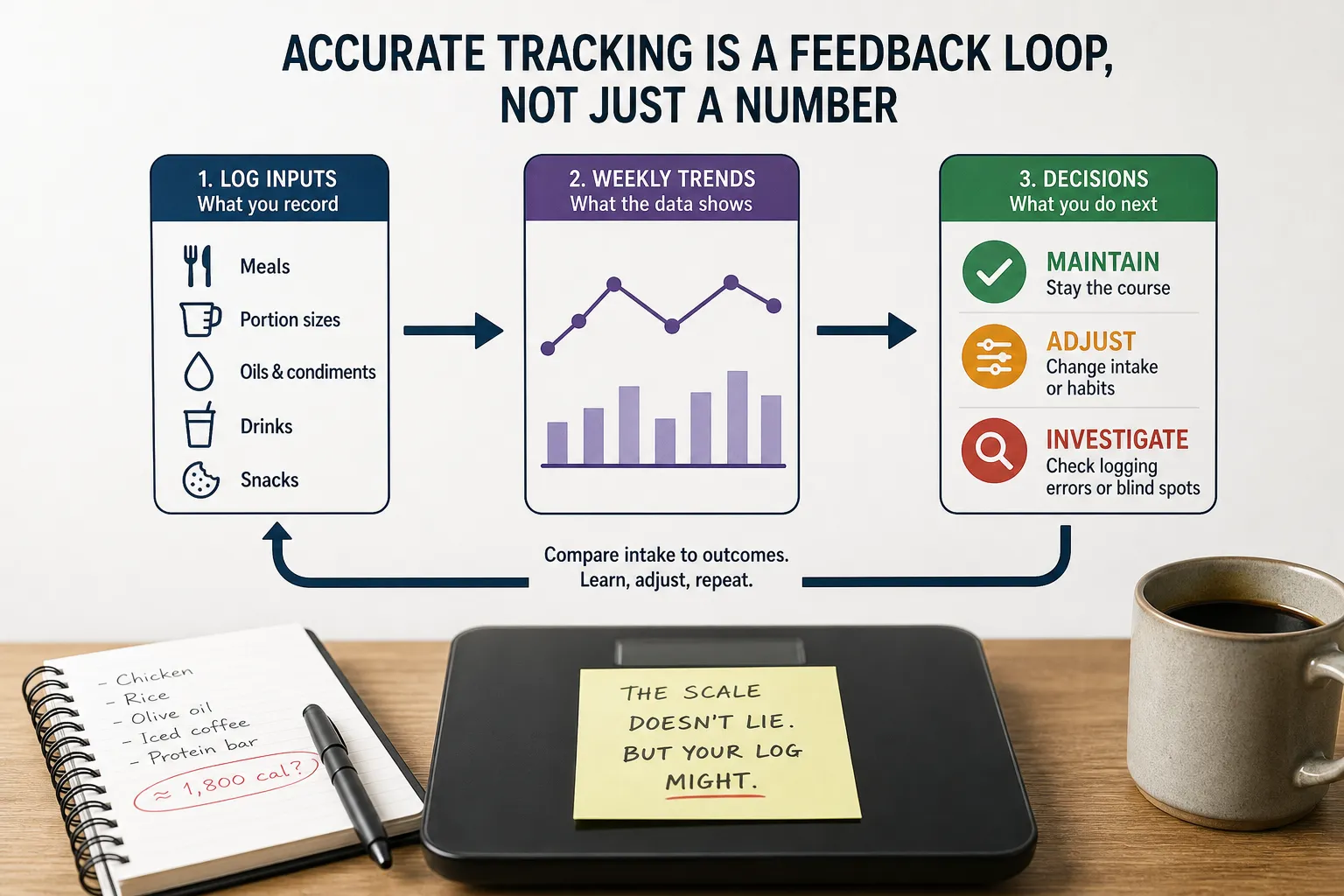
The biggest calorie tracking problems usually start in the human estimate, not in the app. Research on dietary misreporting has consistently found that people often underreport what they eat, especially when intake is recalled from memory or portions are eyeballed rather than measured PubMed.
That is not the same as lying. It is what happens when memory, attention, and portion judgment are asked to do a measurement job they are not very good at.
Eyeballing gets worse with energy-dense foods because small visual errors create large calorie errors. A tablespoon of oil is one thing. A free-poured splash that looked close enough can quietly turn into a very different number by the time it hits the pan.
The same pattern shows up with foods that do not look like much but carry a lot of energy: nuts, peanut butter, granola, cheese, dressings, sauces, butter, and alcohol. A handful of nuts, a generous drizzle, or an extra pour in a latte can feel too minor to log, even though those are often the entries that move the weekly total the most.
Then there are the foods people genuinely forget. Oils used in cooking, bites while making dinner, a few fries off someone else’s plate, toppings, condiments, sweetened drinks, cream in coffee, and the second glass of wine are easy to miss because they do not feel like a real eating event. But your body does not care whether it was a meal, a taste, or a “does this even count?” moment.
Mixed dishes make the problem even messier. A packaged yogurt or clearly labeled protein bar gives you a defined serving and a stated number. A homemade bowl, takeout curry, or restaurant pasta hides the oil, the portion size, and the recipe choices that determine the calorie total.
That is why restaurant meals are such a tracking trap. You are not just estimating quantity. You are also guessing preparation method, ingredients, and how much fat was added in cooking, which the Academy of Nutrition and Dietetics notes can make portion awareness and logging much harder in practice.
This is the uncomfortable part: many people think they are tracking accurately because they logged the obvious foods. But the biggest calorie tracking errors often come from the invisible extras, the generous portions, and the things that seemed too small to matter.
That should be clarifying, not discouraging. If undercounting is mostly a predictable human measurement problem, then it is also fixable. You do not need perfect precision. You need to get better at catching the places where your own eyes and memory tend to drift.
If you have a history of disordered eating or notice tracking becoming obsessive, use caution and consider support from a qualified professional. Better data should make decisions calmer and more realistic, not more rigid.
Food labels and databases are helpful, not holy
The second big source of noise is the food data itself. Even if you log honestly and try to be careful, the entry you choose may already be an estimate.
That does not make labels and databases useless. It means they are tools for getting close enough to make good decisions, not instruments that can tell you the exact calorie content of the specific meal in front of you.
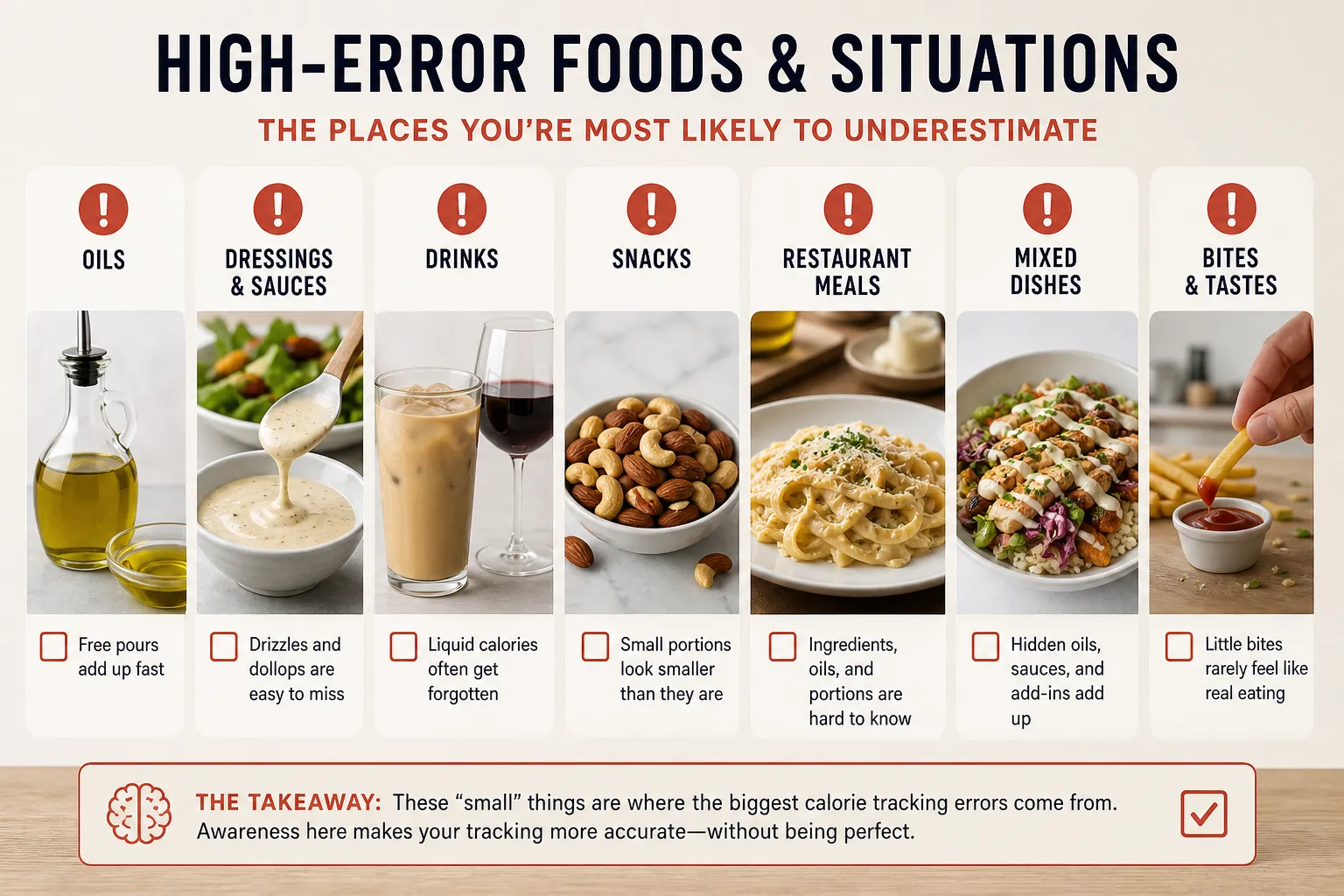
Nutrition labels are regulated and genuinely useful, especially for packaged foods. But they still rely on serving-size conventions, rounding rules, and allowable variation, which is why the FDA’s food labeling guidance is better understood as a standardized consumer tool than a lab report for your plate.
A label can be excellent for comparing two yogurts or two protein bars, even if it is not a perfect account of the exact item you ate. That is usually enough to support better choices, which is the real job of accurate calorie tracking.
Why app entries often disagree
Databases vary for normal reasons, not always because one app is broken. Two entries for the same food can differ because one is raw and one is cooked, one is generic and one is branded, or one is listed per 100 grams while another uses “1 cup” or “1 serving.”
User-entered foods add another layer of messiness. Some are excellent, some are outdated, and some are just wrong because a user picked the wrong brand, guessed a recipe, or entered a serving size that does not match the package.
That is why a source like USDA FoodData Central matters. It is a credible food composition database, but even a strong reference source cannot perfectly represent every homemade chili, bakery muffin, or takeout burrito you will ever eat.
Restaurant meals are even less exact. Portions shift, cooks use different amounts of oil, recipes change, and the same menu item can come out noticeably different from one visit to the next.
The fix is better judgment, not cynicism
The wrong takeaway is “nothing is accurate, so none of this matters.” The right takeaway is that good tracking tools should make estimates transparent and easy to correct, especially when the brand, portion, or ingredients obviously do not match what you ate.
In practice, that means choosing verified or branded entries when possible, checking whether the item is raw or cooked, and making sure the serving unit actually fits the food in front of you. If an app gives you an AI estimate, treat it as a starting point and fix the obvious misses, which we cover more in this guide to what AI calorie estimates can and cannot do.
None of this requires obsessive precision. It requires consistency, a willingness to correct mismatches, and enough skepticism to know that databases are useful maps, not the territory.
Useful accuracy is stable, not perfect
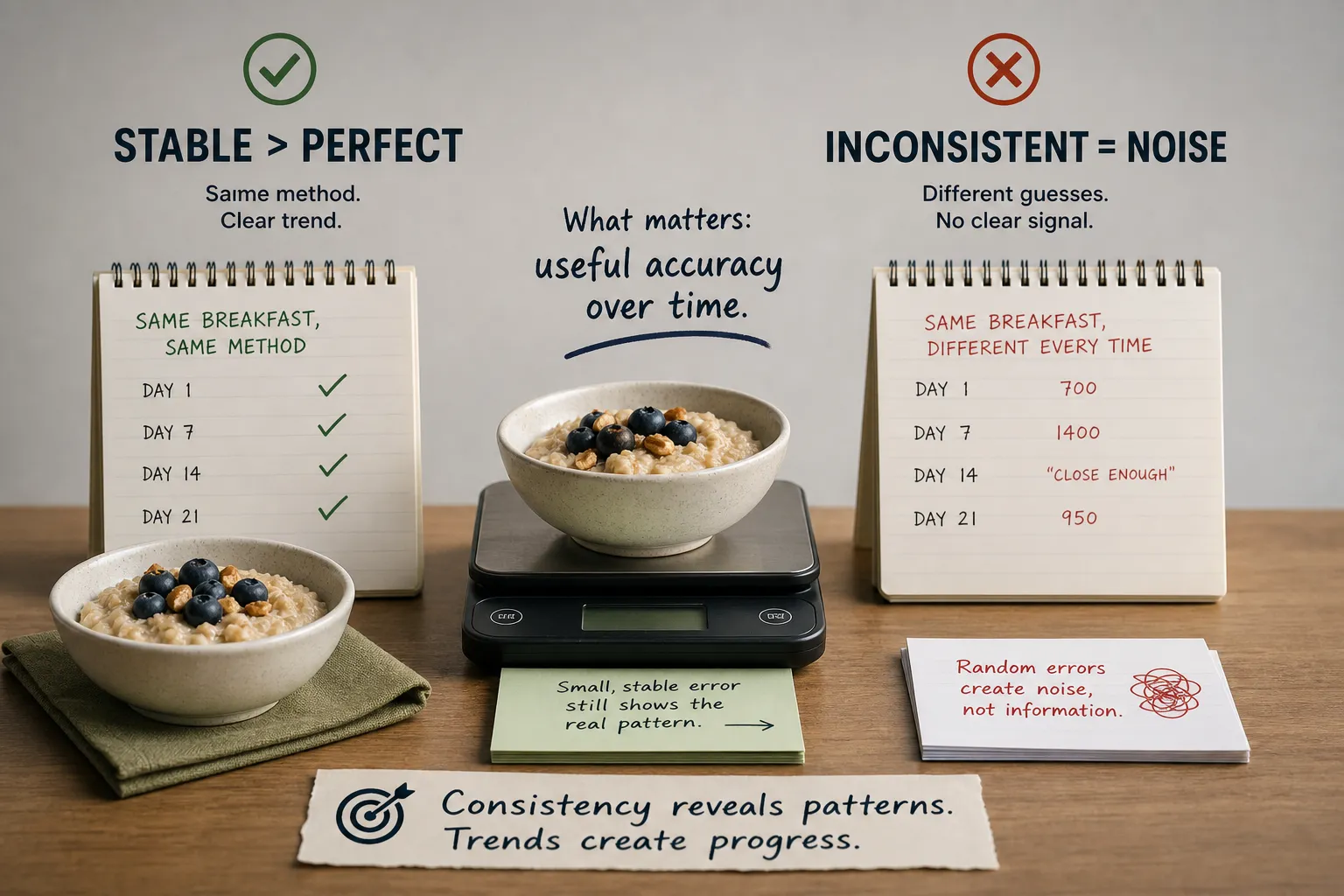
The standard that actually matters is not perfection. It is consistency strong enough to reveal patterns, and flexible enough to correct when real-world results disagree.
That is the turning point most people miss. One perfectly logged day tells you very little, but a repeatable method used for three or four weeks can show whether your intake estimate is roughly aligned with what your body is doing.
If your breakfast is logged the same way every day, it may still be a little off. But that kind of error is often workable because the signal stays stable, which makes the trend easier to read.
Random errors are worse. If one restaurant meal gets logged as 700 calories one week, 1,400 the next, and “close enough” after that, your weekly average starts behaving like noise instead of information.
This is why useful accurate calorie tracking is really about method quality. If your process stays mostly the same, you can compare intake against weight trends and adjust from there, which is exactly how tools like the NIDDK Body Weight Planner become practical rather than theoretical.
In plain language: stable errors can often be corrected, because outcomes give you feedback. If your log says you are eating 2,000 calories but your multi-week trend suggests maintenance is closer to 2,300, that does not mean tracking failed. It means your current method needs calibration.
What makes data hard to use is not being slightly wrong. It is being inconsistently wrong in a different direction every day.
You do not need to micromanage every crumb to avoid that. A few simple habits usually make tracking much more useful:
- Use a consistent meal template for foods you eat often.
- Estimate repeated portions the same way instead of reinventing the guess each time.
- Save common recipes so the inputs stay similar week to week.
- Review your week as a whole, not meal by meal in a panic.
This approach also makes it easier to notice real patterns. You may not know the exact calorie count of every dinner, but you can still see that weekends, drinks, or sauces are regularly pushing the weekly total higher.
That is the practical standard for accuracy in this article: good enough to reveal patterns, and correctable when outcomes disagree. If you want a more realistic way to apply that idea, Kibora has a related guide on making calorie tracking useful without chasing fake precision.
Used this way, tracking can support calmer decisions instead of obsessive ones. If you have a history of disordered eating or notice tracking becoming compulsive, use caution and consider support from a qualified professional.
Fix the high-variance foods first
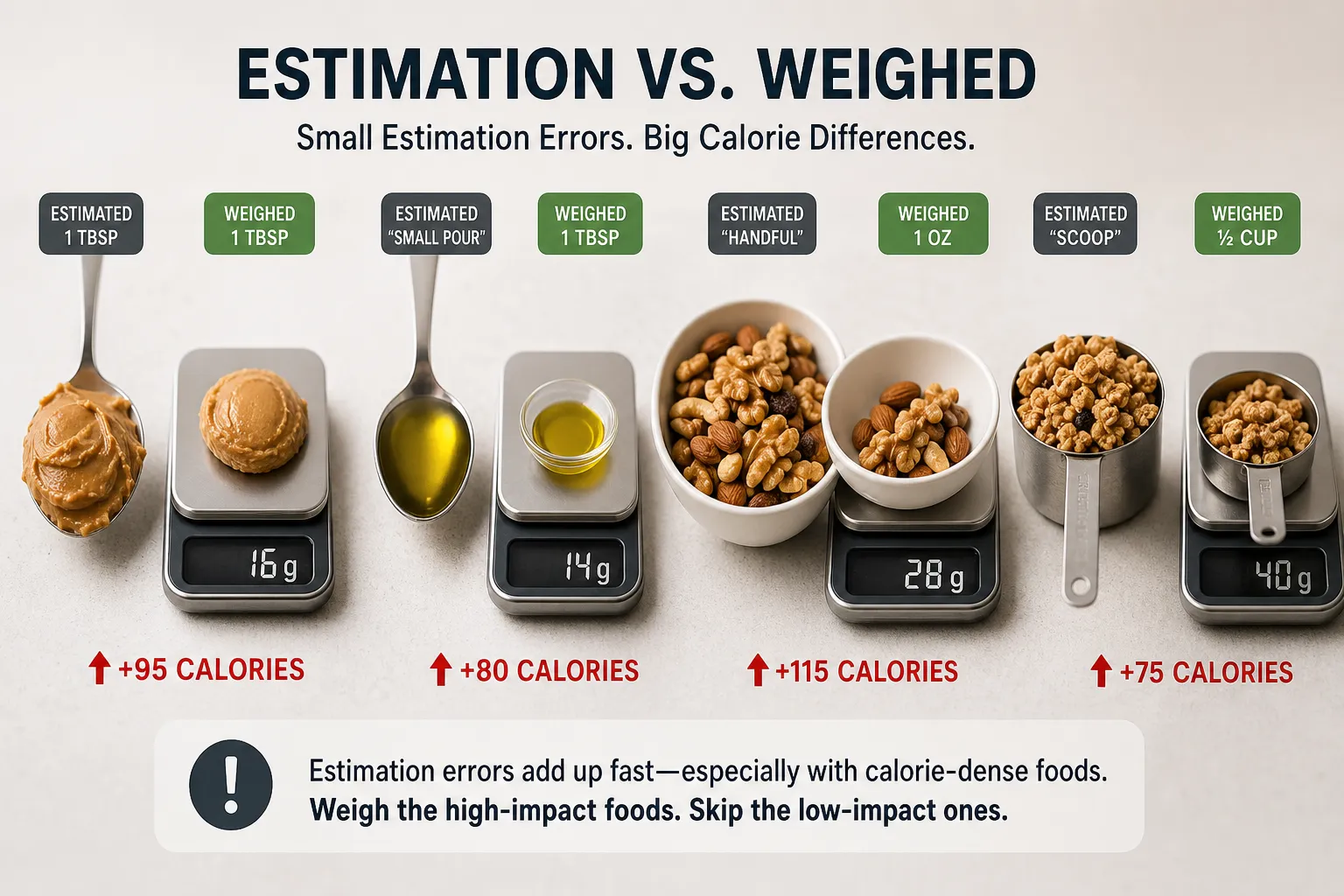
If you want more accurate calorie tracking, do not start by weighing spinach leaves. Start with the foods where a small eyeballing error can mean a big calorie error: oils, nut butters, nuts, cereal, rice, pasta, cheese, trail mix, chips, and other dense snacks.
This is where most people lose the plot. A loose spoonful of peanut butter or a casual pour of olive oil can add far more calories than the difference between 80 grams and 120 grams of broccoli. The Academy of Nutrition and Dietetics regularly emphasizes practical portion awareness because estimation gets harder as foods become more energy-dense and easy to overpour or overscoop source.
Use the scale where it actually changes decisions
A food scale is a tool, not a lifestyle. Use it strategically for the foods most likely to distort your log, then relax on the low-impact stuff.
- Weigh oils, butter, nut butters, nuts, cereal, rice, pasta, granola, cheese, chocolate, and snack foods.
- Do not bother weighing lettuce, cucumber, herbs, or other very low-calorie foods unless you have a specific reason.
- If you eat the same breakfast or lunch often, weigh it a few times, learn the real portion, and stop guessing every day.
That last point matters. Weighing everything forever is not the goal. The goal is to reduce the biggest errors so your log becomes stable enough to show patterns.
Liquids and extras are where “I barely had anything” goes wrong
Hidden calories are often not hidden at all. They are just easy to ignore because they come from pours, splashes, drizzles, and add-ins.
- Log cooking oil separately, even if it is “just for the pan.”
- Measure dressings, mayo, aioli, sauces, cream, syrup, and coffee add-ins.
- Count alcohol, juice, soda, sweetened coffee, and smoothies on purpose, not as afterthoughts.
- Treat condiments honestly when they are calorie-dense. Ketchup is usually a small issue. Ranch is often not.
A simple habit like logging cooking oil can explain a stalled deficit better than overhauling your entire diet. That is the kind of fix that improves decision-making fast.
Database choice matters too. Use verified or reputable entries when available, and check that the entry matches the actual food: raw versus cooked, brand name, and serving size. A correct food with the wrong form or serving basis is still a tracking error.
If you eat something often, stop re-creating it from memory every time. Build a saved meal or log a homemade recipe once, then reuse it. That cuts daily friction and removes the repeated little guesses that quietly wreck consistency.
Restaurant meals are different. You are not going to get exact numbers, so stop pretending you can. Pick the closest reputable entry, make a consistent conservative estimate for obviously oily or oversized meals, and use the same approach each time.
If your calorie target itself is fuzzy, get a reasonable starting point first, then improve the log around it. A tool like a calorie and macro target calculator can help you set clearer inputs before you tighten up the highest-impact foods.
One safety note here: if tracking starts to feel compulsive, distressing, or hard to stop, use caution. People with a history of eating disorders or obsessive behaviors may do better with professional support and a less granular approach.
The standard is not perfection. It is making the parts of the log that matter most more honest, more repeatable, and easier to correct.
When your log and your results disagree, trust the trend
A mismatch between your calorie log and your results is not proof that tracking failed. It is feedback. The mistake is turning one weird day, or one weird weigh-in, into a full-blown crisis.
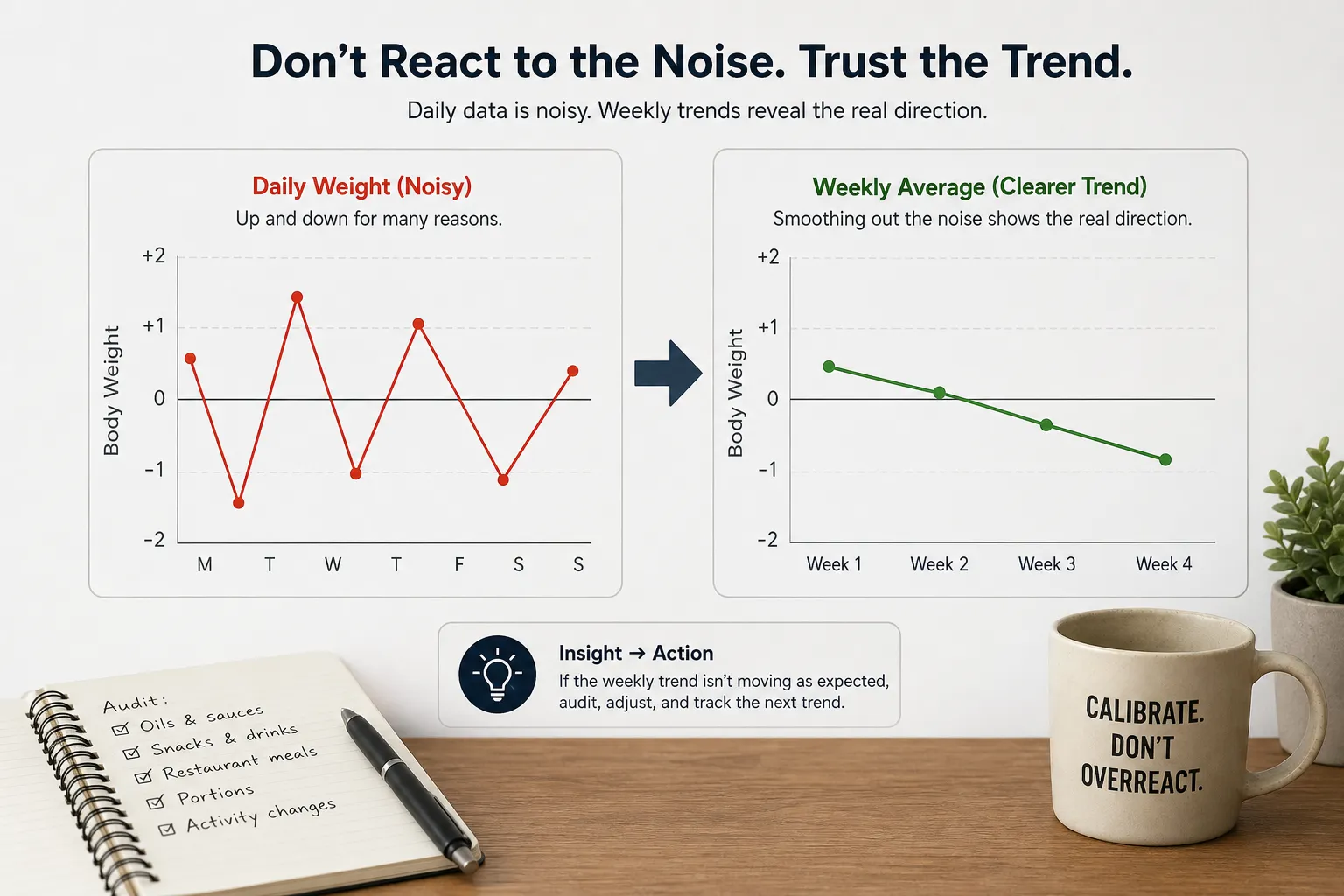
Single-day calorie totals are noisy, and single weigh-ins are noisy too. A weekly average tells you more because it smooths out sodium, menstrual cycle effects, glycogen shifts, and the occasional logging miss that would otherwise look dramatic for no good reason.
This is also why tools like the NIDDK Body Weight Planner are more useful for trend-based interpretation than for judging a single day. Body weight change tends to reflect patterns over time, not perfect day-to-day math.
If your log shows a consistent deficit for three weeks but your weight trend is flat, do not jump straight to “my metabolism is broken.” First assume the more boring explanation: your log is an estimate, and estimates can drift.
Common reasons for the mismatch are predictable. Missed calories, portion size bias, restaurant estimates, activity changes, water retention, and targets that were too aggressive or unrealistic can all make the numbers look cleaner than real life.
Audit first, then adjust
The smart move is to check the biggest error sources before making a major change. Review oils, sauces, snacks, drinks, restaurant meals, and any foods you tend to eyeball instead of portion consistently.
Then make one modest adjustment and watch the next trend. That might mean tightening how you log high-variance foods, slightly reducing your intake target, or slowing a target down if you are losing faster than expected and feeling lousy.
If you are losing faster than planned and feel drained, that is feedback too. Your target may be too aggressive, or your actual intake may be lower than what you logged, so the right response is not pride or panic. It is calibration.
Calm correction beats daily overreaction. Good tracking is not about proving you were perfect. It is about comparing what you logged with what happened, then updating the system so the next two weeks are more accurate than the last two.
If you want a practical next step, this guide on adjusting calories based on progress walks through how to change targets using real trend data instead of single-entry noise.
One important caution: if tracking starts to feel obsessive, rigid, or mentally disruptive, especially if you have a history of disordered eating, use care and consider support from a qualified professional. A tracking system should help you make clearer decisions, not trap you in them.
Aim for useful accuracy, not fake precision
Accurate calorie tracking matters because your decisions can only be as good as the information behind them. If the log misses the biggest inputs, the problem is not a lack of effort. It is that the data is pointing you in the wrong direction.
The best system is not the one that looks most impressive. It is the one you can repeat, that stays honest about uncertainty, and that gives you a stable enough picture to adjust from week to week.
A log that consistently captures oils, drinks, snacks, and portions will usually beat a log filled with ultra-specific entries that still misses the biggest sources of error. That is the real standard for consistent calorie tracking: not perfect numbers, but numbers truthful enough to guide the next move.
So start where the errors are largest. Tighten up the foods you estimate badly, review your trends, and then adjust intake based on what actually happens rather than what you hoped the log would say.
If you want a reasonable place to begin, use a simple baseline like a calorie target calculator, then let your bodyweight, intake consistency, and weekly patterns tell you whether that estimate needs to move. That is a better approach than chasing fake precision from day one.
One caution matters here. If you have a history of disordered eating, obsessive tracking, or strong anxiety around food, calorie logging may not be the right tool to use alone. In that case, it is worth considering support from a qualified professional who can help you choose a safer way to monitor progress.
The goal is simple: build a log that tells the truth often enough to reduce guesswork and improve decisions. Do not weigh every lettuce leaf. Just use a standard you can actually live with: capture the big stuff, stay consistent, watch the trend, and correct when the evidence says to.
- Key sources
- NIDDK - Body Weight Planner
- CDC - Healthy Weight, Nutrition, and Physical Activity
- FDA - Food Labeling & Nutrition
- USDA FoodData Central
- Academy of Nutrition and Dietetics
- PubMed - Self-monitoring dietary intake systematic review literature
- PubMed - Dietary misreporting and underreporting review literature


