- What you'll learn
- How meal timing can change glucose responses and hunger without guaranteeing lasting weight loss or better sleep.
- What research says about late dinners, breakfast, regular mealtimes and earlier eating windows.
- Why shifting calories to breakfast differs from adding breakfast.
- How to make room for evening exercise and recovery meals.
- What limited evidence suggests about overnight eating during shift work, and why safety and individual needs come first.
Meal timing can affect glucose and hunger, but “watch the clock” misses the question: what outcome matters to you? Calories, nutrition and a workable routine still count.
In an acute experiment, matched-calorie late dinners changed glucose in healthy adults without changing sleep architecture. In a 12-week trial in adults with obesity and impaired glucose regulation, an early 10-hour eating window produced no greater weight loss than a longer, later window with matched calories and nutrients.
No schedule fits everyone. Let’s explore breakfast, dinner and eating windows alongside different work and training schedules.
Meal timing matters, but the outcome matters more
Meal timing can change how the body handles a meal without necessarily changing how much weight a person loses. Glucose responses, appetite and sustained weight loss are different outcomes: a change in one does not guarantee a meaningful improvement in another.
A 2024 review of 29 randomized trials involving 2,485 adults found about 1.37 kg greater weight loss with time-restricted eating and 1.75 kg with earlier calorie distribution versus controls. But calorie intake was not consistently matched, so those differences cannot all be attributed to the clock.
Participants mostly had overweight or obesity, and interventions varied. With high risk-of-bias concerns in 22 trials, the authors described the average effects as small and of uncertain clinical importance, not a promise of extra weight loss for an individual.
Three trials show why the timing pattern, participants and calorie controls matter:
| Study group |
Timing tested |
Calories |
Duration |
Main result |
| Sutton: 8 men with prediabetes |
6-hour window ending by 3 p.m. versus 12 hours |
Provided, matched for weight maintenance |
5 weeks |
Improved insulin sensitivity without weight loss |
| Maruthur: 41 adults with obesity and dysglycemia |
Early 10-hour versus later, up-to-16-hour pattern |
Provided, matched calories and nutrients |
12 weeks |
No added weight or measured glucose benefit |
| ChronoFast: 31 women with overweight or obesity |
8 a.m.–4 p.m. versus 1–9 p.m. |
Intake intended to remain unchanged |
2 weeks each |
No meaningful insulin-sensitivity benefit |
These trials asked different questions. Sutton changed both meal timing and fasting duration, so their separate contributions remain unclear; its eight-person, male-only sample also limits generalization. ChronoFast compared equal-length windows, but food intake was not rigorously matched: the early condition had an approximately 167-calorie daily deficit.
Maruthur tested a substantial redistribution: 80% of calories before 1 p.m. versus at least 50% after 5 p.m. Both groups lost weight, 2.3 and 2.6 kg respectively, showing that matched calories do not mean weight maintenance. Participants had prediabetes or diet-controlled diabetes, and 93% were women and 93% were Black, which matters when considering how widely the results apply.
A five-week insulin-sensitivity improvement and a 12-week weight result are not interchangeable, nor does either establish a universal best schedule. Meal timing is best treated as a possible support for adequate nutrition and adherence, not a way around energy balance.
Late dinners can affect glucose without necessarily changing sleep
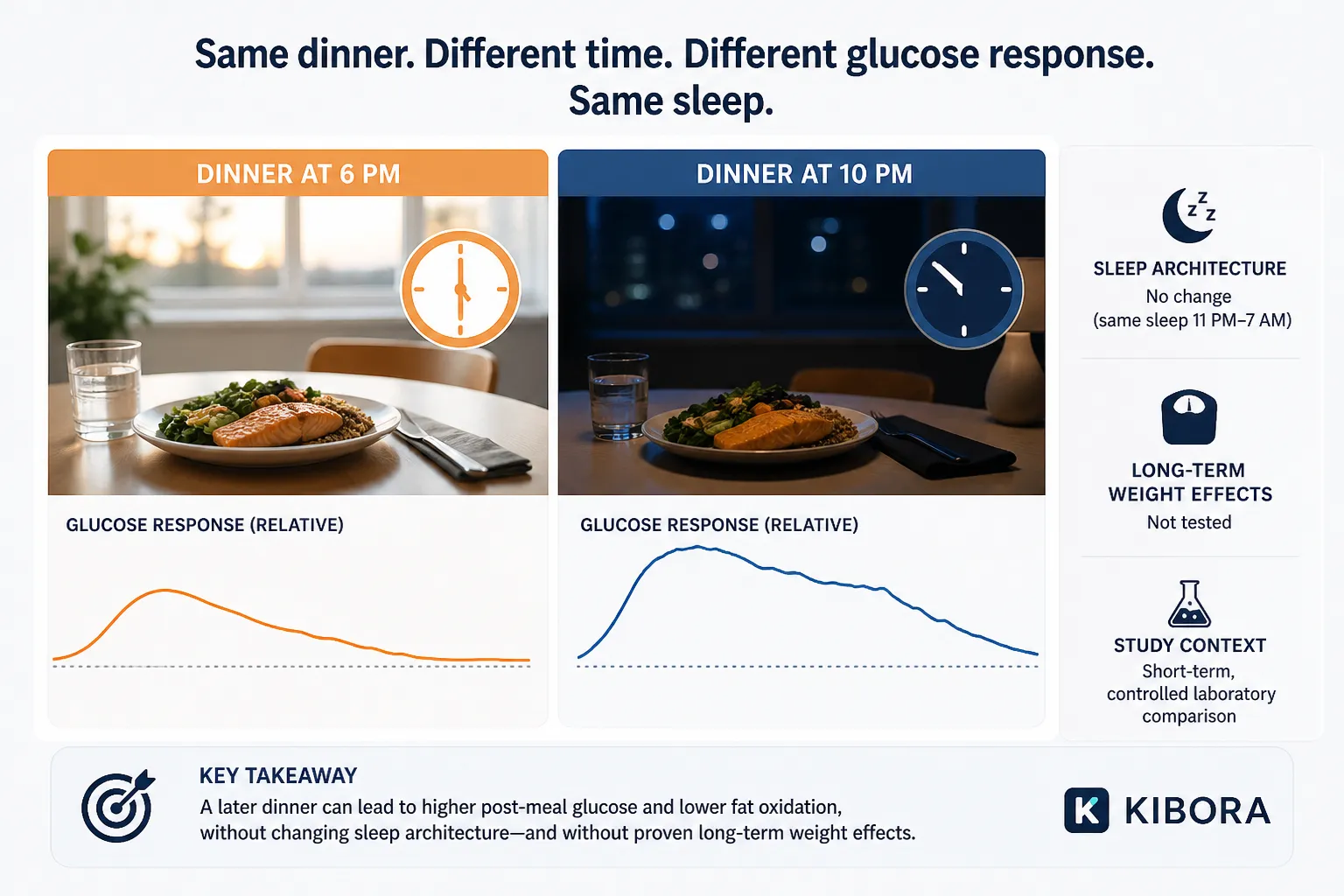
The same dinner can produce a different glucose response depending on when it is eaten. In a randomized crossover laboratory trial of 20 healthy adults, researchers compared dinner at 6 p.m. versus 10 p.m., with matched calories and macronutrients and sleep fixed at 11 p.m. to 7 a.m.
During this short-term, overnight comparison, the late dinner produced higher post-dinner glucose and lower dietary fat oxidation, meaning less of the meal’s fat was burned for fuel during the measurement period. That does not prove the meal became body fat or caused lasting weight gain. Sleep architecture, the pattern of sleep stages, did not change.
“Late” is not just a clock time: proximity to sleep and a person’s biological timing help determine what a late meal means. Responses were greater in habitual earlier sleepers, so the findings should not be assumed to apply identically to someone who normally sleeps at 2 a.m. They do not establish a universal dinner cutoff.
This is the context behind circadian nutrition: the study of how food timing interacts with daily biological rhythms. In a controlled human experiment, delayed meals shifted glucose rhythms and clock-gene rhythms in fat tissue without corresponding shifts in melatonin or cortisol rhythms. Food can signal timing to some tissues, but that is not a whole-body clock reset or proof of a health benefit.
Later eating may also change how hungry a schedule leaves you feeling. In a short-term laboratory experiment involving 16 adults with overweight or obesity, shifting meals about four hours later increased hunger and altered appetite hormones while food intake, sleep, activity and light were controlled.
Researchers also measured lower waking energy expenditure and changes in fat-tissue pathways. These were short-term physiological responses, not demonstrated sustained fat gain. The practical point is that two schedules providing the same food may feel different to follow. Our guide to late-night eating effects explores this distinction further.
Avoiding a very large meal immediately before bed can be a reasonable adjustment if fullness makes settling down uncomfortable. But earlier eating is not an established sleep treatment: a meta-analysis of 13 studies involving 638 participants found no improvement in sleep duration or sleep-quality scores in controlled comparisons, despite small favorable before-and-after changes. Intake control and sleep measurements varied, so a better glucose response should not be read as a promise of better sleep.
Breakfast and regular meals can help hunger—not everyone needs the same pattern
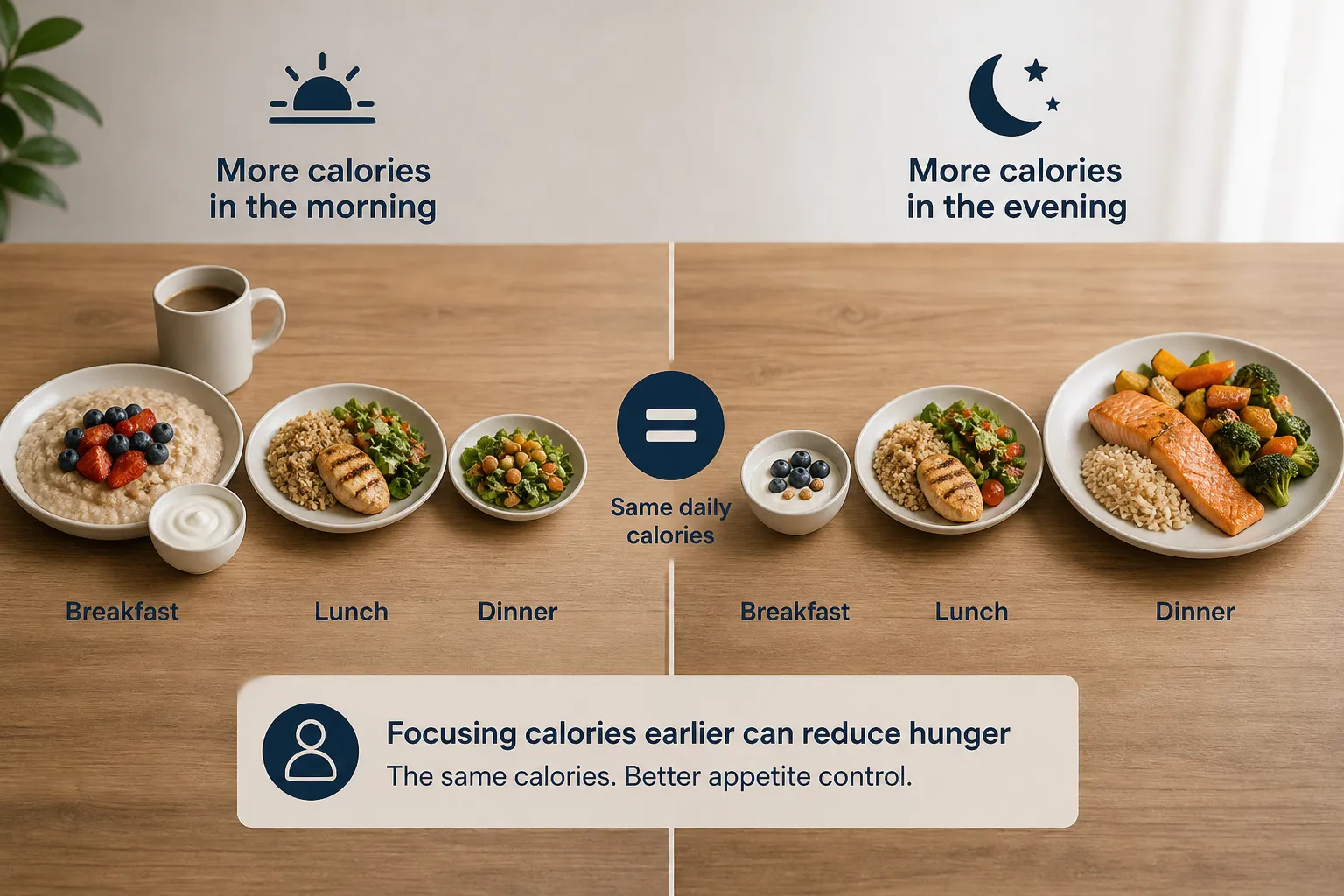
Moving existing calories to breakfast and adding breakfast are different changes, and they can produce different results. A larger morning meal may help with hunger, but that does not mean an extra meal will improve weight loss.
In a controlled-feeding trial of 30 adults with overweight or obesity, participants followed two four-week calorie-restricted diets with matched energy. One allocated 45% of daily calories to breakfast, 35% to lunch and 20% to dinner; the other reversed breakfast and dinner to 20%, 35% and 45%.
The larger-breakfast pattern reduced hunger, but weight loss, resting metabolic rate and total daily energy expenditure did not differ between patterns. Both diets produced weight loss. The practical benefit was better appetite control during the trial, not greater calorie burning or extra weight loss.
If you are not hungry at breakfast
Adult weight-loss evidence does not require you to add breakfast. A review of 13 randomized adult trials found no evidence that adding breakfast promoted weight loss; breakfast groups consumed about 260 more calories per day on average.
Those studies were short and varied, and calorie intake was not matched. The finding does not prove that skipping breakfast is healthier, and it does not establish advice for children. Neither eating nor skipping breakfast is universally the better choice.
A more useful question is: does your current breakfast pattern support energy, manageable hunger and adequate nutrition? If skipping leaves you uncomfortably hungry later, shifting some existing food earlier may be worth trying. If hunger persists despite a workable schedule, consider whether your food choices are keeping you satisfied.
A predictable routine, not a rigid timetable
The same practical test applies to regular meals: does a predictable pattern help you avoid unwanted hunger or difficulty eating enough? Limited evidence suggests possible benefits, but it does not justify minute-by-minute rules.
In a small trial involving 11 normal-weight women, participants completed two 14-day periods with identical provided diets. Six daily eating occasions improved selected post-meal glucose responses and hunger/fullness ratings compared with a pattern varying from three to nine occasions, without a body-weight difference.
Because frequency and regularity changed together, the trial cannot identify an ideal number of meals or an acceptable amount of timing variation. Use routine as a tool: make eating predictable enough to meet your needs, while allowing room for appetite, work and everyday life.
Earlier eating windows look promising; shorter is not always better
Time-restricted eating limits daily food intake to a set window. Moving that window earlier and shortening it are separate decisions: shifting 10 a.m.–8 p.m. to 8 a.m.–6 p.m. preserves its length; shifting to noon–8 p.m. shortens it. Studies often change both.
A 2026 review of 41 randomized trials involving 2,287 participants estimated that early windows outperformed late ones by a modest 1.15 kg in weight and 3.32 μIU/mL in fasting insulin. Energy restriction varied, some comparisons were indirect, and median duration was eight weeks, so this does not isolate timing from intake. Its search ended in January 2023, excluding newer trials.
The review’s “early” category meant finishing before 5 p.m.; “late” meant after 7 p.m. These are study categories, not a 5 p.m. dinner deadline. Findings for window length were inconsistent: no universally optimal duration is established, and narrower is not automatically healthier or more sustainable.
In a 12-week trial of 41 adults with obesity and dysglycemia, provided, matched calories and nutrients produced weight loss in both groups. An early 10-hour pattern did not outperform a longer, later pattern for weight or measured glucose outcomes.
Before substantial fasting changes, seek clinical guidance if taking insulin or other medicines that can cause hypoglycemia; do not adjust medication independently. Restrictive fasting is also inappropriate to casually recommend with an eating disorder. A workable window must accommodate adequate food, medication needs and daily life.
Fit meals around exercise, not just an early cutoff
If you train in the evening, dinner afterward can fit a reasonable schedule. Skipping it to meet an arbitrary eating deadline can leave you short of food for recovery. Prioritize adequate overall intake, including sufficient daily protein and carbohydrate availability appropriate to your activity.
The International Society of Sports Nutrition’s nutrient-timing guidance supports nutrition before or after exercise for recovery and adaptation. It draws on varied studies, not a single matched-calorie meal-clock trial, and does not establish a universal eating window. For an evening exerciser, making room for a recovery meal is a practical scheduling choice, not a failure to eat early enough.
Moving after dinner answers a different question. A review of eight small randomized crossover trials, involving 116 adults with and without type 2 diabetes, found that post-meal exercise reduced the immediate glucose rise more than pre-meal exercise or inactivity. Meal challenges were standardized within comparisons but varied across studies, and the trials had a high risk of bias.
A walk soon after a meal is an accessible option if it suits your health, energy and circumstances. Eating for exercise recovery supports training needs; moving after a meal can help with that meal’s glucose response. Neither finding establishes guaranteed weight loss, and post-meal activity does not replace diabetes treatment.
Night shifts need a different approach
Limited breaks, hunger and safety-critical tasks can make avoiding overnight food impractical. Safe functioning and adequate nutrition come first, even though eating during the biological night may compound night work’s effects on blood sugar.
In a 14-day laboratory study of 19 healthy young adults, controlled-energy meals spread across day and night raised average glucose by 6.4% during simulated night work; daytime-only eating did not. These were not established shift workers, and the study did not test long-term diabetes prevention.
A second trial assigned 55 healthy non-shift-workers to a 12:30 a.m. meal, snack or overnight fasting, with balanced daily calories and similar macronutrients. After four night shifts and recovery sleep, glucose tolerance, the ability to handle a glucose load, worsened with either food option but remained stable with fasting.
However, insulin sensitivity, how readily the body responds to insulin, worsened in every group. Meal timing may reduce one part of night work’s glucose disruption, but it does not make the biological effects of night shifts disappear.
NIOSH guidance for night-shift nurses suggests reducing intake between midnight and 6 a.m. where feasible, not mandatory fasting. Consider smaller overnight meals only as workload, breaks, hunger and medication allow; neither snacking nor fasting is universally best. Seek clinical advice before substantial fasting changes, especially with insulin or other medicines that can cause low blood sugar.
Three schedules show why there is no perfect eating clock
These are editorial illustrations, not tested complete protocols. Each gives meal timing a different job: making a workday predictable, supporting evening exercise, or fitting food around overnight work. Practical feasibility is not the same as proven benefit.
| Routine |
Sleep or work anchor |
Example eating times |
Main priority |
| Conventional workday |
Wake 7 a.m.; bed 11 p.m. |
Optional breakfast 8 a.m.; lunch 12:30 p.m.; dinner 6:30–7 p.m. |
Predictable intake; avoid a very large meal immediately before sleep |
| Evening training |
Workout 6:30 p.m. |
Breakfast 8 a.m.; lunch 1 p.m.; pre-training snack 5 p.m.; dinner around 8 p.m. |
Fueling and recovery |
| Overnight work |
Shift 11 p.m.–7 a.m.; daytime sleep |
Substantial meals around 4 p.m. and 9 p.m.; individualized overnight and post-shift intake |
Reduce large overnight meals where feasible |
The dinner-to-bed gap is not an established optimum. In an acute, matched-calorie crossover trial of 20 healthy adults, dinner at 10 p.m. rather than 6 p.m., with sleep fixed at 11 p.m.–7 a.m., increased post-dinner glucose and reduced dietary fat oxidation without changing sleep architecture. That late-dinner trial does not validate the table’s clock times or demonstrate long-term weight gain.
Breakfast is optional according to appetite, preferences and nutritional needs. A review of 13 randomized adult trials, with calories not matched, did not establish adding breakfast as a weight-loss intervention; it did not establish that skipping breakfast is universally healthier either.
An evening training meal need not disappear to meet an arbitrary cutoff. Sports-nutrition guidance prioritizes adequate daily protein, appropriate carbohydrate availability and food around exercise to support recovery and adaptation. An 8 p.m. dinner can serve those needs rather than represent a scheduling failure.
For overnight work, CDC/NIOSH guidance suggests reducing intake between midnight and 6 a.m. where feasible, not requiring everyone to fast. Workload, breaks, hunger, medication and safe functioning determine overnight and post-shift needs. Seek clinical advice before substantial fasting changes if you take insulin or other medicines that can cause low blood sugar; restrictive fasting is not a casual recommendation for anyone with an eating disorder.
Use the schedule to serve your needs, not your needs to serve the schedule.
Build your own routine in this order:
- Identify your sleep, work and break constraints.
- Protect adequate food intake and exercise fueling.
- Adjust one timing feature that addresses a real problem, rather than copying an entire schedule.
Change the part of your routine that solves a real problem
If your routine supports adequate nutrition, manageable hunger, sleep and training, there is no need to overhaul it just to match a clock. Choose the outcome you want to improve before changing when you eat.
Then try one feasible adjustment. If morning hunger is a recurring problem, redistribute some existing food earlier rather than simply adding more. If a very large meal immediately before bed leaves you uncomfortable, reconsider its size or timing without imposing a universal dinner cutoff.
Notice whether the change helps and remains workable. Personal observations can guide your preferences, but they cannot prove causation or diagnose glucose problems. Do not sacrifice adequate intake, recovery or safe functioning for a theoretical timing advantage.
For medication-related or glucose-management questions, speak with a clinician rather than prescribing yourself a fasting schedule. Clinical planning before fasting is especially important if you use insulin or other medicines that can cause low blood sugar.
- Key sources
- Liu et al. Meal Timing and Anthropometric and Metabolic Outcomes, 2024
- Maruthur et al. Effect of Isocaloric, Time-Restricted Eating on Body Weight in Adults With Obesity, 2024
- Gu et al. Metabolic Effects of Late Dinner in Healthy Volunteers, 2020
- Ruddick-Collins et al. Timing of daily calorie loading affects appetite and hunger responses without changes in energy metabolism, 2022
- Sievert et al. Effect of breakfast on weight and energy intake, 2019
- Effects of timing and eating duration of time restricted eating on metabolic outcomes, 2026
- Jin et al. The Effect of Time-Restricted Eating on Sleep
- Centofanti et al. Fasting as an intervention to alter the impact of simulated night-shift work on glucose metabolism, 2024/2025
- Engeroff et al. After Dinner Rest a While, After Supper Walk a Mile?, 2023
- International Society of Sports Nutrition position stand: nutrient timing, 2017
- NIDDK: Fasting Safely with Diabetes